Justice
Justice in City of Windows · Major Arcana XI
RelationshipsIn short
Checking the facts, owning the consequences of what was done, setting fair terms.
Reversed
A double standard, rationalizing, an unfair accusation, or a refusal to answer for what was said.
- Major Arcana
- 11
- Libra
- The Fair Witness
- truth
- cause and effect
- an equal measure of responsibility
Upright
Checking the facts, owning the consequences of what was done, setting fair terms. What can be checked, and what share of the responsibility does each of you take?
After their familiar rhythm has changed, Mira and Lev, in their shared kitchen, compare the entries in her notebook with the paper work schedule Lev has brought to the conversation. Mira points to a specific entry; Lev answers, looking at the sheet.
It is a tense matching of words against dates, but what they are checking cannot yet be turned into a ready-made accusation of cheating.
A question to sit with
“Which words, actions and consequences can honestly be set side by side?”
One step
Write down what can be checked, with dates, and what share of it each of you takes on.
Reversed
A double standard, rationalizing, an unfair accusation, or a refusal to answer for what was said.
Don’t let an argument about feelings erase the order of events.
A question to sit with
“Where does one standard apply to me and another to them, and what was actually said and done, in what order?”
One step
Don’t let an argument about feelings erase the order of events.
How this deck reads reversed cards
Reversed, a window may show a delay, an imbalance, a defensive reaction or the first step out of one; the neighboring cards help tell which. A reversal does not mean “a bad person”, and one card proves no one’s motive.
In love
Words and dates may need to be set side by side, calmly, at one table, to see what holds up and who answers for what.
- Supports
- Facts that both people can check.
- Watch for
- Jumping from a mismatch to an accusation.
- One step
- Write one fact and one feeling about a question between you, on separate lines.
One person may be held to a rule the other ignores, a fair question may be met with excuses, or a mismatch may be turned into a charge it does not yet support.
- Supports
- Keeping the order of events straight.
- Watch for
- An argument about feelings that rubs out what happened when.
- One step
- Before the next talk, write the events in order, with dates where you have them.
At work
Fair terms at work may depend on what is on paper: the schedule, the notes, the agreed dates.
- Supports
- Clear records kept by both sides.
- Watch for
- Relying on memory where a note would settle it.
- One step
- Note the date and terms of one spoken agreement at work, while both sides remember them.
A double standard may be in play at work, or someone may be explaining away what was said, with no one answering for it.
- Supports
- Asking that the same rule apply to everyone.
- Watch for
- Excusing your own slip while counting others’.
- One step
- Check one disputed point against a written record before you raise it.
The choice may come down to what can be checked, each option’s record laid on the counter like a notebook beside a schedule.
- Supports
- Weighing evidence over impressions.
- Watch for
- Letting the loudest feeling stand in for the facts.
- One step
- For each option, write two facts you have checked yourself.
A choice may be leaning on a justification you would not accept from someone else.
- Supports
- Applying your own standard both ways.
- Watch for
- Building the reasons after the decision.
- One step
- Picture a friend making this choice for these reasons, and note what you would tell them.
Owning your share, what you said, what you did and what followed, may be the next honest step for you.
- Supports
- An equal measure of responsibility.
- Watch for
- Counting only the other side’s mistakes.
- One step
- Name one consequence of your own actions this month and one thing you could repair.
It may be easier right now to accuse than to look at your own share, or to avoid answering for words you said.
- Supports
- Admitting your part without erasing theirs.
- Watch for
- Defensiveness dressed as fairness.
- One step
- Acknowledge one thing you said that did not match what you did.
A family disagreement may settle more fairly if dates, chores and promises are laid out on the kitchen table where everyone can see them.
- Supports
- One standard for every person in the house.
- Watch for
- Old grievances brought in as evidence.
- One step
- Put the household’s shared tasks on one page with a name beside each.
At home, one person may be judged by different rules, or an old charge may be repeated without anyone checking it.
- Supports
- Fairness that does not depend on who is speaking.
- Watch for
- Repeating a family story as if it were proven.
- One step
- Ask for the facts behind one complaint at home before you answer it.
Yes or no
YesNoWhere words can be checked against actions and each person owns their share, the answer leans toward yes.
Supports
- What was said and what was done can be set side by side.
- Fair terms may be within reach.
Limits
- Some things may not be checkable yet.
- Owning your share of the consequences can be uncomfortable.
One step
Write down one claim and the date or record that could confirm it.
When there is a double standard, an unfair accusation or a refusal to own what was said, the answer leans away until the order of events is clear.
Supports
- You can notice when one rule applies to you and another to them.
- Your memory of events deserves a written record.
Limits
- A double standard may be at work.
- An argument about feelings could erase the order of events.
One step
Put the events in order, with dates, before discussing how anyone feels about them.
What is in the picture
Mira in a blue sweater and Lev in black stand on either side of a kitchen island. In front of Mira is an open notebook; Lev holds a paper schedule, and a calendar hangs on the wall. They look at the notes with focused, anxious faces. Outside the window the city is growing dark.
It is a tense matching of words against dates, but what they are checking cannot yet be turned into a ready-made accusation of cheating.
- open notebook
- paper work schedule
- wall calendar
- kitchen island
- darkening city window
This card in other decks
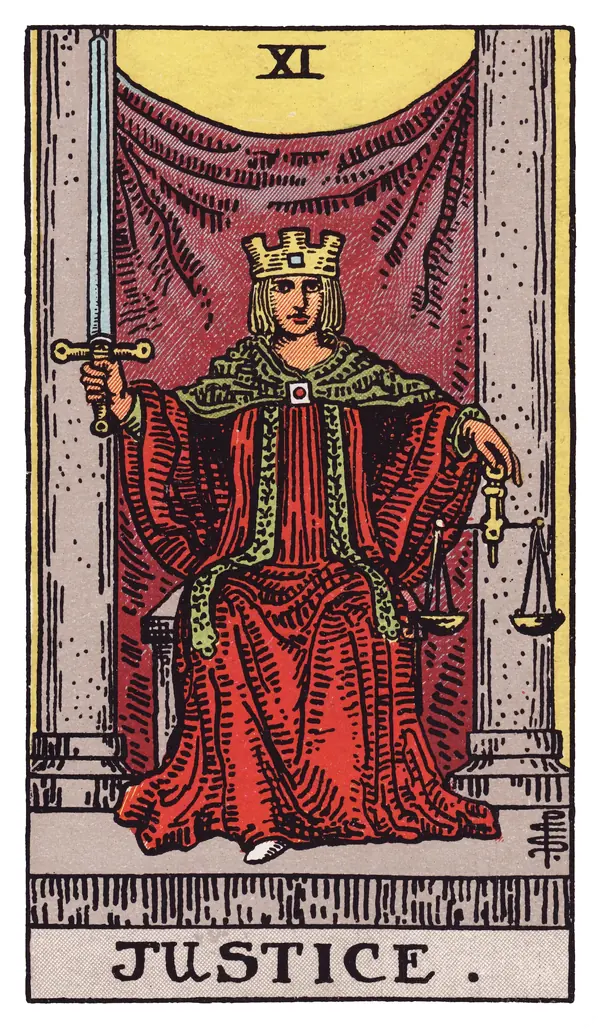 Rider–Waite–SmithJusticeA fair, honest look at the facts, including your own part in them, is what this situation needs right now.
 FamiliaJusticeAn honest reckoning across generations: debts and merits weighed evenly, each side receiving what it earned.
 CarnalJusticeAccountability, proportion and the return of what is owed.
 Crimson InfernoJusticeDistinguish proof from pressure.
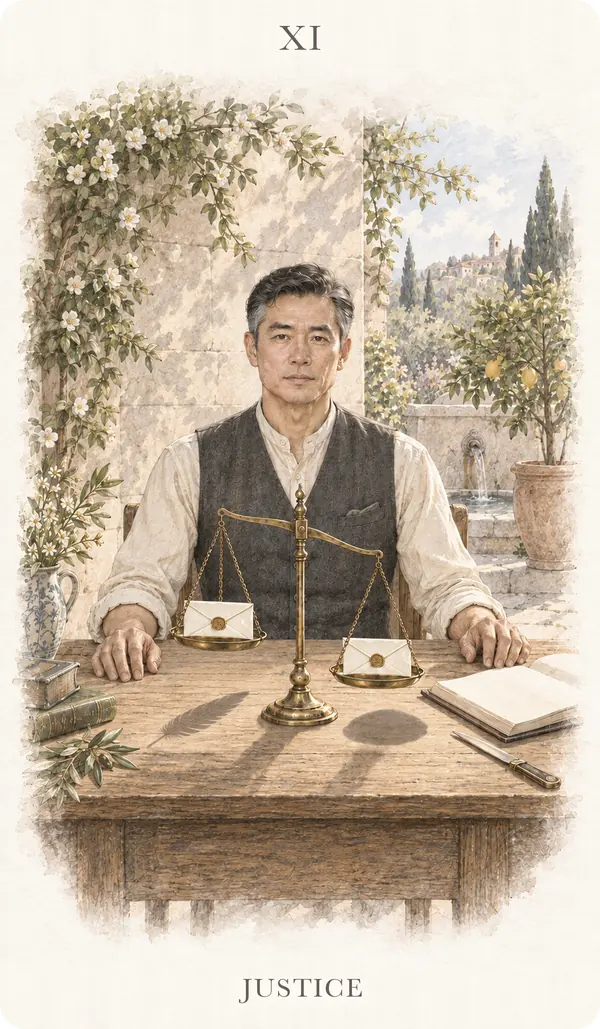 Everyday WondersJusticeClear judgment, proportion, responsibility and consequences.
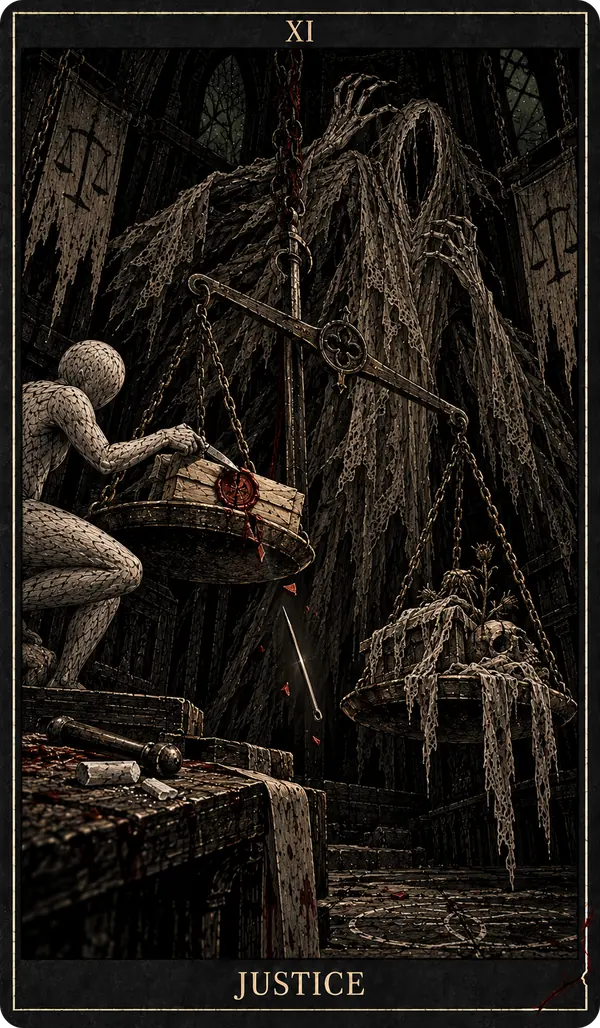 Mirror NightJusticeRevise the verdict when a hidden needle falls.
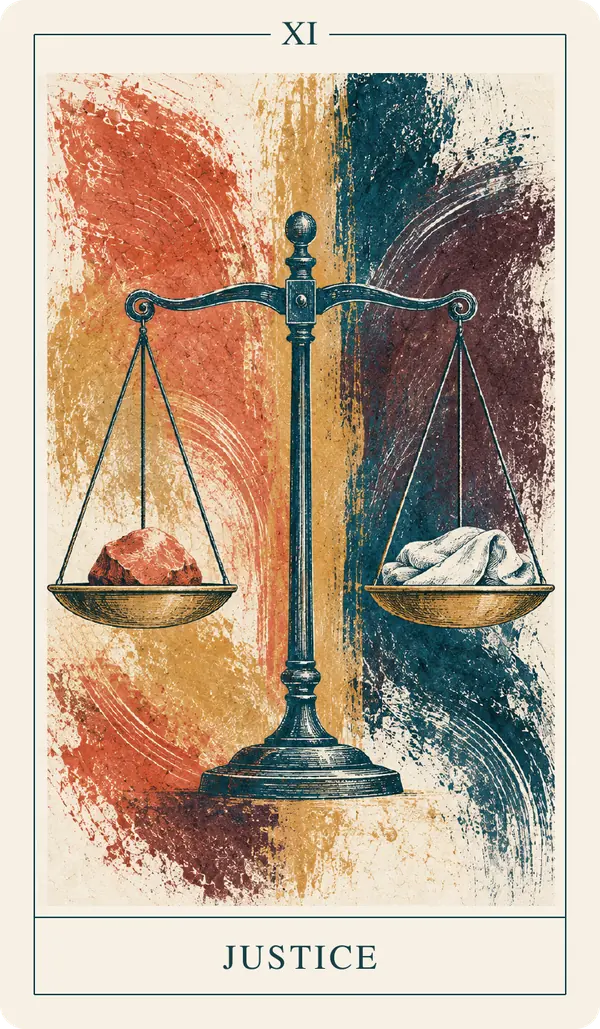 Self ContactJusticeApply the same measure to yourself and others.
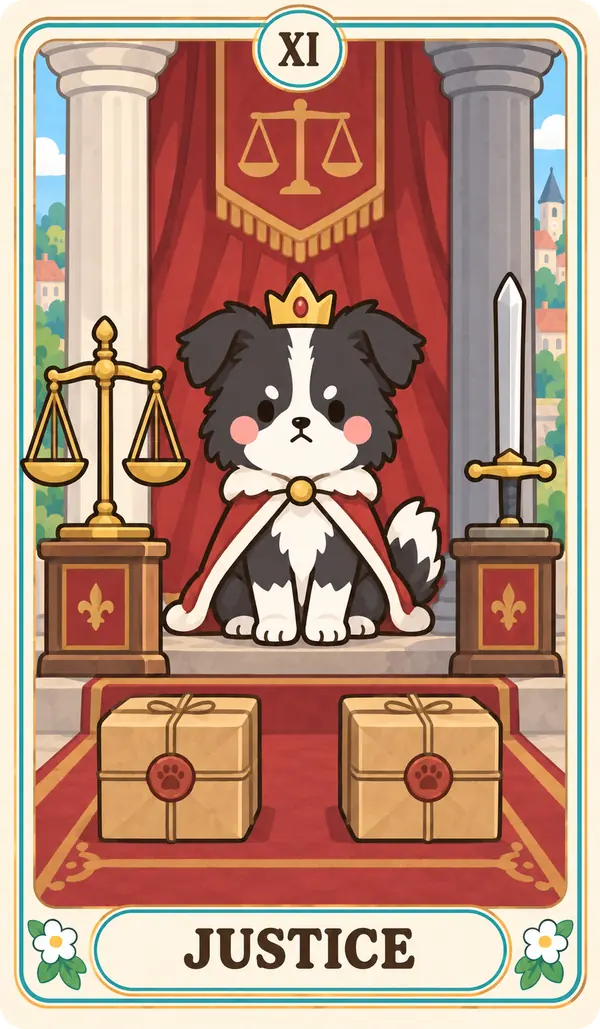 Shiba TownJusticeFairness; accountability; consequences based on facts.
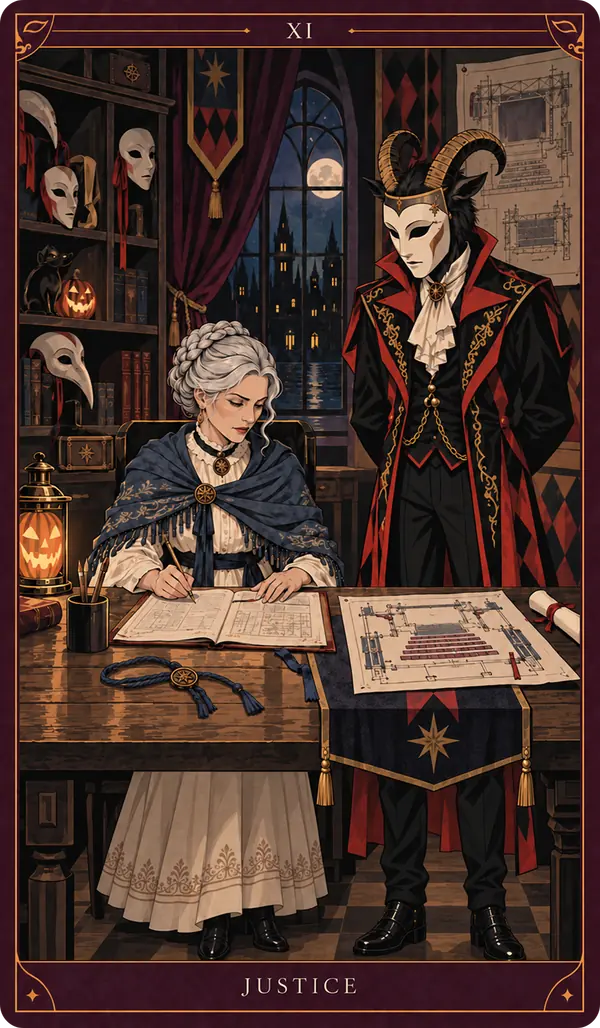 Velvet MasqueradeJusticeA fair consequence grounded in what can be checked.
 Four HorsemenJusticeExamine evidence, own your part and choose a proportionate response.
 Four TrailsJusticeFairness, truth, consequences.
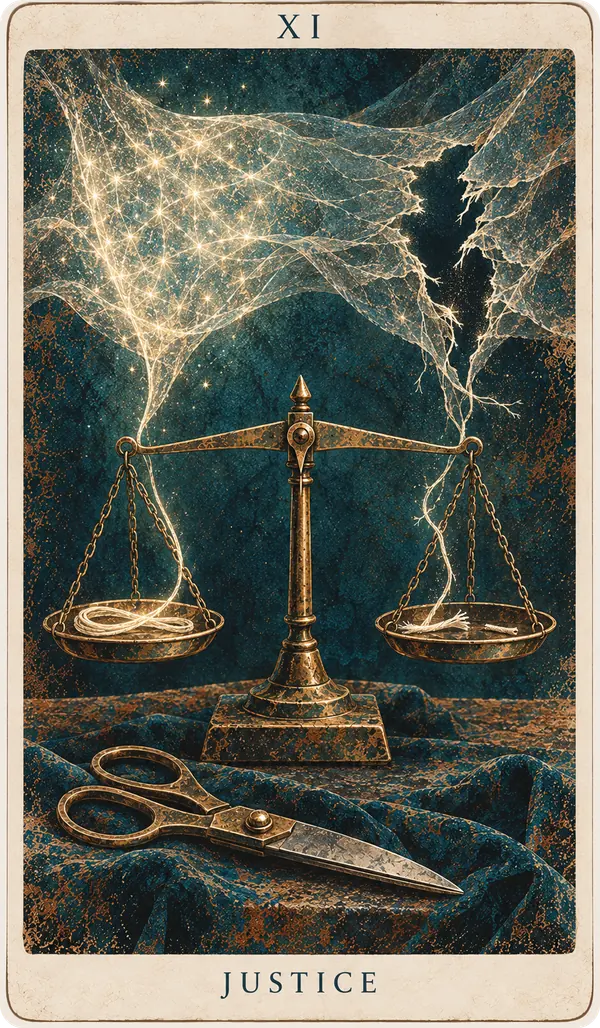 Living ThresholdJusticeThe balance reveals what a cut changes and where the fabric still needs mending.
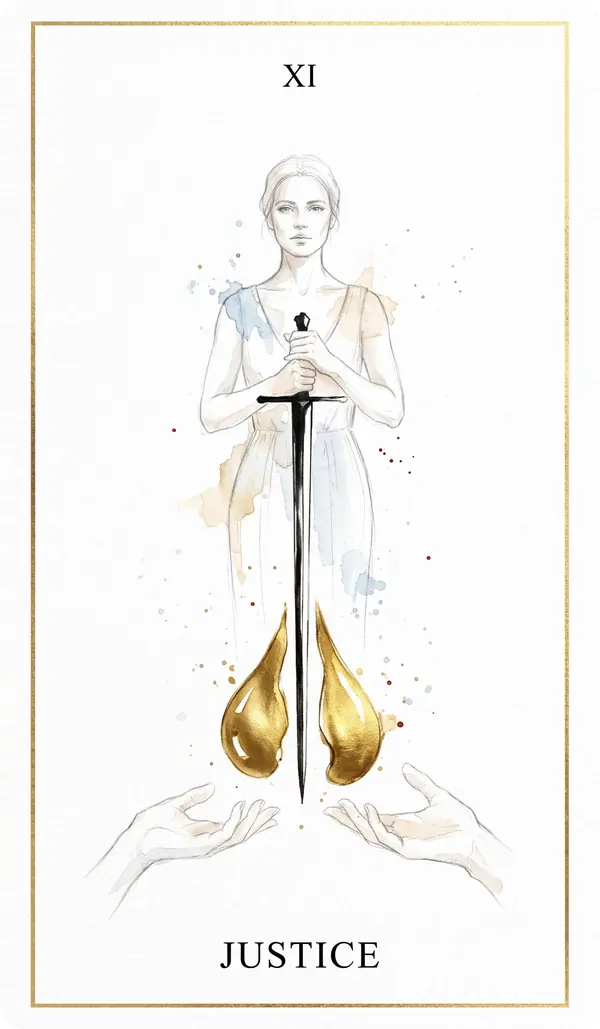 Colour of PowerJusticeAn honest cut: what was invested is counted, and the clean need not fear.
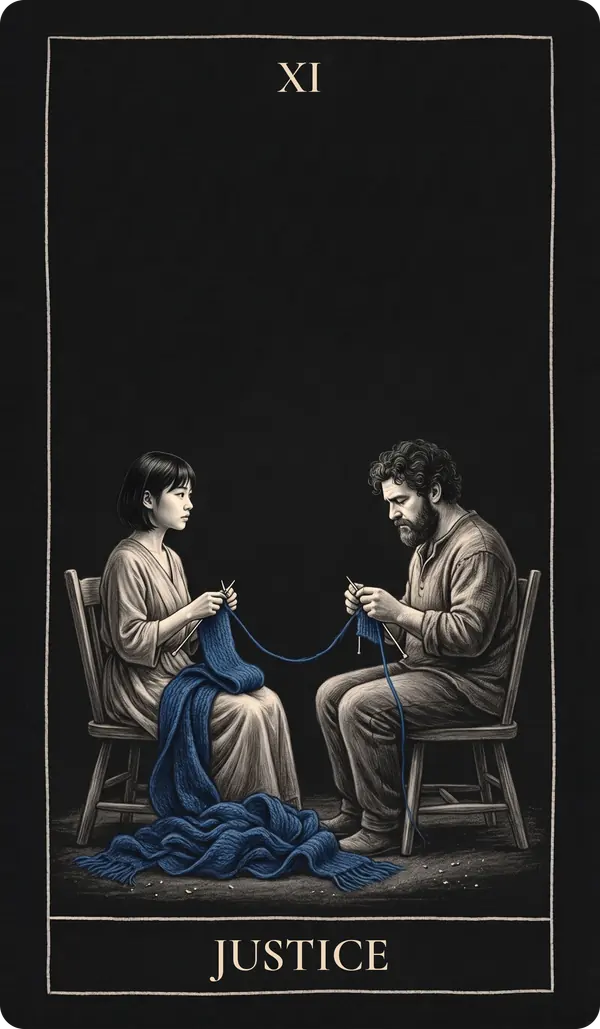 BoundJusticeAn honest count: the thread shows who has knitted how much.
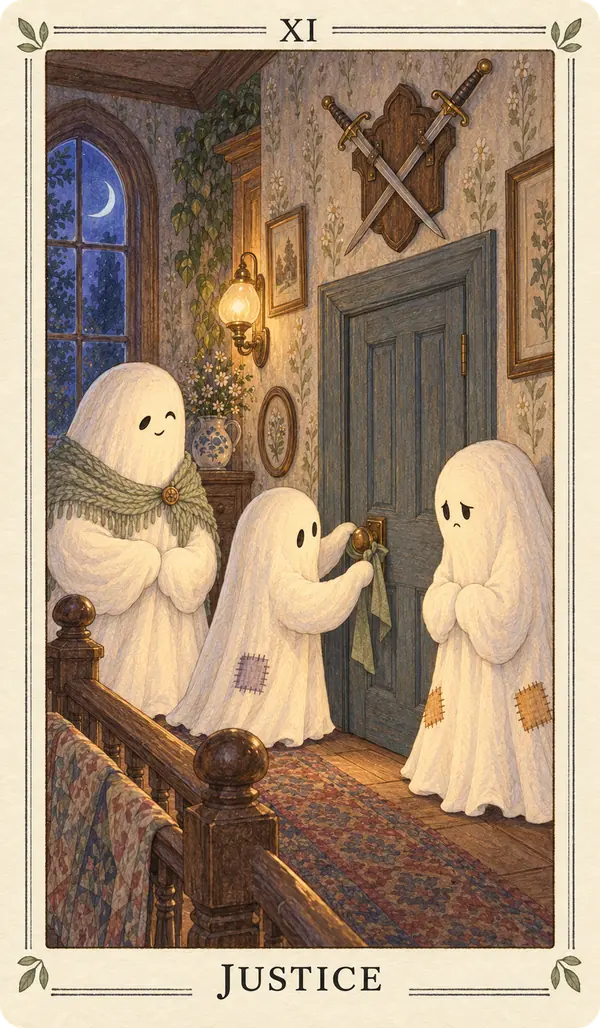 Cozy HauntJusticeAccountability and a fair boundary.
 Celestial Night SkyJusticeAn answer open to checking.
Where it appears
Questions about this card
Is Justice a yes or no card in love?
Upright, Justice leans yes. Words can be checked against actions and each person owns their share, so the answer can rest on facts. Reversed, it leans no: a double standard, an unfair accusation or a refusal to own what was said blurs the picture, and the answer waits until the order of events is clear again.
Can Justice mean someone is lying?
It can point to a moment when words are checked against actions, and a lie is one of the things that check may find. In City of Windows, Mira sets entries from her notebook beside Lev’s work schedule, and the scene is tense but not yet proof of anything. Justice asks for facts before a verdict. Compare one promise with what happened next, calmly and with dates.
What does Justice mean reversed in love?
Reversed, Justice points to a double standard, one rule for one of you and another for the other, or to facts explained away. It can include being made to doubt your own memory in an argument about feelings; when that keeps happening, it is gaslighting. Keep dated notes of what was said, just for yourself, and talk them over with someone you trust.