Learn by drawing, not by memorizing
A tarot deck has 78 cards, and if you read reversals, 156 meanings. Learning them from a list before you start is the slowest way in, because a meaning from a list stays abstract. A card you drew on a Tuesday, when your question was about work and the picture showed someone carrying far too much, stays with you.
So the plan for your first week is to read from day one. You draw one card each morning, try a small spread in the middle of the week, and keep a line of notes on each reading. By the end of the week you have met a dozen or more cards in real situations, which teaches you more than a hundred you have only read about.
You don’t need a deck of your own to start. On this site you can draw at random, pick cards yourself from a fan on screen, or shuffle a physical deck and enter the cards as they fell. Any of the three works for the plan below.
Daily Tarot Card
Meet the energy of your day with one card and one grounded next step.
- The energy to meet
Day 1: one card, picture first
Draw a single card with Daily Tarot Card or from your own deck. Before you read any meaning, look at the picture for a minute and answer three plain questions: who or what is in it, what are they doing, and how does the scene feel? Write the answers down in a sentence or two.
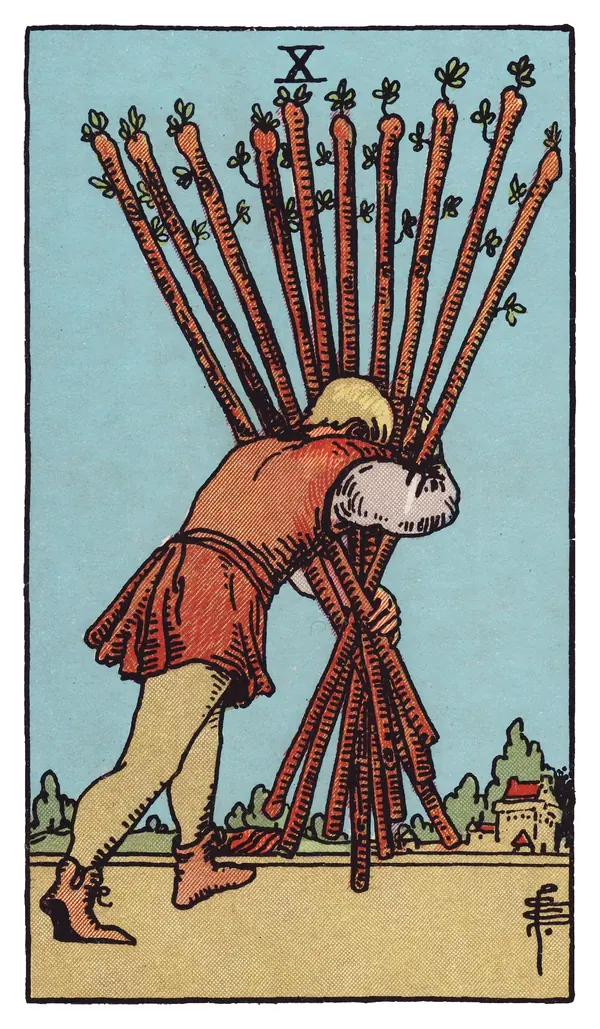
Then read the meaning and compare. Say you draw the Ten of Wands and write: “Someone bent over, hugging a huge bundle of sticks, can’t see where they’re walking.” The card’s meaning is about carrying more than you need to, even when the finish line is close. Your sentence already had most of it. Every card in the Rider–Waite–Smith deck shows a scene, the numbered minor cards included, so you can describe almost any of them without knowing a thing about tarot.
Finish with the reading’s next step. The daily card gives you one small thing to try or notice today. Keep it in mind through the day, and in the evening spend a minute on whether you noticed it.
Days 2 and 3: keep going and start notes
Draw a new card each morning. On this site the daily card stays the same all day, so you can come back to it at lunch and find the same card waiting. A new one comes after midnight in your time zone. Keep one line of notes per reading, in a notebook or a notes app:
If you read here while signed in, your readings are saved in your account history, and daily card entries keep your evening answer and a short note. The looking back is still yours to write. Keeping a Tarot Journal has a fuller method when you want one.
The evening question isn’t whether the card came true. It is where the card’s message showed up: did it point you at something you then met during the day? Some days the answer is plain and some days it is quiet, and both kinds of day teach you the card.
Day 4: your first three-card spread
Midweek, try a small spread on a real question. Past · Present · Future is the classic first one. The past card shows what led here and still has weight, the present card shows what is taking shape now, and the future card shows where things are heading if nothing changes.
Pick a question you actually care about, and keep it on your side of things. “What do I need to understand about this job search?” gives the spread more to work with than “Will they hire me?”, because the cards describe your situation and you decide what to do with it. How to Ask a Good Tarot Question goes into phrasing in more detail.
The position asks the question and the card answers it.
Read each card the way you read your daily card: picture first, then meaning, then what the meaning says in that position. The position asks the question and the card answers it, so the same card reads one way as the past and another way as the future.
Day 5: read the three cards as one story
Go back to yesterday’s spread, or draw a new one, and this time look at the cards together. Beginners often read three cards as three separate answers. The spread gets far more useful once you ask how they connect. A few things to look for:
- Do two or three cards share a suit? Cups lean toward feelings, Swords toward thought and conflict. The Four Tarot Suits covers what each suit speaks to.
- Is there a Major Arcana card? It often marks the weightiest part of the reading. The Major and Minor Arcana, Explained sets out the difference.
- Which way do the figures face? A figure in the present card turned away from the future card is worth a sentence in your notes.
- Does the future card follow from the present one, or push against it?
Then write one short paragraph that tells the three cards as a single story about your question. It will feel clumsy the first few times. That clumsy paragraph still teaches you more than three meanings read one after another.
Day 6: reversed cards and cards that look alarming
By now at least one card has probably come up reversed. In our decks a reversed card keeps its theme and shows it blocked, delayed or turned inward, which is different from simply the bad version. If reversals feel like too much for a first week, read every card upright for now and add them later. How to Read Reversed Tarot Cards explains both approaches.
You may also have drawn a card that looked frightening, such as Death or The Tower. Their meanings are hard: an ending that is due, a sudden change that knocks down something built on shaky ground. They describe what is happening in a situation, and each comes with a practical question. Death, the Tower, the Devil: What the Scary Cards Mean goes through them one by one.
Day 7: look back at the week
Read the week’s notes in one sitting. Look for the cards whose meaning you now remember without checking, the places where your first sentence about the picture matched the meaning, and the places where it didn’t. The mismatches deserve a second look, because they show you how you tend to read: more darkly than the card, more hopefully, or in a hurry.
Then decide how to carry on. Many readers keep the daily card as the habit and add a spread when a real question comes up. The card catalogue is there on the days you want a card’s full page, with its upright and reversed meanings side by side.
When a card makes no sense
This happens every week, to beginners and to people who have read for years. First, try reading the card smaller. The heavy bundle in the Ten of Wands might be one task you have been carrying alone rather than your whole workload. Then look at the picture again and reread what the position asks.
If it still doesn’t fit, write down that it didn’t and move on. Your notes will show later whether the card was pointing at something you weren’t ready to see, or whether it simply didn’t land that day. Keep the card you drew rather than drawing again until one fits. The card you wanted to replace is often the one with something to say.
Frequently asked questions
Do I need to memorize all 78 tarot cards?
No. You can start reading with the meanings in front of you, and every reading on this site gives you the text for each card in its position. Memory comes from use: draw a card, describe its picture, read its meaning and write one line about it. After a few weeks many meanings come back on their own, starting with the cards whose pictures you described in your own words.
How long does it take to learn tarot?
There is no fixed timeline. You can give a useful reading in your first week, because the meaning of each card is there to read. With one card a day you meet roughly two thirds of the deck in three months, since some cards come up again while others take longer to appear. Meanings learned in real readings tend to stay, so a steady habit matters more than long study sessions.
What is the best tarot spread for beginners?
Start with one card a day, then try a three-card spread such as Past · Present · Future when you have a real question. One card lets you learn the deck a card at a time. Three cards teach you to read positions and connect cards into a story, without the load of a ten-card spread like the Celtic Cross. Keep the bigger spreads for when three cards feel easy.
Can I read tarot for myself as a beginner?
Yes, and most people start that way. Reading for yourself lets you practice every day, and you already know the context behind each question. The hard part is honesty: it is tempting to redraw a card you don’t like, or to read it more kindly than it deserves. Writing your first impression before you read the meaning, and keeping the card you drew, both help.
Written by the editorial team · Reviewed on November 4, 2026 · Method →