Justice
Justice in Four Horsemen · Major Arcana XI
LossIn short
Examine evidence, own your part and choose a proportionate response.
Reversed
Selecting facts to fit an outcome, evading accountability or punishing without listening.
- Major Arcana
- XI
- The Mediator
- examining evidence
- owning your part
- a proportionate response
Upright
Examine evidence, own your part and choose a proportionate response. The healer’s register lies open beside a water sample and an empty grain measure.
Those who decided and those who lived with the consequences stand in the same place. The mediator asks what each person can establish, what each decided, and who bore the cost.
Some of that cost cannot be repaid; it can still be named.
A question to sit with
“What would a fair account include that my preferred account leaves out?”
One step
Write down your own part in one plain sentence, then write the part you have been leaving out.
Reversed
Selecting facts to fit an outcome, evading accountability or punishing without listening. An account can be built backwards from the verdict someone already wants.
The register stays closed, the water sample goes unmentioned, and the people who went thirsty are never called to speak.
Blame lands on whoever stands nearest, while the ones who held the keys leave the hearing untouched.
A question to sit with
“Which facts have I left out because they spoil the verdict I already want?”
One step
Ask one person who bore the consequences what they saw, and listen to the end before you answer.
How this deck reads reversed cards
Reversed, the act on the card turns inward, meets an obstacle, grows harsher or shows its price. On this road a reversal is not automatically the opposite, and not automatically something worse.
In love
A relationship may need a fair account: what each person did, decided and bore.
- Supports
- Honesty about your own part.
- Watch for
- Keeping score instead of seeking fairness.
- One step
- Tell the other person one thing you did that affected them, plainly and without excuse.
One side of the story may be missing, or blame may be landing without listening.
- Supports
- The chance to hear the other account.
- Watch for
- Punishing before understanding.
- One step
- Ask the other person for their version and repeat it back before you answer.
At work
At work, responsibility may need to be weighed openly, with evidence on the table.
- Supports
- Records, facts and a proportionate response.
- Watch for
- Taking credit or dodging blame.
- One step
- Gather the facts on one disputed issue before you speak about it.
Facts may be selected to fit a result at work, or accountability may be quietly avoided.
- Supports
- Open records.
- Watch for
- Blame landing on whoever stands nearest.
- One step
- Check one decision you disagree with against the full record, not the summary.
The decision may call for weighing evidence rather than preference.
- Supports
- A clear account of what you know and do not know.
- Watch for
- An account that happens to favour what you already wanted.
- One step
- List the facts for and against each option, and add one fact you would prefer to ignore.
The choice may rest on facts picked to support a conclusion already reached.
- Supports
- The fact you left out.
- Watch for
- Mistaking a convenient story for the truth.
- One step
- Argue the other side of your decision on paper for ten minutes.
Your growth may come through owning your part honestly and choosing a response in proportion.
- Supports
- Readiness to be accountable.
- Watch for
- Harsh self-judgement dressed up as honesty.
- One step
- Write one mistake you made and one proportionate way to put part of it right.
You may be avoiding your part, or punishing yourself out of proportion.
- Supports
- A fairer account of what happened.
- Watch for
- Evasion or self-punishment passing for reflection.
- One step
- Name your part in one sentence, without excuse and without cruelty.
A family matter may need a hearing where everyone who bore the cost can speak.
- Supports
- A willingness to listen to every side.
- Watch for
- Letting the loudest person write the account.
- One step
- Set aside time for each person involved to say what they saw, uninterrupted.
At home, someone may be carrying blame that belongs elsewhere, or a voice may never be heard.
- Supports
- A family member who is willing to listen.
- Watch for
- Punishment handed out before anyone has spoken.
- One step
- Give one person at home the chance to finish their account before anyone responds.
Yes or no
MixedNoThe answer depends on what the full record shows, so it is mixed until the evidence is on the table.
Supports
- The evidence can be laid out openly.
- Owning your part gives you standing in the outcome.
Limits
- A fair account may include facts you would rather leave out.
- Some costs, once named, cannot be repaid.
One step
Add to your account one thing the people who bore the consequences would say belongs in it.
A decision built on selected facts is unlikely to hold, so the answer leans no while the record stays partial.
Supports
- Missing facts can still be brought in.
- Listening can begin before any verdict.
Limits
- The account may be shaped to fit a wanted outcome.
- Blame may be falling on whoever is nearest instead of whoever decided.
One step
Write down the fact you have been keeping out of the hearing, and your reason for keeping it out.
What is in the picture
A mediator holds level scales and a grounded sword while the Keeper brings the well register. Open records, a water sample and an empty grain measure make responsibility something people can see.
The people who made decisions and those who bore their consequences share one hearing.
- level scales
- grounded sword
- open records
- water sample in a glass bottle
- empty grain measure
- well register
- broken columns
- stone steps
This card in other decks
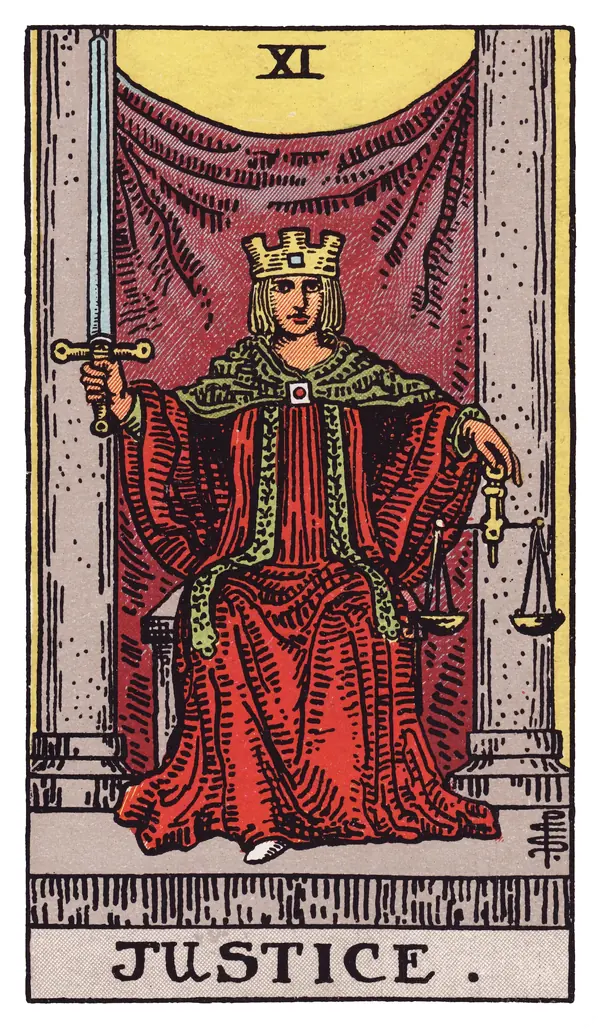 Rider–Waite–SmithJusticeA fair, honest look at the facts, including your own part in them, is what this situation needs right now.
 FamiliaJusticeAn honest reckoning across generations: debts and merits weighed evenly, each side receiving what it earned.
 City of WindowsJusticeChecking the facts, owning the consequences of what was done, setting fair terms.
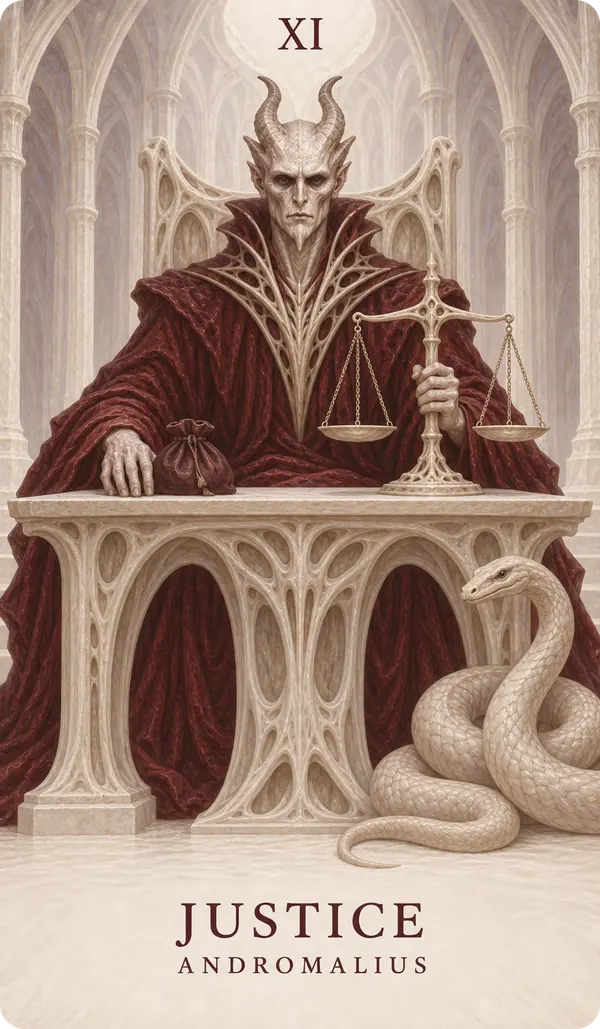 CarnalJusticeAccountability, proportion and the return of what is owed.
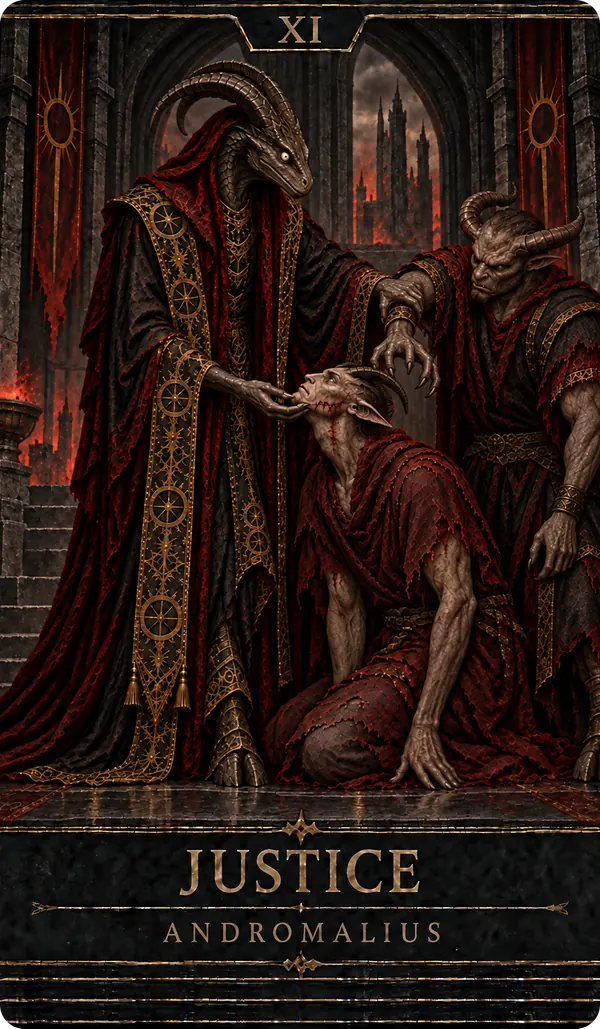 Crimson InfernoJusticeDistinguish proof from pressure.
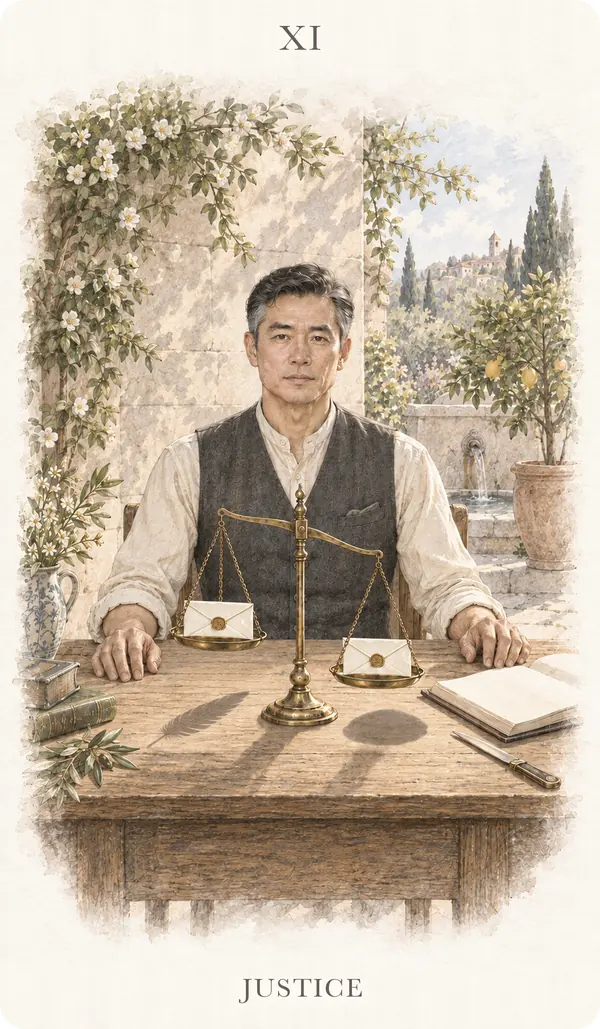 Everyday WondersJusticeClear judgment, proportion, responsibility and consequences.
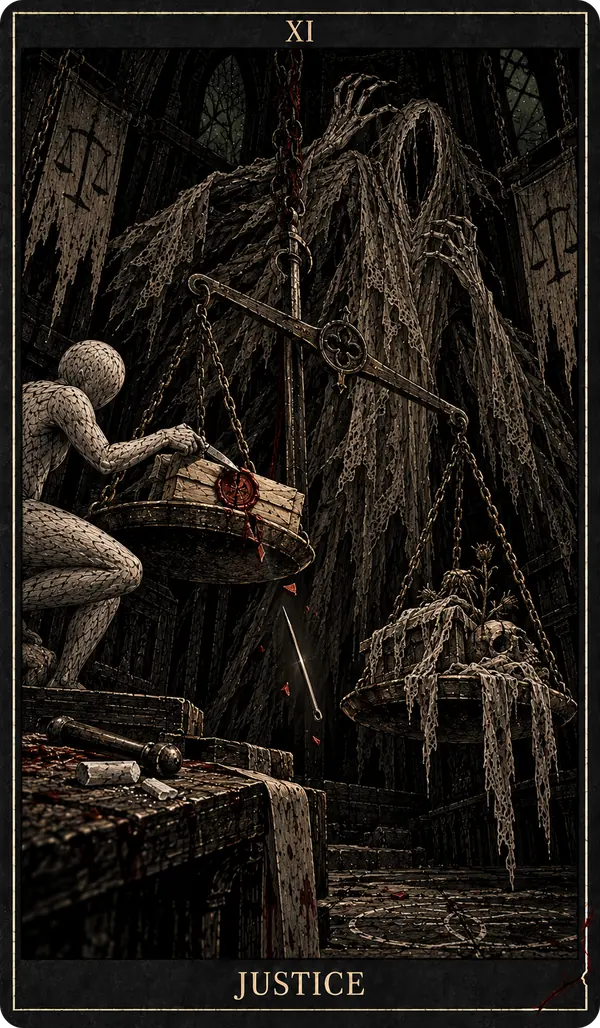 Mirror NightJusticeRevise the verdict when a hidden needle falls.
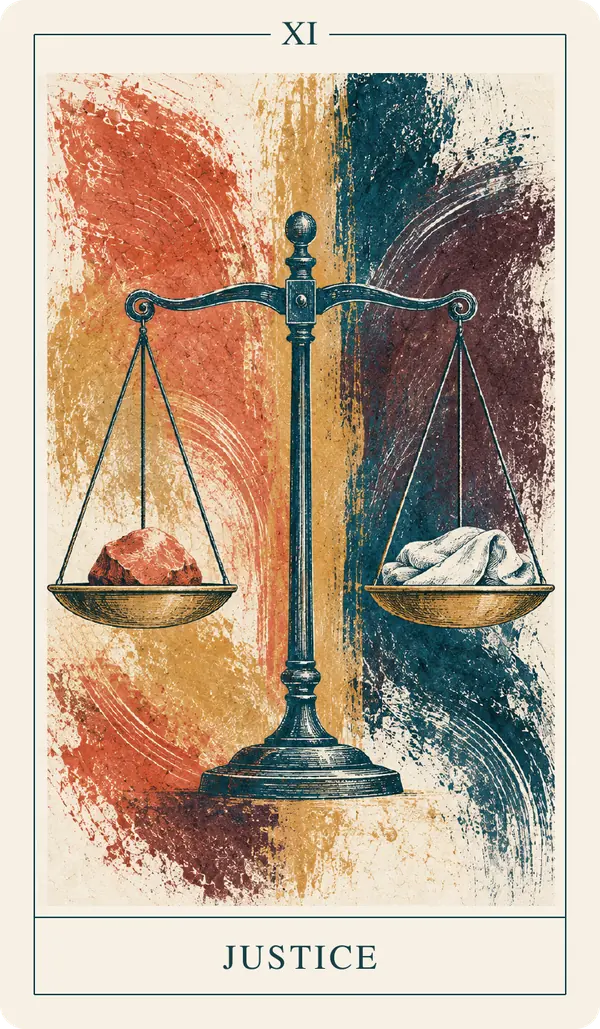 Self ContactJusticeApply the same measure to yourself and others.
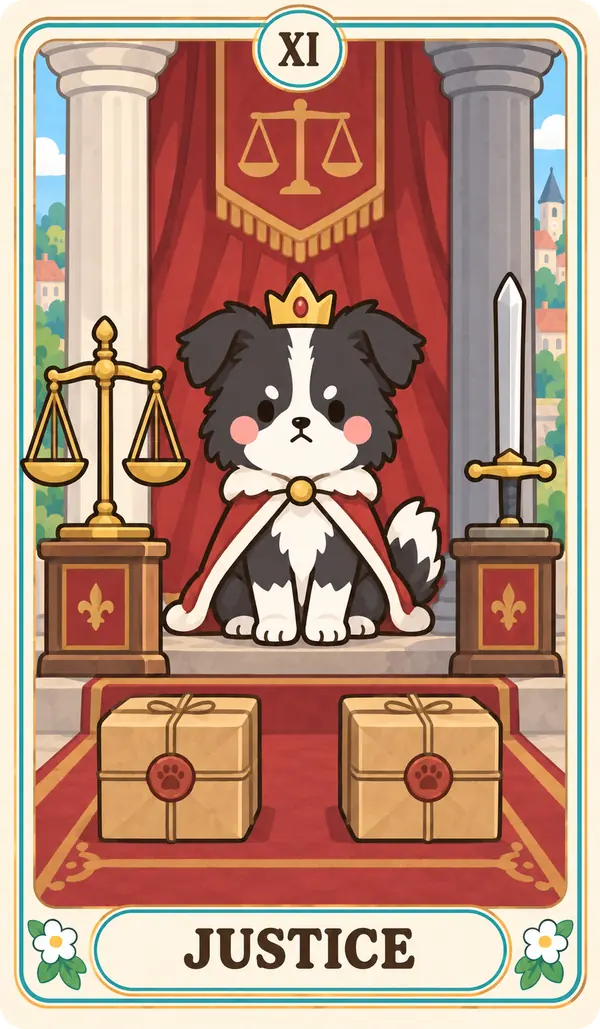 Shiba TownJusticeFairness; accountability; consequences based on facts.
 Velvet MasqueradeJusticeA fair consequence grounded in what can be checked.
 Four TrailsJusticeFairness, truth, consequences.
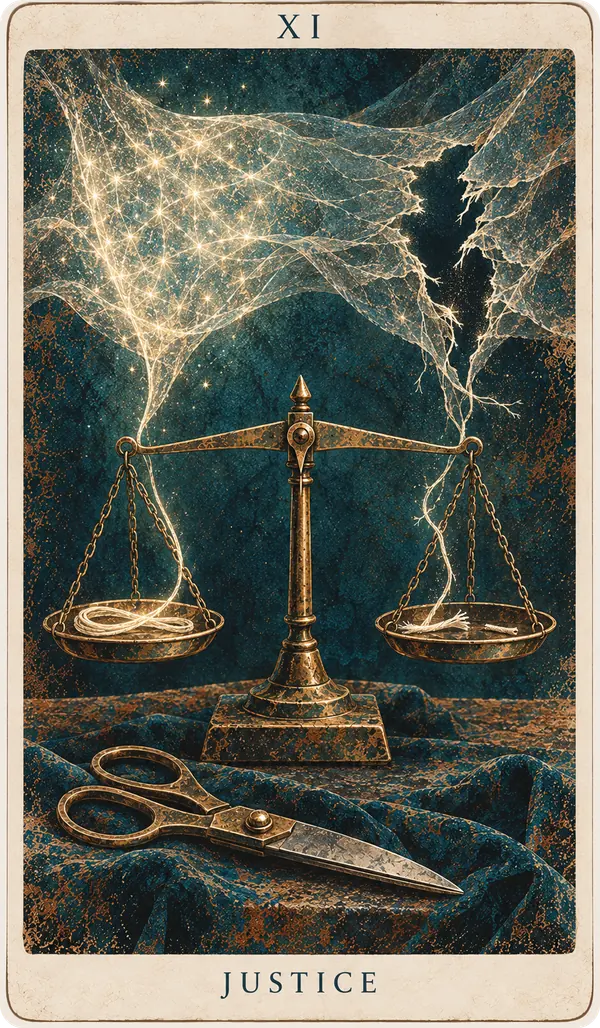 Living ThresholdJusticeThe balance reveals what a cut changes and where the fabric still needs mending.
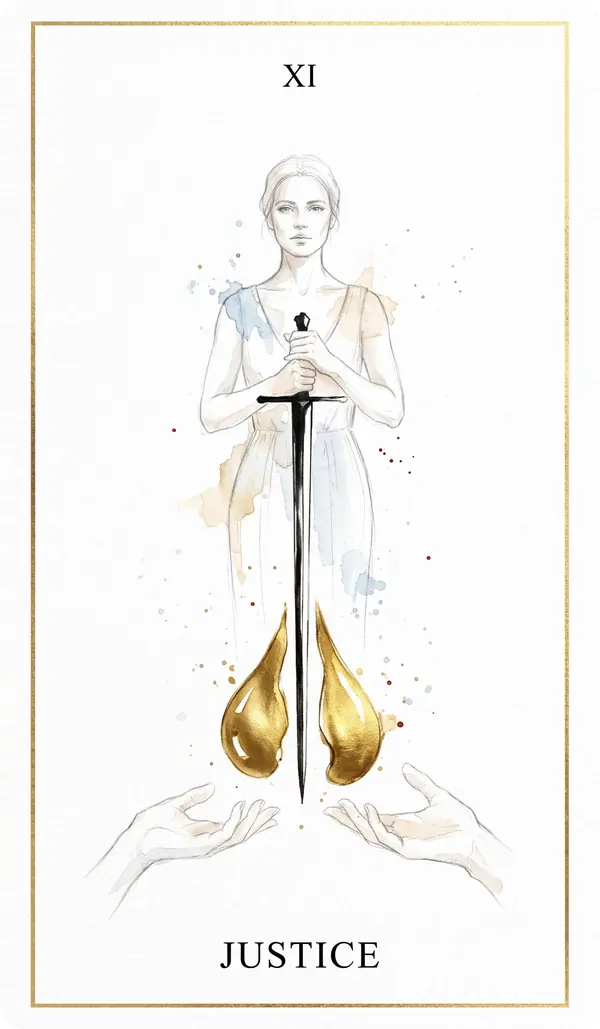 Colour of PowerJusticeAn honest cut: what was invested is counted, and the clean need not fear.
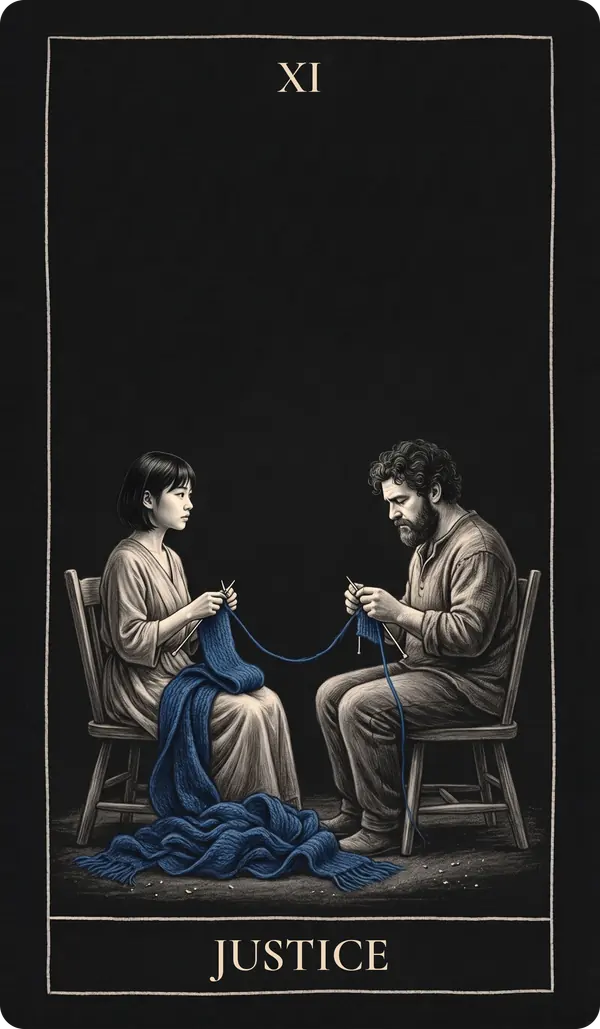 BoundJusticeAn honest count: the thread shows who has knitted how much.
 Cozy HauntJusticeAccountability and a fair boundary.
 Celestial Night SkyJusticeAn answer open to checking.
Where it appears
Questions about this card
Is Justice a yes or no card in Four Horsemen?
Justice is mixed upright in a yes or no question: the answer depends on what the full record shows. Reversed, it leans no, because a decision built on selected facts is unlikely to hold. Add one thing to your account that the people who bore the consequences would say belongs in it, then ask again.
What does Justice mean in love?
On the subject of love, Justice may point to a relationship that needs a fair account of what each person did, decided and bore. Reversed, one side of the story may be missing, or blame may land without listening. Ask the other person for their version and repeat it back before you answer.
What does Justice mean reversed in Four Horsemen?
A reversed Justice describes selecting facts to fit an outcome, evading accountability or punishing without listening. The open records and the water sample in the picture are exactly what gets left out. Write down the fact you have been keeping out of the hearing, and the reason you are keeping it out.