The Chariot
The Chariot in City of Windows · Major Arcana VII
RelationshipsIn short
A shared course, the will to keep going and the ability to adjust the pace along the way.
Reversed
A race in which one person leads and the other can only catch up, or a standstill over who gets to steer.
- Major Arcana
- 7
- Cancer
- The Co-Driver
- direction
- self-control
- moving through contradictions
Upright
A shared course, the will to keep going and the ability to adjust the pace along the way. Check whether each of you sees the other’s load and is willing to change speed. Mira and Lev are moving their things into the building where they plan to live together.
Behind them is the open van with the last of the boxes; they walk side by side along the sidewalk toward the lit entrance. Mira wheels the hand truck with two boxes, and Lev carries one more. Their eyes meet; her face is serious, and his attention is on her.
This kind of movement asks both people to notice the pace and the load each one is carrying.
A question to sit with
“Are we moving together, and do we notice each other’s load?”
One step
Check whether each of you sees the other’s load and is willing to change speed.
Reversed
A race in which one person leads and the other can only catch up, or a standstill over who gets to steer.
Rethink how the load is shared before the next step.
A question to sit with
“Who is steering and who is only catching up, and how is the load shared between us?”
One step
Rethink how the load is shared before the next step.
How this deck reads reversed cards
Reversed, a window may show a delay, an imbalance, a defensive reaction or the first step out of one; the neighboring cards help tell which. A reversal does not mean “a bad person”, and one card proves no one’s motive.
In love
A shared route may be opening, two people wheeling boxes toward the same lit entrance and glancing over to see who carries what.
- Supports
- Walking side by side, each able to see the other’s load.
- Watch for
- Racing ahead with the hand truck while the other carries boxes in their arms.
- One step
- Talk through one shared plan this week and settle who carries which part of it.
One person may be striding ahead with the cart while the other trails with an armful, or both may be stuck on the sidewalk over who steers.
- Supports
- Stopping on the pavement to look at the load again.
- Watch for
- Calling it teamwork when one person sets every pace.
- One step
- Before the next shared step, say how heavy your side feels and ask about theirs.
At work
Momentum at work may be real now; a project can move from the van to the door if the pace suits everyone pushing it.
- Supports
- Steady will, with room to change speed.
- Watch for
- Measuring progress only by how fast the boxes move.
- One step
- Check the pace of one shared task with the people working on it.
A project may be stalled in a tug over who holds the handle, or racing on with one person doing the heavy lifting.
- Supports
- Dividing the load again before speeding up.
- Watch for
- Rushing past a colleague who has fallen behind.
- One step
- Raise how the work is split before agreeing to the next deadline.
Picking a direction and wheeling it forward may be the call here, as long as you keep an eye on the load as you go.
- Supports
- A clear course you can still adjust on the way.
- Watch for
- Choosing the route by speed alone.
- One step
- Choose only the next stretch, from here to the door, and leave the rest open.
Two pulls may be fighting for the steering, so the choice either races off one way or sits on the curb going nowhere.
- Supports
- Naming which part of you wants to steer.
- Watch for
- Following whichever pull pushes hardest.
- One step
- Give each pull one line on paper, then pick only the next step, not the whole route.
Self-command may grow through a long carry: feeling your own load, slowing when you need to, and still reaching the door.
- Supports
- The ability to keep going and to change pace.
- Watch for
- Pushing harder when the cart only needs balancing.
- One step
- Set one goal for the week and mark in advance where you could slow down.
Drive may have slid into strain, carrying more boxes than two arms can manage just to prove you can.
- Supports
- Putting a box down without calling it failure.
- Watch for
- Willpower spent on a pace no one asked for.
- One step
- Take one task off this week’s load and let it wait.
A household on the move, a relocation or a new routine, may go well if everyone can see who lifts what.
- Supports
- Loads shared out where everyone can see them.
- Watch for
- One person steering every trip while the others follow.
- One step
- Make a short list at home of who handles which job during the change.
A move or a change at home may be grinding along, someone steering every decision and someone else only catching up.
- Supports
- Taking turns at the handle at home.
- Watch for
- Silence from the one who carries most.
- One step
- Ask the most tired person at home what they would put down first.
Yes or no
YesNoWhere two people share a direction and can adjust the pace, the answer leans toward yes: the road can hold both of them.
Supports
- You and the other person may be moving the same way, at a pace you can both keep.
- The load can be talked about and shifted along the way.
Limits
- One of you may be carrying more without saying so.
- Speed could start to matter more than staying side by side.
One step
Ask each other what you are carrying right now, and whether the pace suits you both.
When one person leads and the other only catches up, or nobody can agree who steers, the answer leans away until the load is shared again.
Supports
- You can notice who is steering and who is catching up.
- How the load is shared can still be talked through.
Limits
- One person may be setting the pace while the other runs to keep up.
- The move may be stalled by a quarrel over who decides.
One step
Look at the last shared decision and ask who made it, and who went along.
What is in the picture
A level sidewalk leads from an open van to the entrance of a building. Two boxes stand on a single hand truck, and Lev carries a third in his arms. Mira pushes the hand truck; the two of them walk side by side, looking at each other. By the door, the lit entrance area is visible.
Their eyes meet; her face is serious, and his attention is on her.
- open van with the last boxes
- hand truck with two boxes
- box in Lev’s arms
- level sidewalk
- lit building entrance
This card in other decks
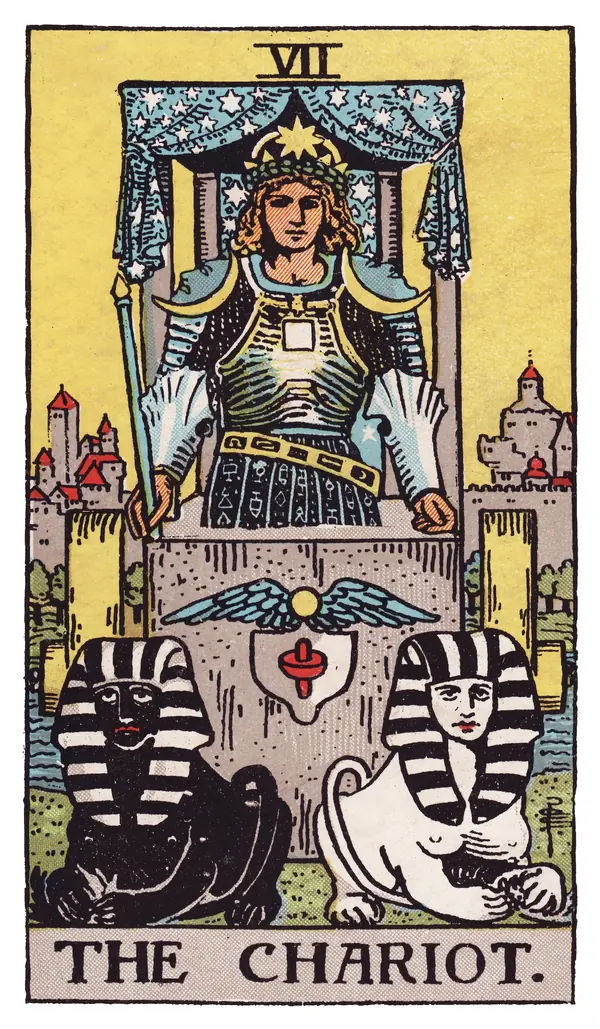 Rider–Waite–SmithThe ChariotStrong forward motion is available if you can hold two pulling directions together instead of letting either one win alone.
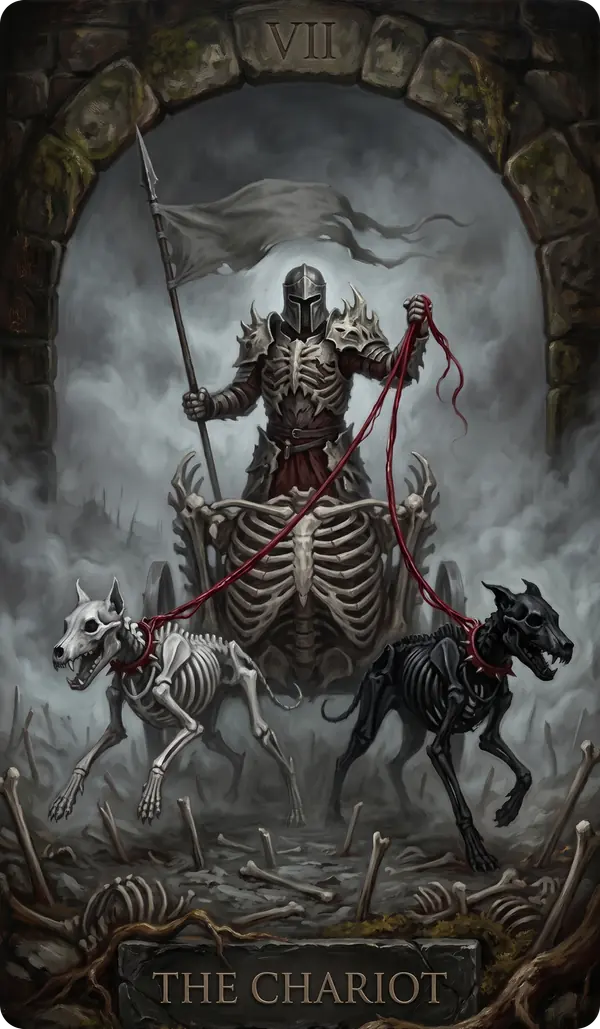 FamiliaThe ChariotThe line’s will moving onto new ground, with ambition and caution held in one firm harness.
 CarnalThe ChariotDirection maintained while competing forces remain present.
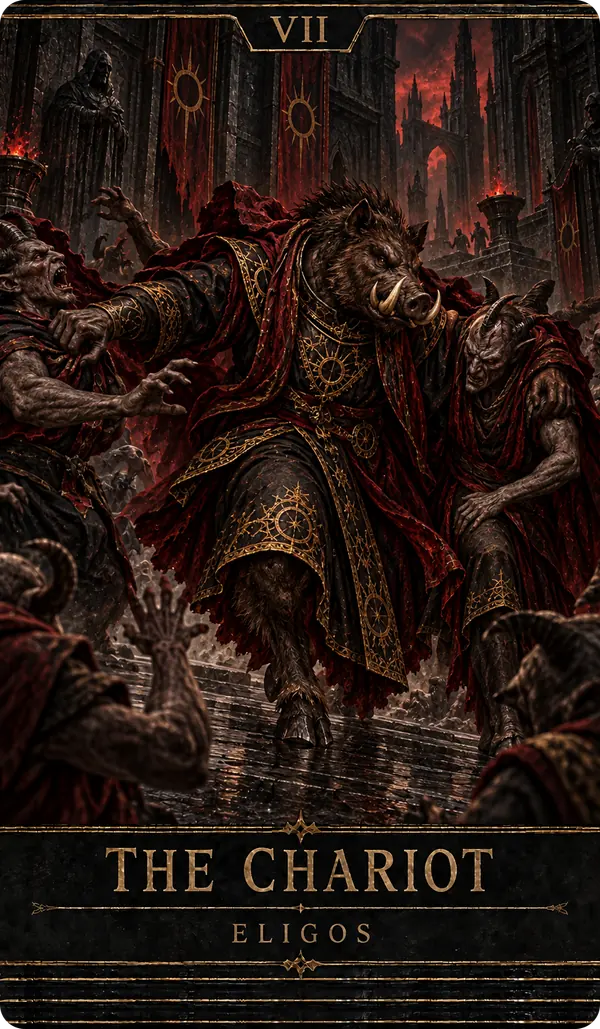 Crimson InfernoThe ChariotUnify competing impulses and choose a direction.
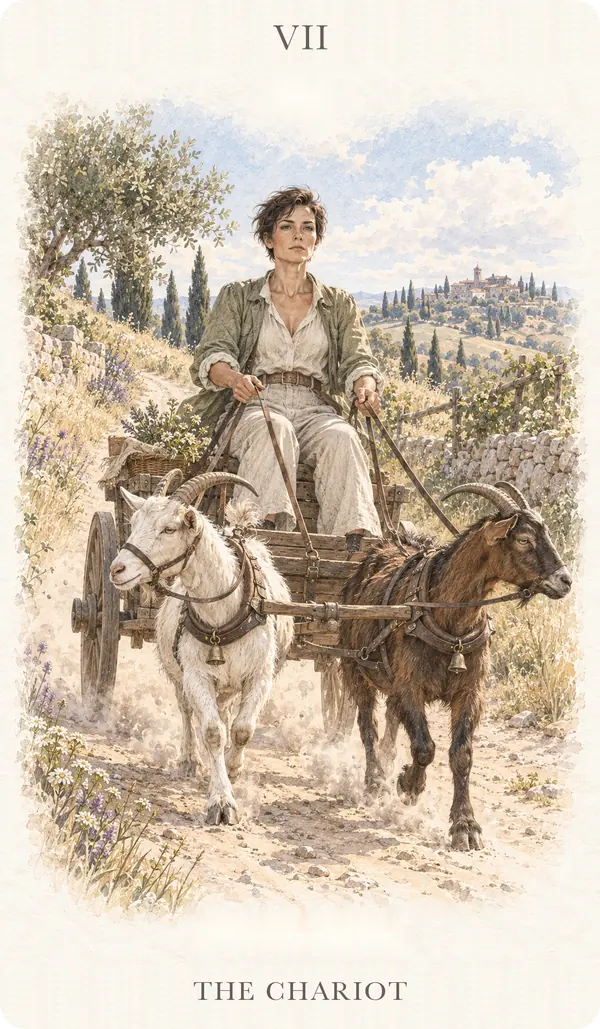 Everyday WondersThe ChariotWill, focus and the coordination of conflicting forces.
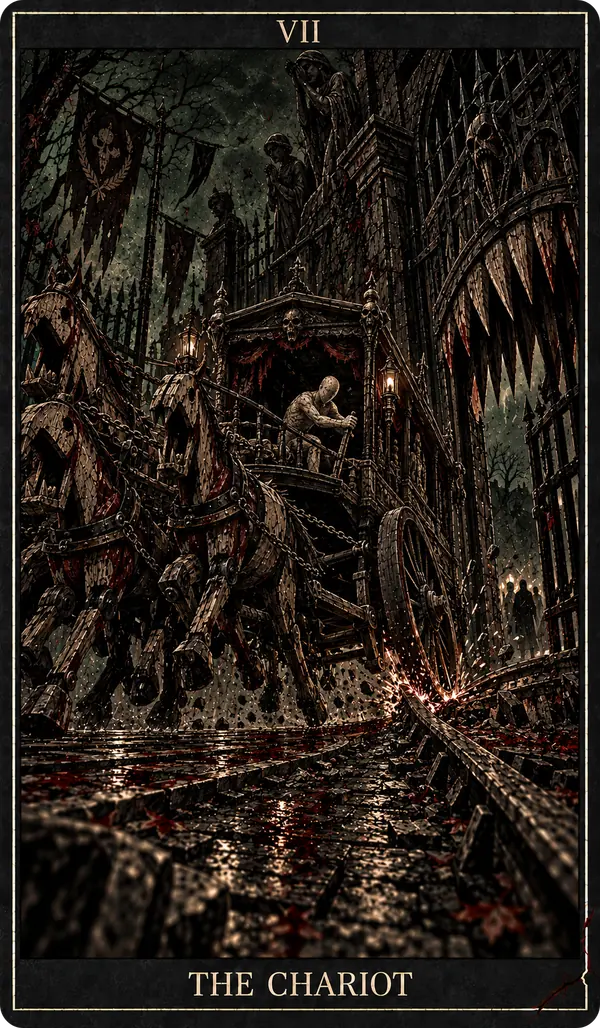 Mirror NightThe ChariotSteer a force that cannot be fully stopped.
 Self ContactThe ChariotChoose a direction and bring competing impulses into a workable rhythm.
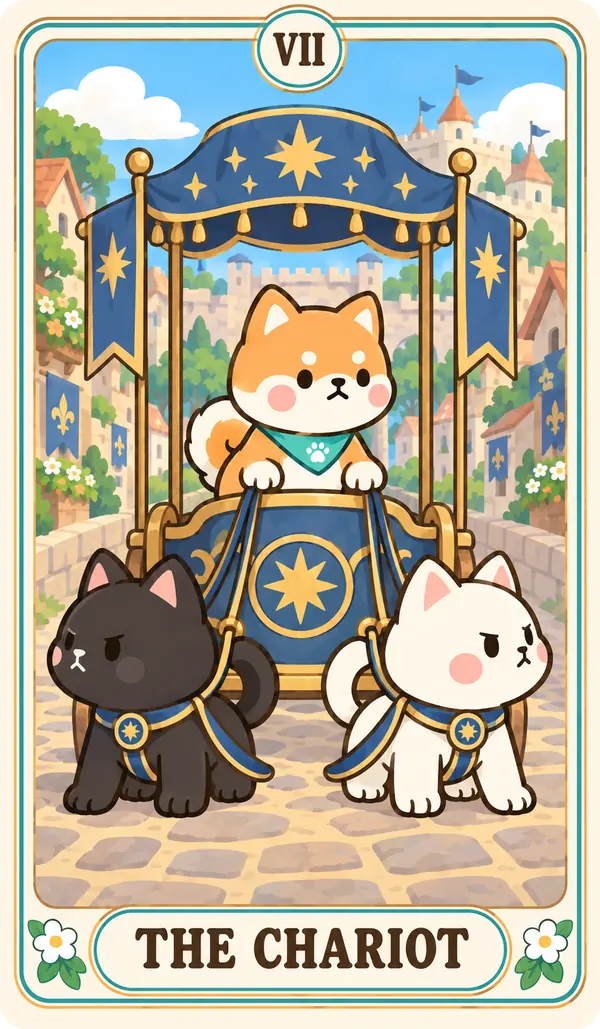 Shiba TownThe ChariotDirection; determination; bringing competing impulses together.
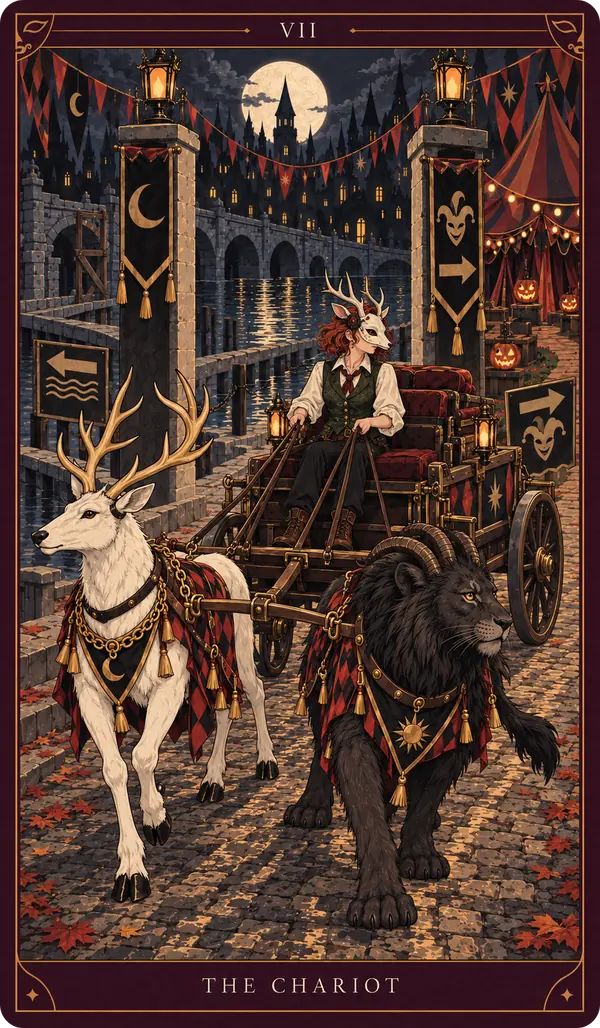 Velvet MasqueradeThe ChariotGuiding opposing energies along one chosen route.
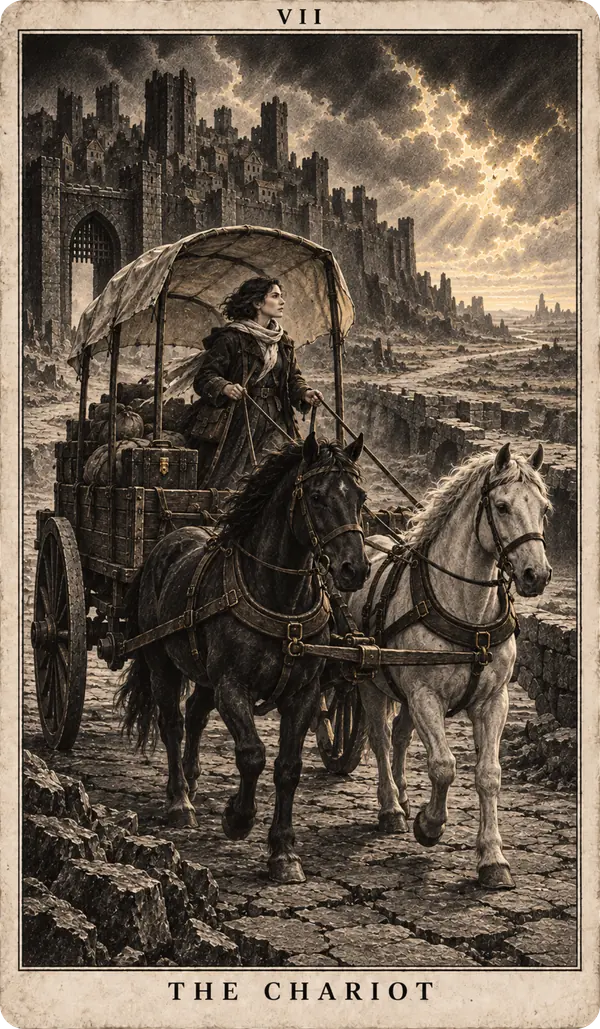 Four HorsemenThe ChariotChoose a direction and coordinate competing forces through discipline.
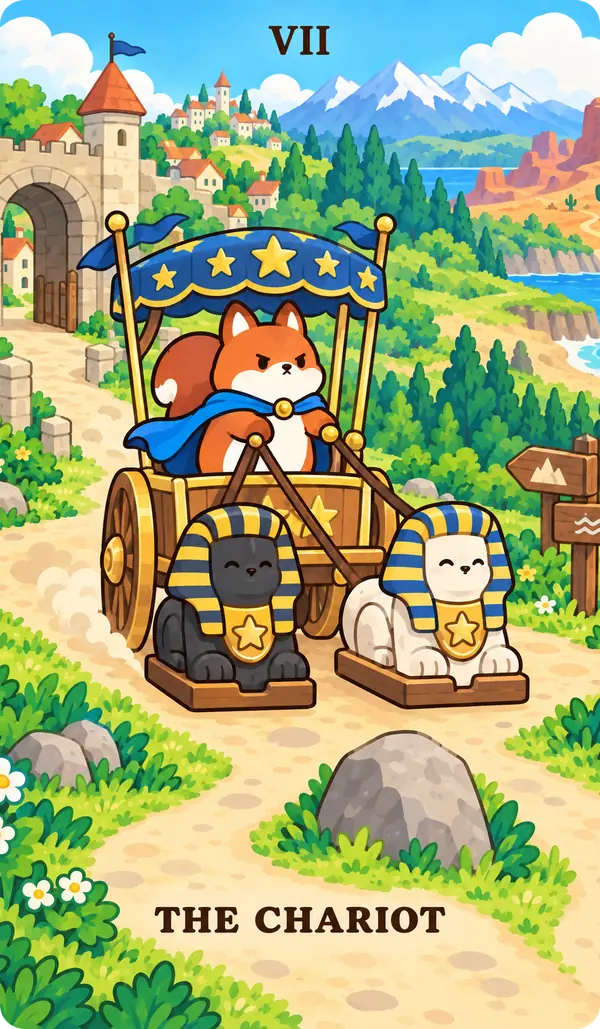 Four TrailsThe ChariotDirection, discipline, determined progress.
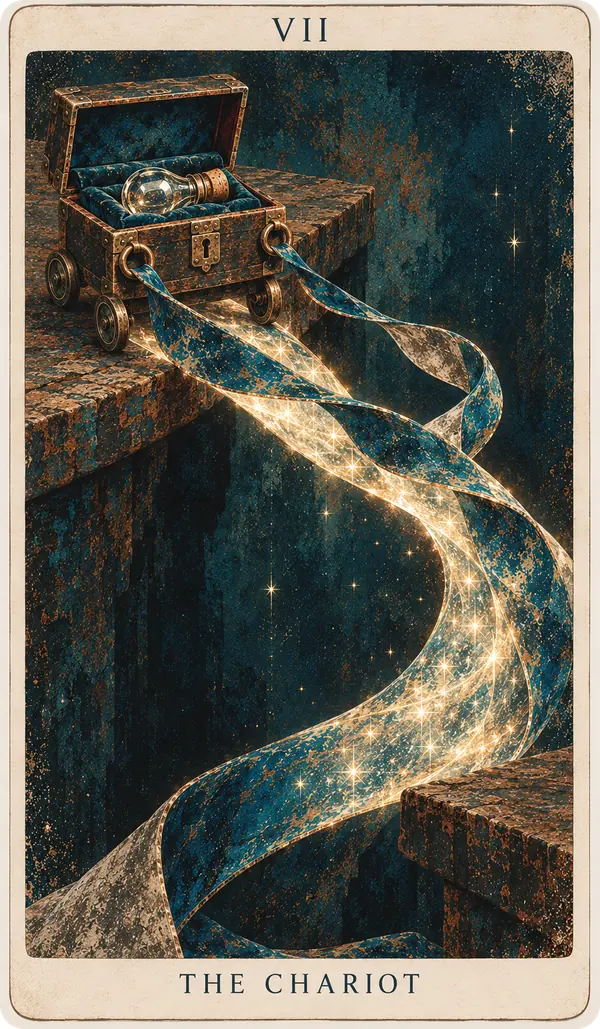 Living ThresholdThe ChariotTwo living ribbons weave a road that carries a sheltered vial through change.
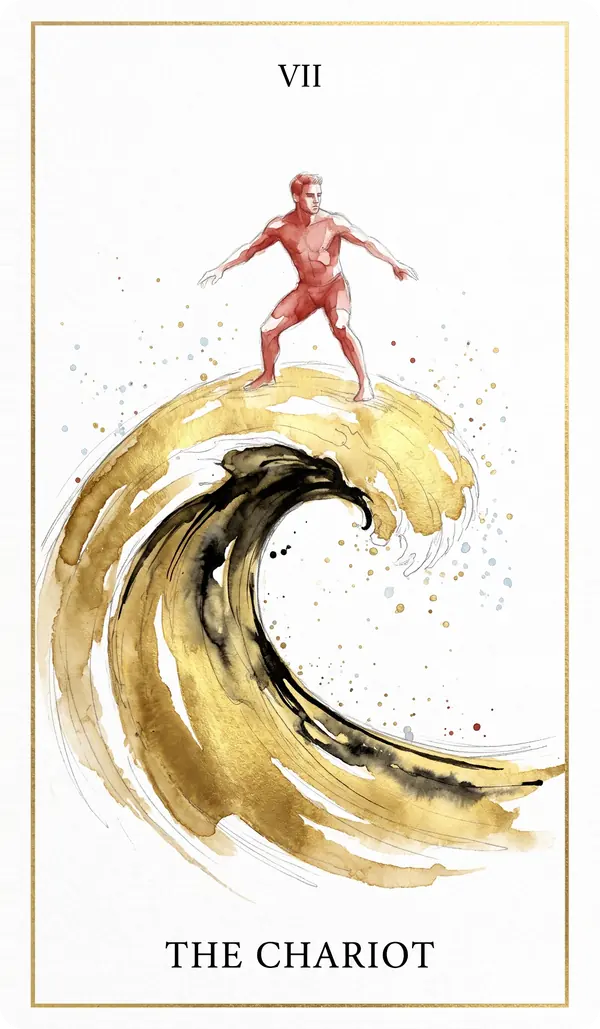 Colour of PowerThe ChariotYou caught the moment; ride it, and keep your own balance.
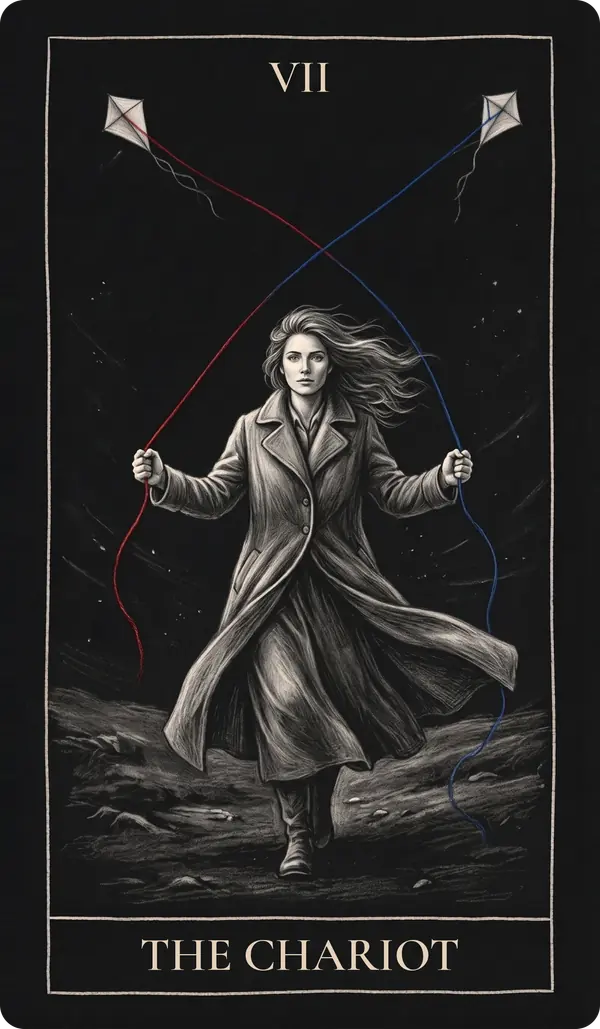 BoundThe ChariotYou walk through the wind and hold both threads.
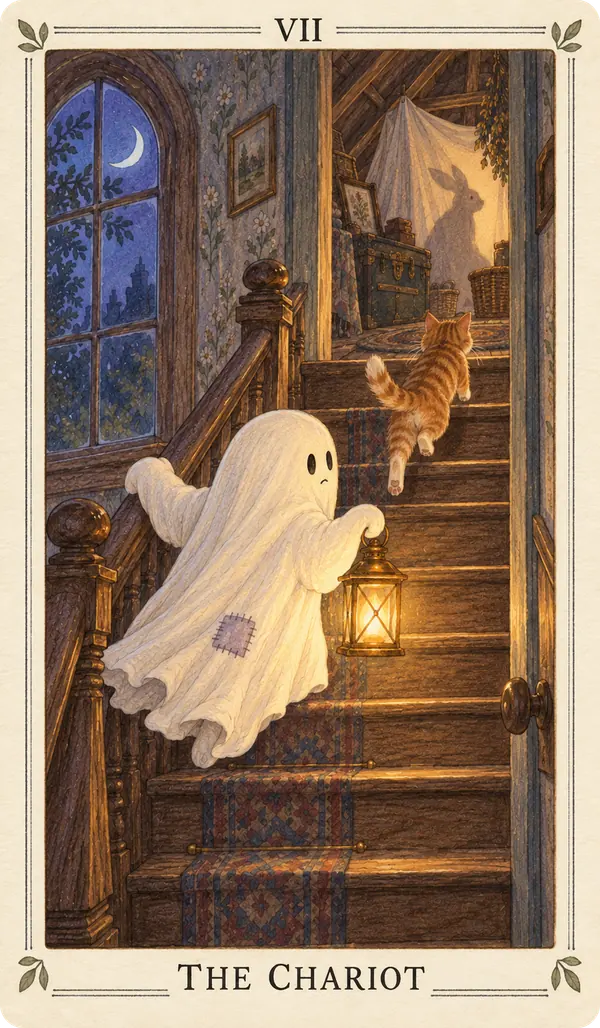 Cozy HauntThe ChariotDirection, will and care held together.
 Celestial Night SkyThe ChariotA course held together.
Where it appears
Questions about this card
Is The Chariot a yes or no card in love?
Upright, The Chariot leans yes. Two people share a direction and can adjust the pace, so the road can hold both of them; in the deck, Mira and Lev are carrying boxes into the home they will share. Reversed, it leans no: one person leads and the other only catches up, or you are stuck over who steers. The answer waits until the load is shared again.
Does The Chariot mean moving in together?
It can. In City of Windows, The Chariot is moving day: Mira wheels two boxes on a hand truck and Lev carries one more toward the entrance of their new building. Upright, it points to moving forward together, whether that is a move, a shared plan or a next step taken side by side. Ask what feels heaviest for them this week, and tell them what feels heaviest for you.
What does The Chariot mean reversed in love?
Reversed, The Chariot points to a race where one person sets the pace and the other can only catch up, or to a standstill over who gets to steer. Watch for calling it teamwork when one person does both the steering and the carrying. Before the next big step, talk through one shared decision and how the work around it was split.