Justice
Justice in Self Contact · Major Arcana XI
GrowthIn short
Apply the same measure to yourself and others.
Reversed
Bias, self-excusing or punitive judgement may have replaced a fair assessment.
- Major Arcana
- 11
- The Fair Witness
- the same measure
- evidence and consequences
- fair proportion
Upright
Look plainly at evidence and consequences.
Apply the same measure to yourself and others.
A question to sit with
“What would a fair account of this situation include?”
One step
Look plainly at evidence and consequences.
Reversed
Bias, self-excusing or punitive judgement may have replaced a fair assessment.
Turned over, the pans hang above the beam, and whatever is put in them could tip one way before anyone weighs it.
A question to sit with
“Am I going easier on myself, or harder, than the facts support?”
One step
Write the facts of one situation in two columns, yours and theirs, and read both with the same eye.
How this deck reads reversed cards
Reversed, the same brushstroke meets resistance. The hand on the cloth may hold too tightly, pull away or keep its feeling to itself, and the quality of the card turns into a blockage, an excess or a quiet inward process. It is not the opposite of the upright card and not a worse fate, only the same gesture under strain.
In love
A stone in one pan and a folded cloth in the other may ask for proportion in love: what each person gives could differ in form and still weigh the same.
- Supports
- Fairness that allows for differences.
- Watch for
- Counting favours like a ledger.
- One step
- List what you give and what you receive in a relationship, without judging either column.
The beam may be tilting in love, through bias for or against someone, or through excuses that let a pattern go unexamined.
- Supports
- Seeing both sides with the same eyes.
- Watch for
- Punishing someone now for an old hurt.
- One step
- Write out a disagreement from the other person’s side, as fairly as you can.
At work
The level beam may be the reading for work: plain evidence and honest consequences, weighed the same for you as for anyone else.
- Supports
- Decisions based on facts.
- Watch for
- Excusing yourself for what you would criticise in others.
- One step
- Before one work decision, put the facts on one side of a page and the guesses on the other.
Judgement at work may be skewed by bias, self-excuse or a wish to punish, so the measure applied is no longer the same for everyone.
- Supports
- A second look at a decision you rushed.
- Watch for
- Holding others to rules you excuse yourself from.
- One step
- Review one recent work judgement and check whether you would make it the same way for someone else.
Placing each option in its own pan may help; evidence and likely consequences could show which choice is fair to everyone, you included.
- Supports
- Weighing consequences honestly.
- Watch for
- Tilting the scale toward what you wanted from the start.
- One step
- Write the main consequence of each option and how it might feel a month later.
The pans may be weighted before you start, the choice tipped in advance by bias or by fear of being judged.
- Supports
- Testing your reasoning against an honest friend.
- Watch for
- Calling your preference the fair choice.
- One step
- Explain your reasoning to one person and ask where it seems lopsided.
Applying the same measure to yourself that you use on others may be where growth lies, neither pan heavier nor lighter.
- Supports
- A fair account of your own actions.
- Watch for
- Harsh judgement passed off as honesty.
- One step
- Name one thing you did well this week and one you would do differently.
A scale that only tips against you, or one that always excuses you, may be blocking growth, so a fair account never gets made.
- Supports
- Proportion in how you judge yourself.
- Watch for
- Swinging between blame and excuse.
- One step
- Describe one mistake in plain words, without blame and without excuse.
Warm and cool halves of the household may both need fair weight; balance at home could mean each person’s needs are seen at their real size.
- Supports
- Even-handed attention to each person.
- Watch for
- Taking sides out of habit.
- One step
- Make sure everyone at home gets a say in the next shared decision.
Fairness at home may have slipped, one person’s needs weighing more, or old grievances keeping the beam from settling level.
- Supports
- A fresh, honest count of who does what.
- Watch for
- Keeping score of past wrongs.
- One step
- Suggest one fairer way to share a household task.
Yes or no
MixedNoThe answer rests on the evidence, so it is mixed until you weigh it fairly.
Supports
- The facts may support it.
- A fair look could make the answer clear.
Limits
- Consequences need honest weighing.
- You may have to hold yourself to the same standard.
One step
List the evidence on each side and see which way it tips.
The scales look tilted, so the answer leans no until the measure is fair.
Supports
- Bias you notice can be corrected.
- The facts can still be looked at again.
Limits
- Judgement may be tilted.
- Excuses or harshness may be doing the weighing.
One step
Ask whether you would judge this the same way if someone else stood in your place.
What is in the picture
Two pans share a level beam.
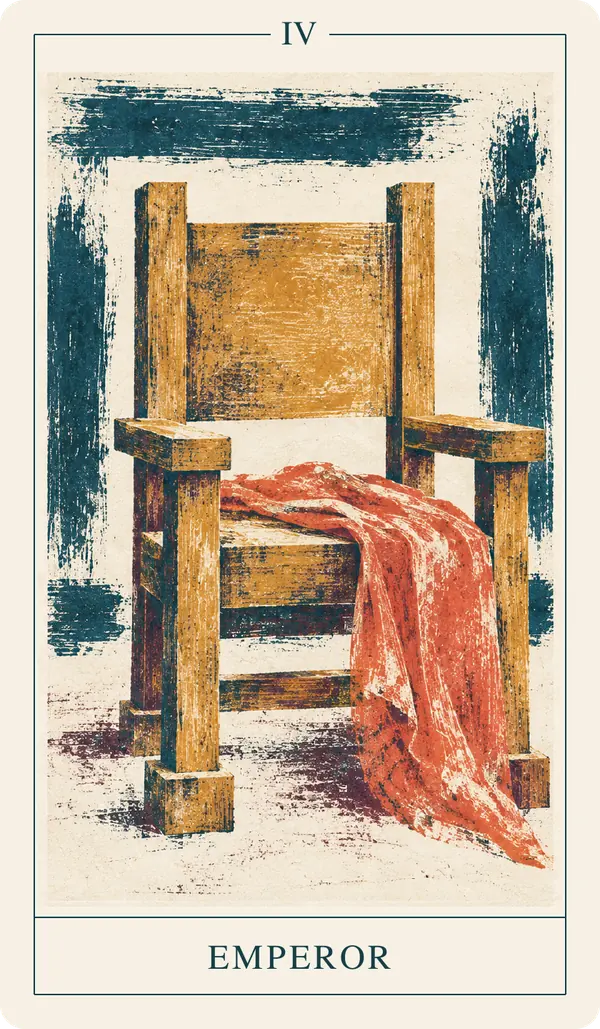
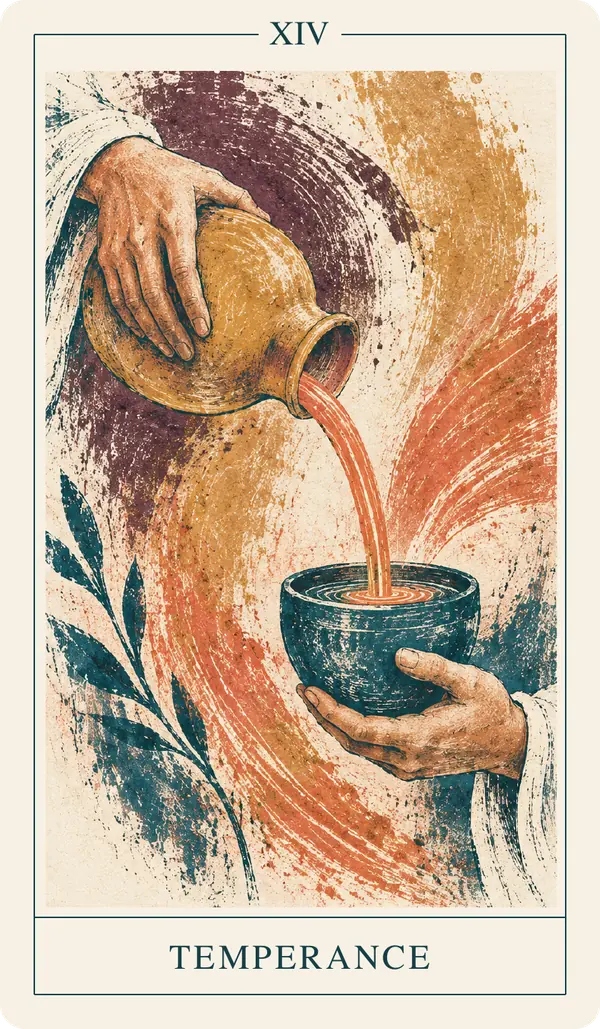
A stone and folded cloth ask for proportion despite their different forms. The paired containers can be read beside TEMPERANCE. Its measured structure offers a question for the authority of EMPEROR.
- balance scale on a pillar
- red stone in the left pan
- folded white cloth in the right pan
- level beam
- warm and cool halves of the background
This card in other decks
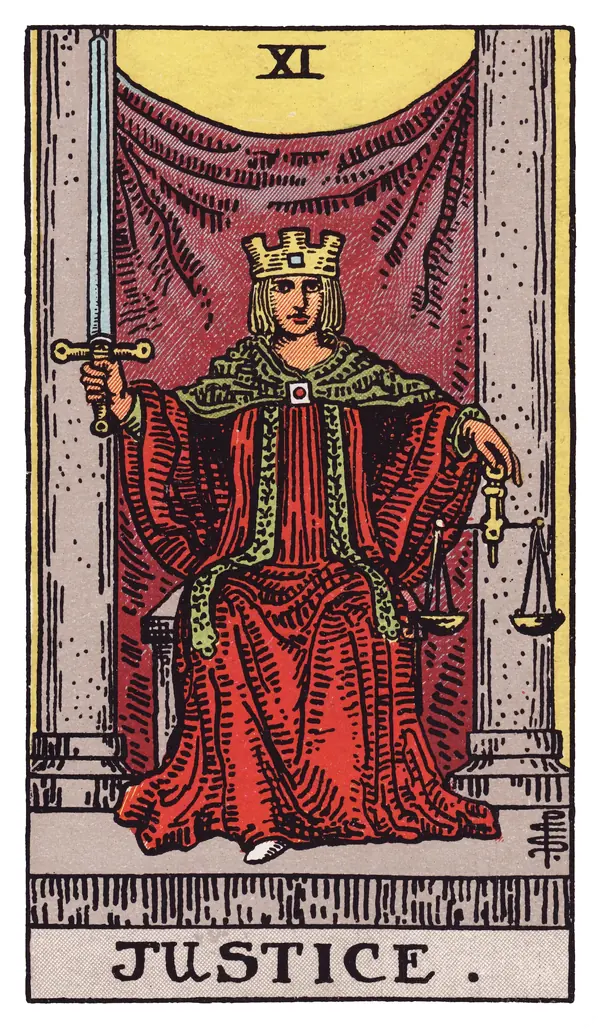 Rider–Waite–SmithJusticeA fair, honest look at the facts, including your own part in them, is what this situation needs right now.
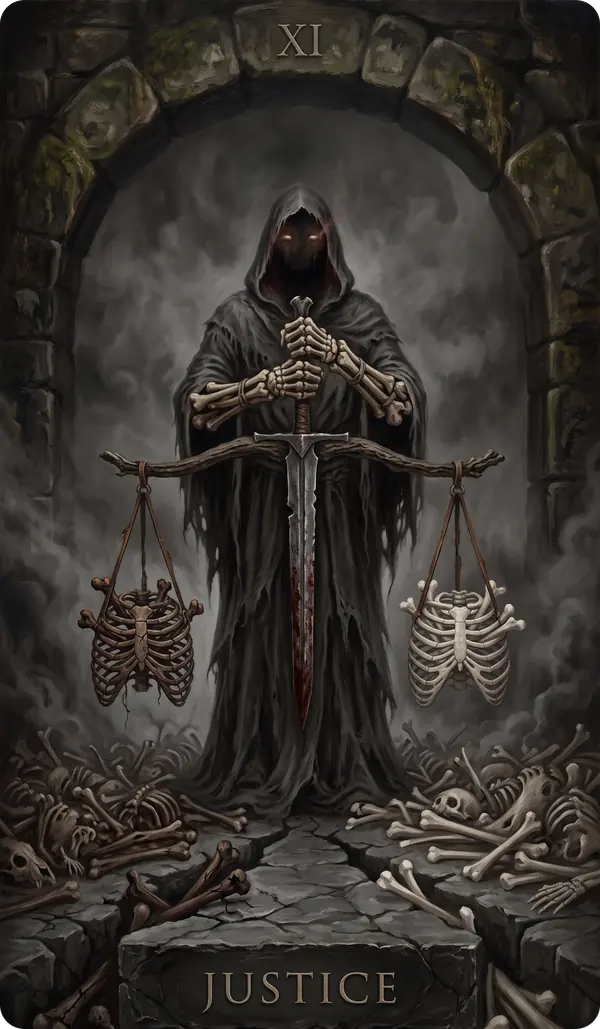 FamiliaJusticeAn honest reckoning across generations: debts and merits weighed evenly, each side receiving what it earned.
 City of WindowsJusticeChecking the facts, owning the consequences of what was done, setting fair terms.
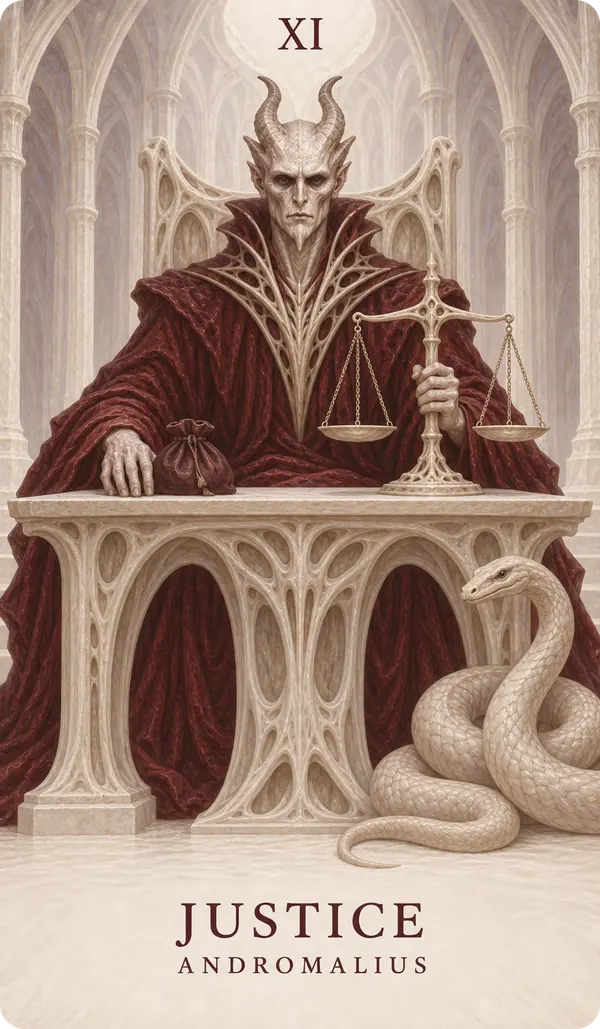 CarnalJusticeAccountability, proportion and the return of what is owed.
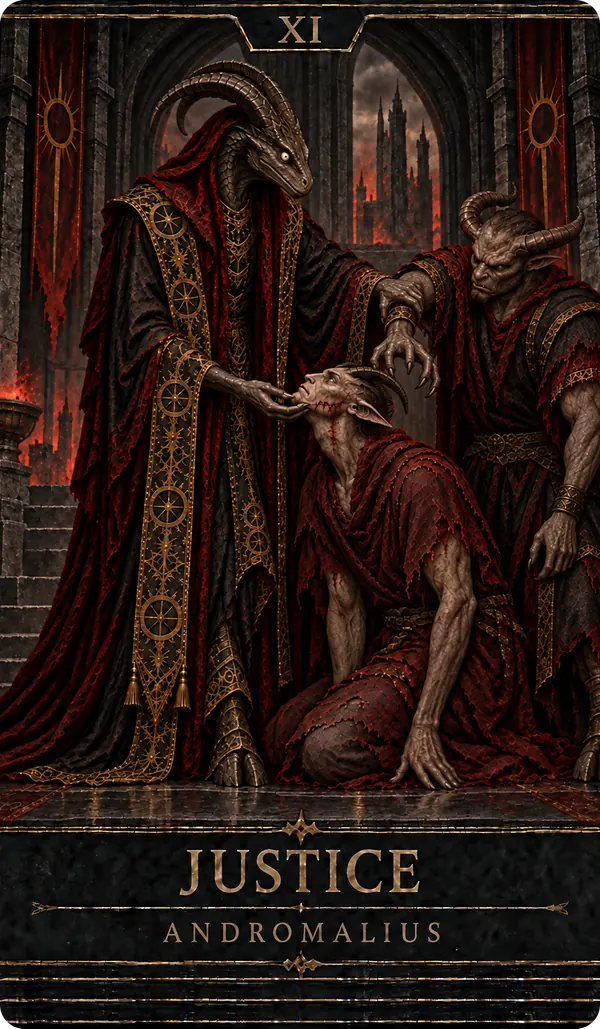 Crimson InfernoJusticeDistinguish proof from pressure.
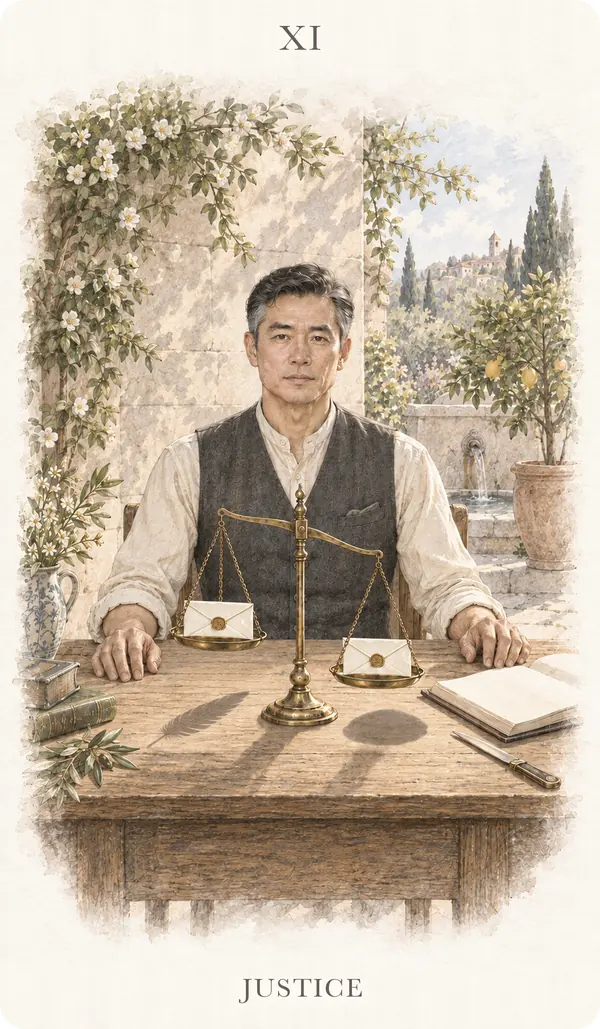 Everyday WondersJusticeClear judgment, proportion, responsibility and consequences.
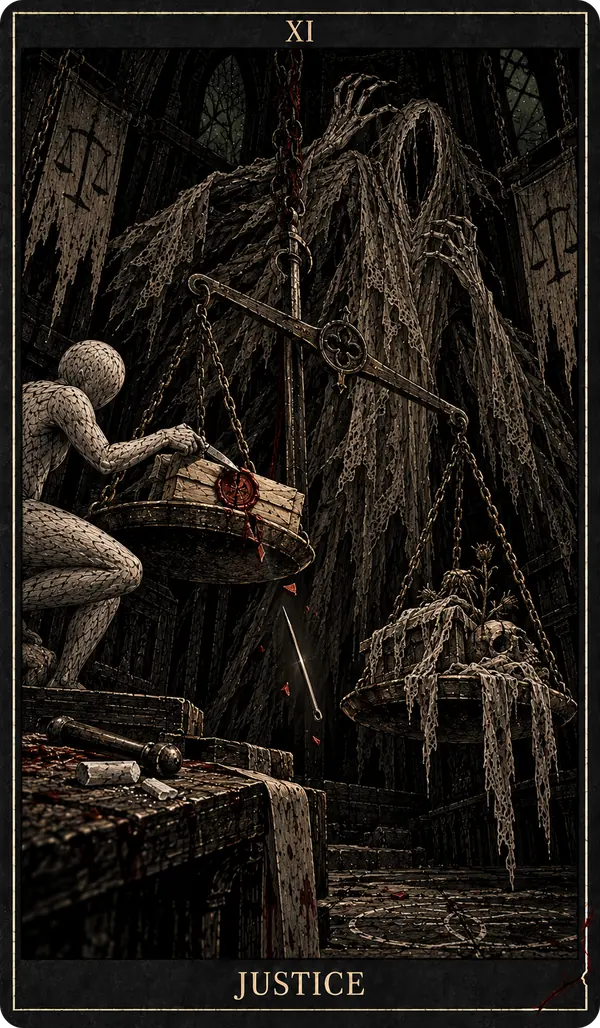 Mirror NightJusticeRevise the verdict when a hidden needle falls.
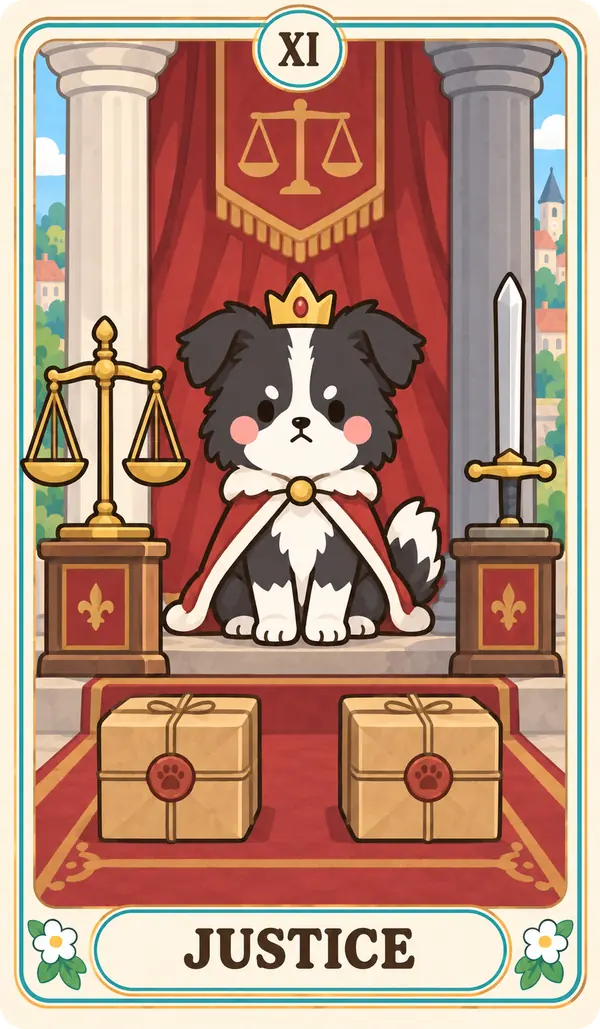 Shiba TownJusticeFairness; accountability; consequences based on facts.
 Velvet MasqueradeJusticeA fair consequence grounded in what can be checked.
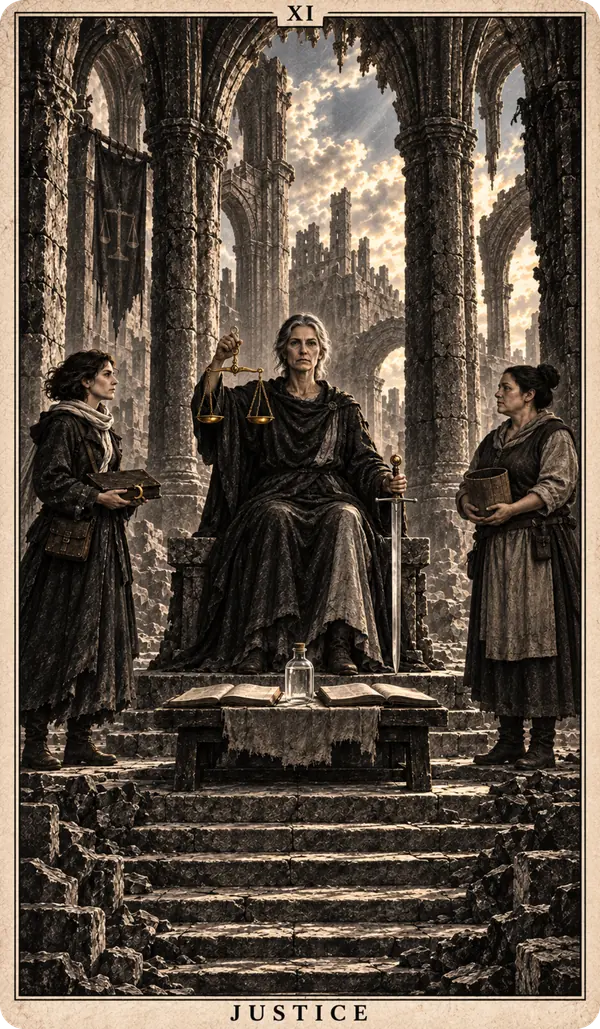 Four HorsemenJusticeExamine evidence, own your part and choose a proportionate response.
 Four TrailsJusticeFairness, truth, consequences.
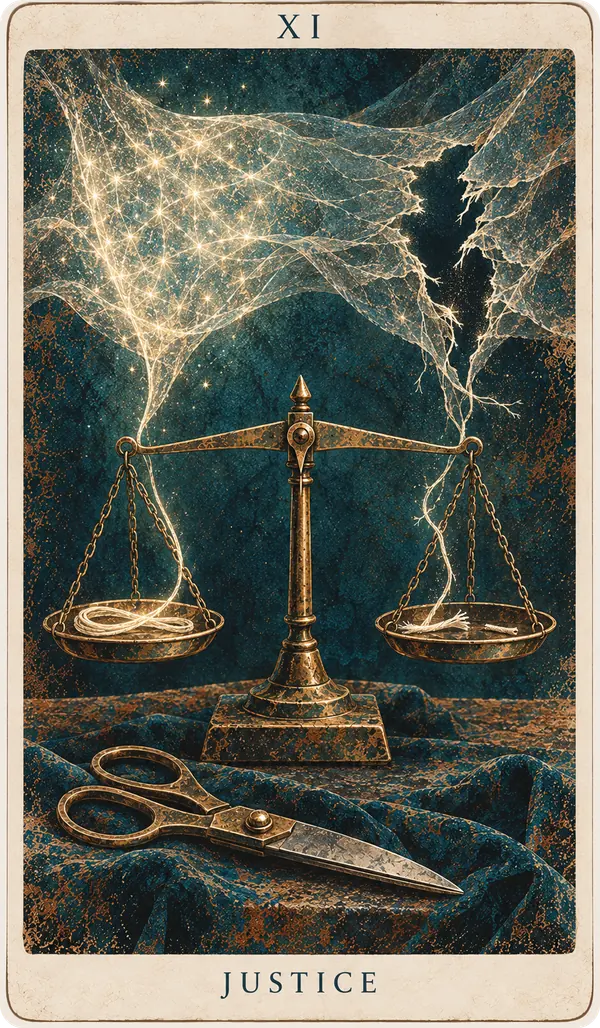 Living ThresholdJusticeThe balance reveals what a cut changes and where the fabric still needs mending.
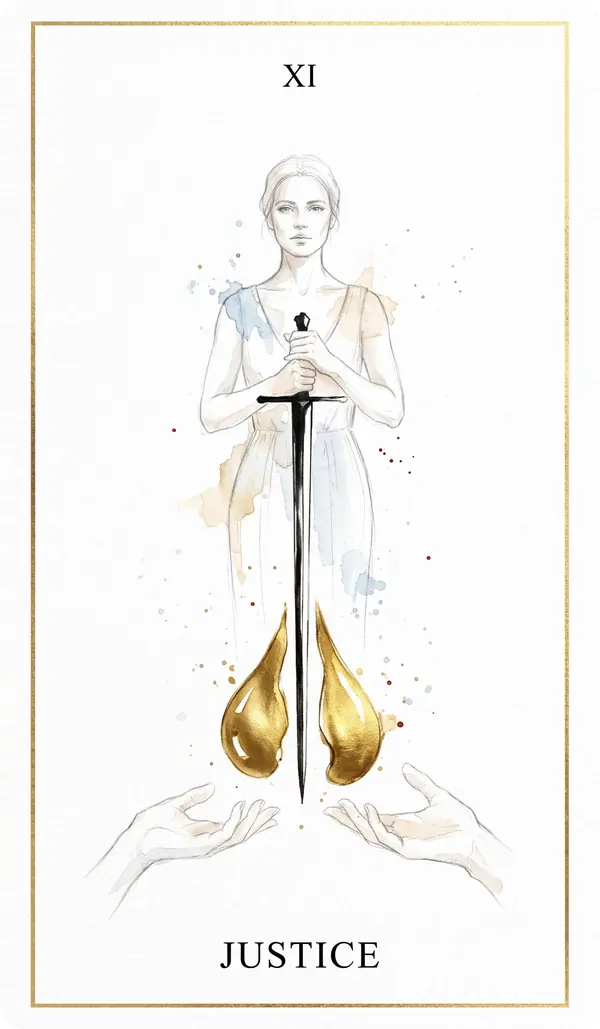 Colour of PowerJusticeAn honest cut: what was invested is counted, and the clean need not fear.
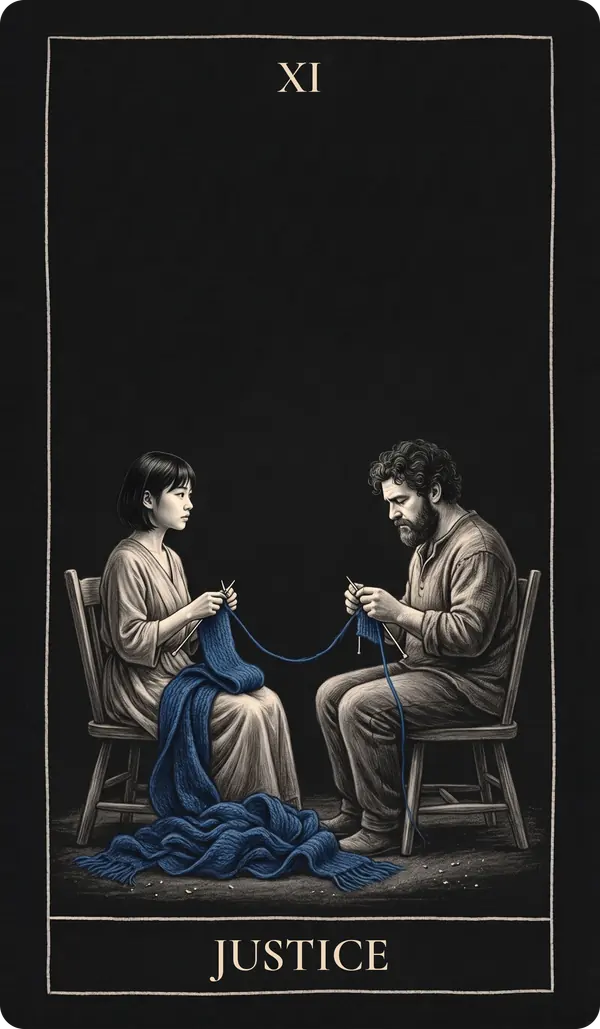 BoundJusticeAn honest count: the thread shows who has knitted how much.
 Cozy HauntJusticeAccountability and a fair boundary.
 Celestial Night SkyJusticeAn answer open to checking.
Where it appears
Questions about this card
Is Justice a yes or no card in Self Contact?
Justice upright leans mixed: the answer rests on the evidence, so weigh it fairly first. Reversed, it leans no, because the scales look tilted. List the evidence on each side and see which way it tips, then ask whether you would judge it the same way from another seat.
What does Justice mean in love?
A stone in one pan and a folded cloth in the other may ask for proportion in love. What each person gives can differ in form and still weigh the same. List what you give and what you receive in a relationship, without judging either column, and look at the beam.
What does Justice mean reversed in Self Contact?
When it lands reversed, Justice points to bias, self-excusing, or punishment that has replaced a fair assessment. The beam tilts while everyone insists it is level. Write out a disagreement from the other person’s side as fairly as you can, then compare it with your own account.