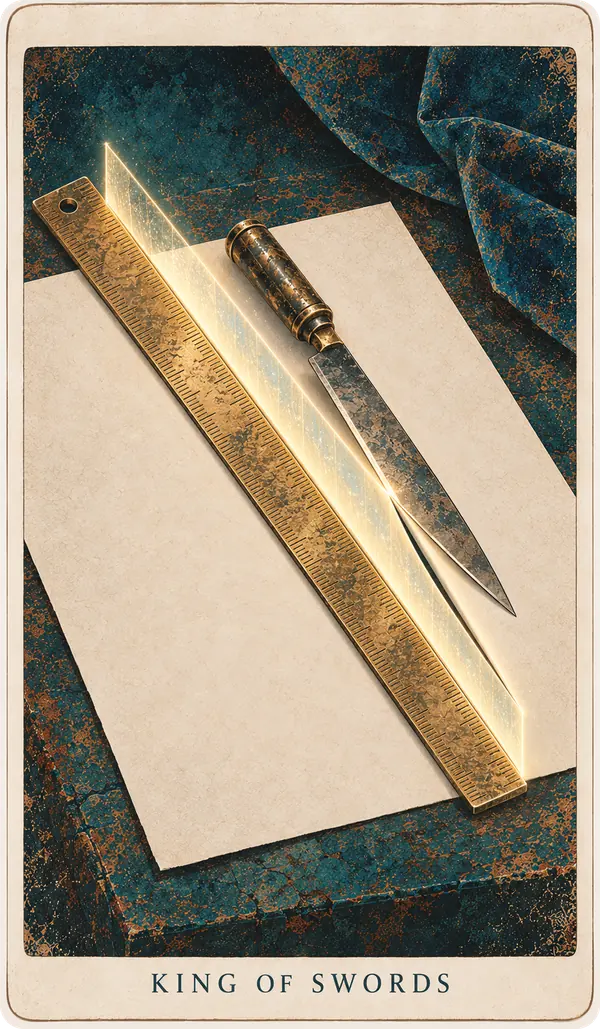
Ten of Swords
Ten of Swords in Living Threshold · Minor Arcana
ProtectionIn short
A broken method reaches its limit while useful material remains.
Reversed
Resistance to a final limit, or recovery through a different support.
- Swords
- Ten
- Air
- The Broken Knife
- an exhausted method
- useful material kept safe
Upright
Recognise when further effort with the same means has become unworkable. A way of proceeding, an argument or a role may have reached a limit it cannot bear. In protective reading, name the failed method without treating its failure as the end of every capacity. The paper knife whose blade and handle will not join again can symbolise an ending that repeated intention cannot reverse.
Stop adding clips to the break. Preserve useful material, acknowledge the cost and choose a different support for the work that remains. Intact sheets extend beyond the broken knife.
You may need to let an exhausted ward rest while sheltering what it was meant to keep safe.
A question to sit with
“Which method may have reached its end while useful work remains?”
One step
Put one reminder of a tiring protective routine in a drawer for today, and clear a quiet place to rest.
Reversed
You may resist the ending because accepting it seems to invalidate the effort already spent. The reversal can also show a first recovery once the broken tool is allowed to stop. Ask what you keep requiring of something that cannot hold, and what remains outside the failure.
A next step becomes possible when it has another support. Recovery does not need the old knife to appear whole before it can begin. The binding clips lie apart from the knife now.
You may be able to lift one weight from a tired doorway before choosing how to mend its protection.
A question to sit with
“Can I let this worn-out way rest while keeping what it was meant to protect?”
One step
Lay a clean sheet over your table and write one gentler way to shelter the part that still matters.
How this deck reads reversed cards
Reversed, the living things work against the grain. An opening jams, a ward is pulled too tight, a lining has worn thin from long service, or a capacity that went quiet starts to come back. What changes is how the boundary does its work: a shelter may need loosening, a channel a gentler flow.
In love
An exhausted way of handling closeness may need rest while the useful paper of the bond is sheltered.
- Supports
- Keeping warmth outside a failed argument.
- Watch for
- Repeating the same exchange in hope that its broken join will hold.
- One step
- Pause a tiring topic for today and agree on a quiet time to return.
A bond may find room to breathe when one exhausted argument rests, or keep circling the broken join.
- Supports
- Warmth that does not require the old exchange to restart.
- Watch for
- Making closeness depend on proving the worn-out way still works.
- One step
- Offer one ordinary kindness without reopening the tiring topic.
At work
A way of working may have broken at its join, like a paper knife snapped in two, while useful work remains around it.
- Supports
- Another person’s help with what survives.
- Watch for
- Adding more weight to the same worn-out method.
- One step
- Set one unsuccessful attempt aside and ask for a different way to approach the task.
Work may begin to recover through a different support, though past effort can keep calling for another try.
- Supports
- A lighter way to hold the remaining task.
- Watch for
- Starting a new attempt under the same weight.
- One step
- Write what remains useful and ask a colleague how it could be carried differently.
An option that needs the broken knife to hold again may have little room to carry you.
- Supports
- Choosing from the intact material nearby.
- Watch for
- Treating past effort as a reason to add another clip to the broken knife.
- One step
- Write one alternative that uses what is still sound without repeating the failed approach.
A fresh option may be nearby while the old knife keeps drawing your choice back to its break.
- Supports
- A path built from intact material.
- Watch for
- Choosing only to make earlier effort seem worthwhile.
- One step
- Put the old approach on one page and a new small attempt on another, then leave both overnight.
The broken join may let you name a limit without calling the whole tabletop lost.
- Supports
- Rest for one exhausted way of protecting yourself.
- Watch for
- Trying to make one failure speak for every capacity.
- One step
- Name one ability that remains and give it a quiet place in today’s plans.
Recovery may begin when the worn-out ward can rest without proving it was ever useless.
- Supports
- Keeping what you learned beyond the failed join.
- Watch for
- Turning a first easing into another heavy weight on yourself.
- One step
- Write one thing the old effort taught you and let the effort pause today.
A tired household routine may need another support while the care behind it stays worth keeping.
- Supports
- Protecting the useful sheets of shared care.
- Watch for
- Asking one person to carry one more load the same old way, like another clip on a broken knife.
- One step
- Ask a family member to help you try a simpler version of one shared task today.
Gentler care at home may continue once an exhausted routine is allowed to stop.
- Supports
- Lifting one clip from a shared load.
- Watch for
- Treating a changed household task as the loss of all its warmth.
- One step
- Tell someone which part of a tiring routine you want to keep and which part needs a pause.
Yes or no
NoMixedThe broken join cannot bear another clip, so continuing by the same means leans no.
Supports
- Useful paper may remain safe beyond the broken join.
- Another support may let protection continue in a gentler form.
Limits
- The same broken paper knife may be unable to carry one more weight.
- Repeated attempts at the old join may draw care away from what survives.
One step
Pause one tiring attempt and name what you still want to shelter.
A different support may become possible once the knife rests, while resistance can keep the old weight in place, so the answer is mixed.
Supports
- Lifting one fallen binding clip may let recovery begin without restoring the old knife.
- Unbroken material may be ready for a different kind of ward.
Limits
- Past effort may keep calling you back to a join that will not hold.
- A first moment of relief may be rushed into another heavy routine.
One step
Name one weight you can set down today and ask for a smaller way to keep what matters safe.
What is in the picture
A broken paper knife lies among fallen binding clips. Blade and handle have separated. A faint joining line tries to form between them, then parts again; the damaged structure cannot hold it.
Surrounding paper remains usable. The work could continue with another tool, but this knife cannot carry another weight. The broken structure cannot sustain a renewed join. Usable material remains around it for a different way to work.
- broken paper knife
- separated blade and handle
- fallen copper binding clips
- faint light between the broken ends
- usable ivory sheets
This card in other decks
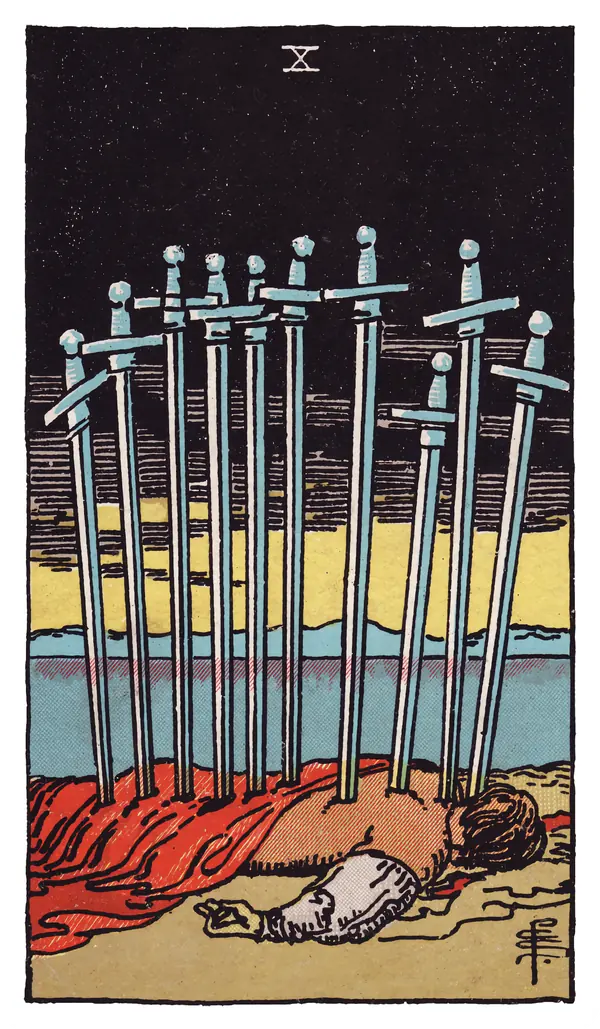 Rider–Waite–SmithTen of SwordsA painful ending may feel like rock bottom, though the dawn on the horizon shows the night is not the whole scene.
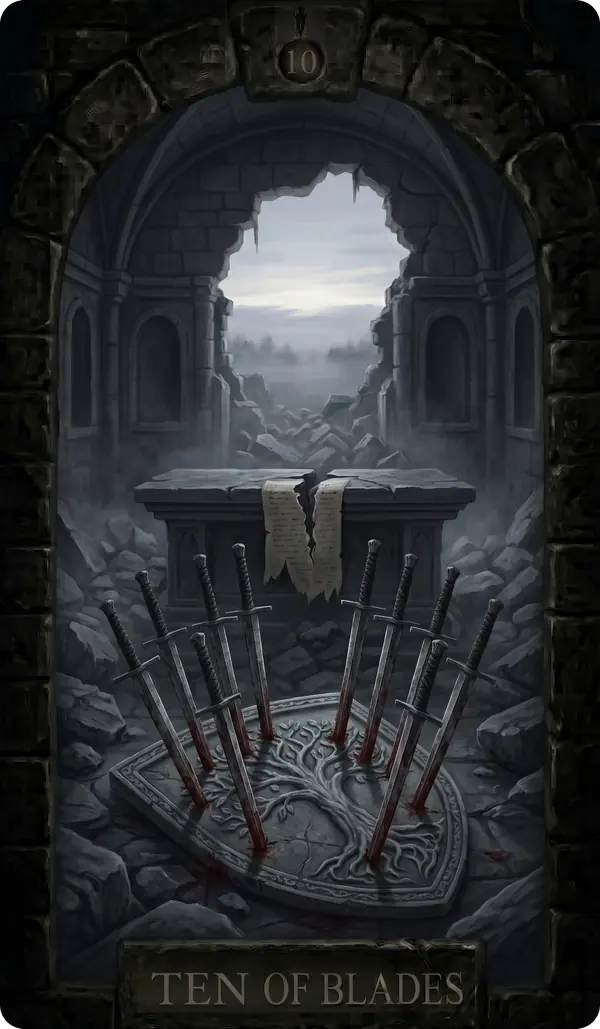 FamiliaTen of BladesThe old order has fallen completely, and there is relief in that: nothing is left to hold, and a new law can begin.
 City of WindowsTen of SwordsAcknowledging the end of an old form of the relationship and following through on your own decision.
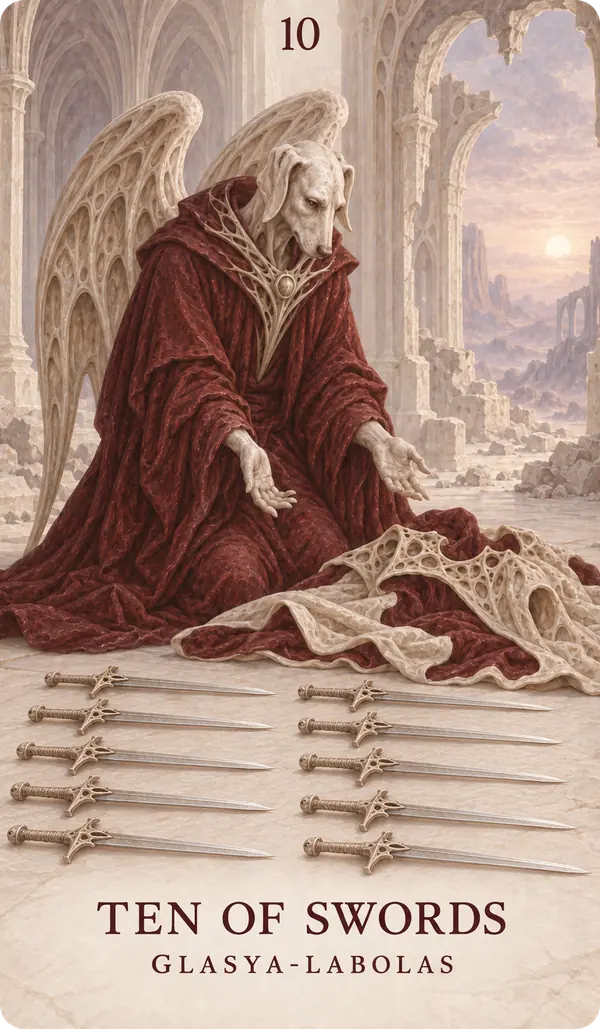 CarnalTen of SwordsA damaging pattern reaches its limit.
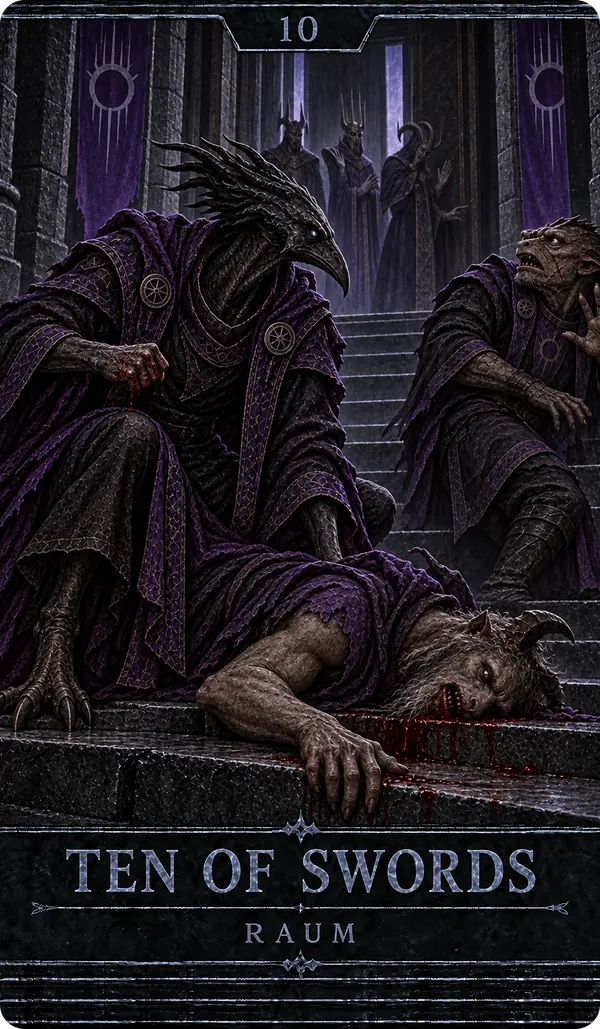 Crimson InfernoTen of SwordsAcknowledge the ending instead of spending more strength defending what has failed.
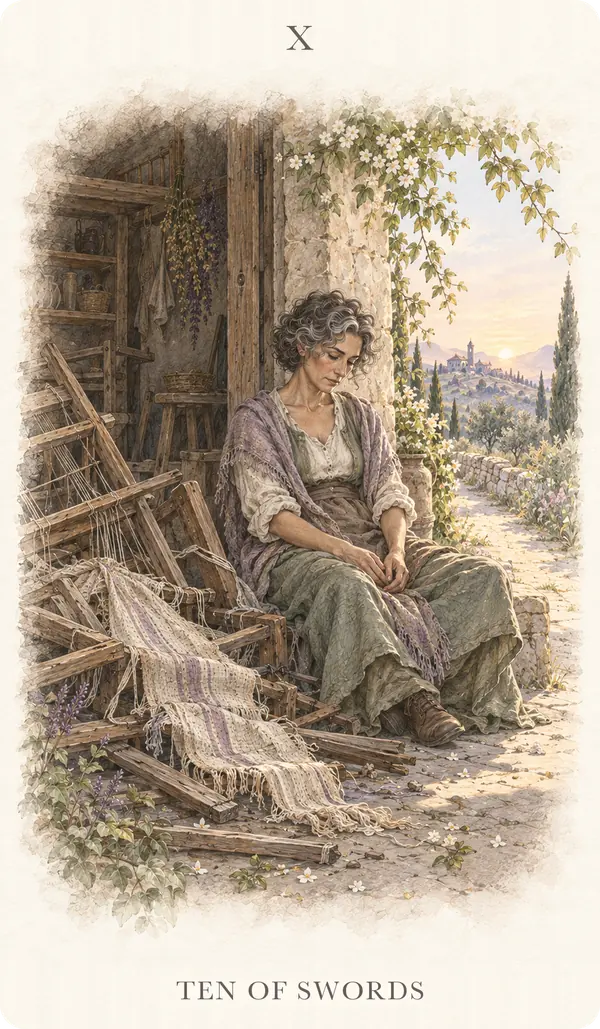 Everyday WondersTen of SwordsA definite ending that more effort alone will not repair.
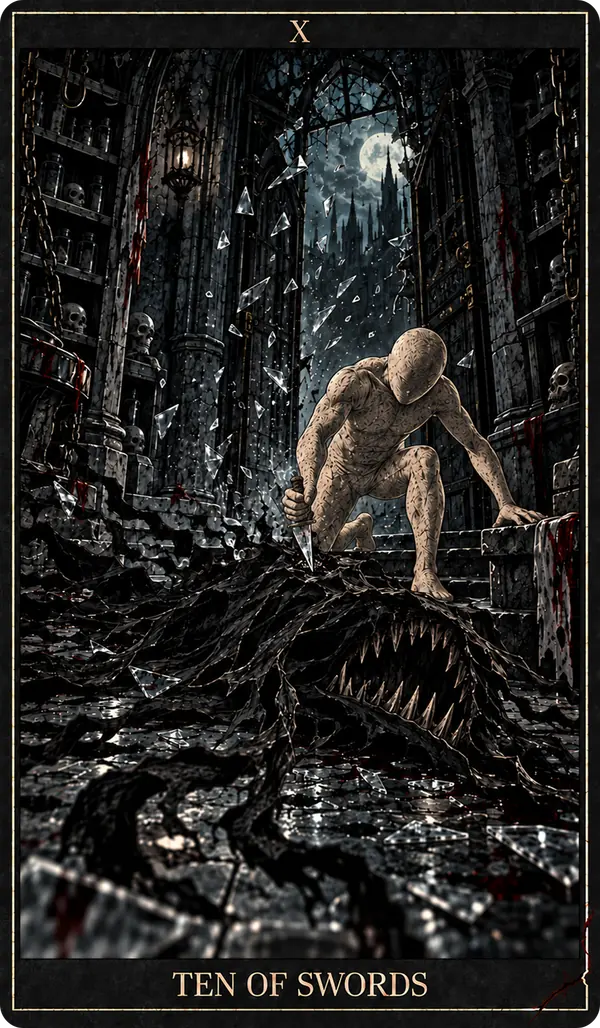 Mirror NightTen of SwordsFinish without denying the cost.
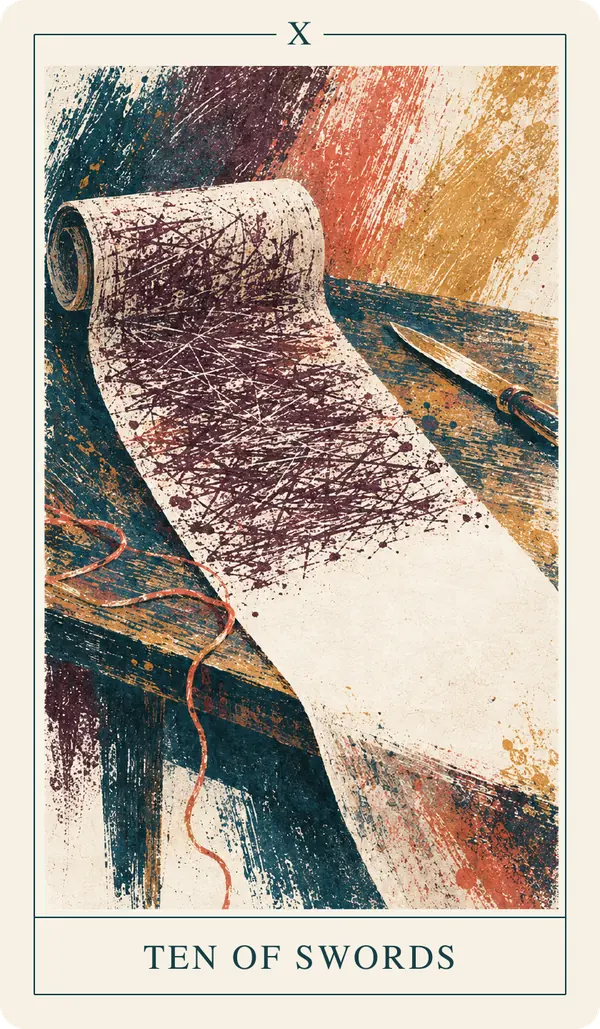 Self ContactTen of SwordsAn exhausted pattern may have reached its end; acknowledge completion.
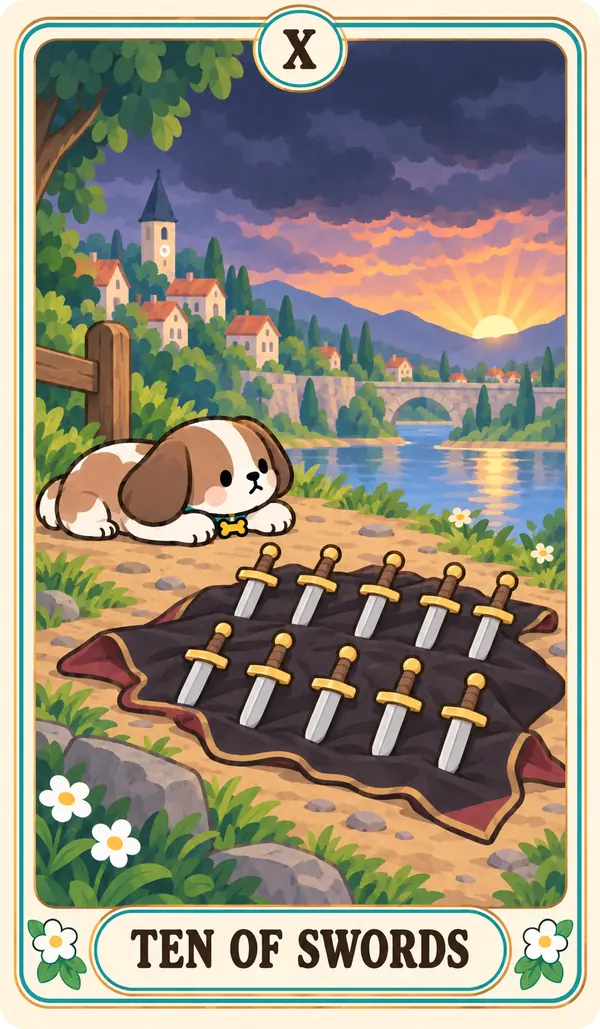 Shiba TownTen of SwordsA painful ending; the limit reached; no need to continue the struggle.
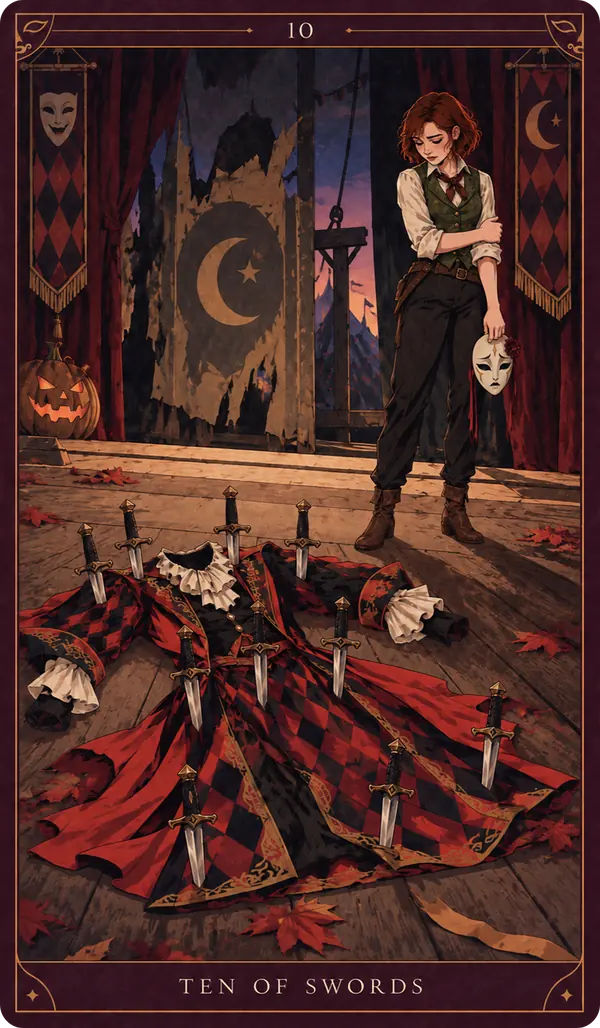 Velvet MasqueradeTen of SwordsA painful ending at the limit of a role.
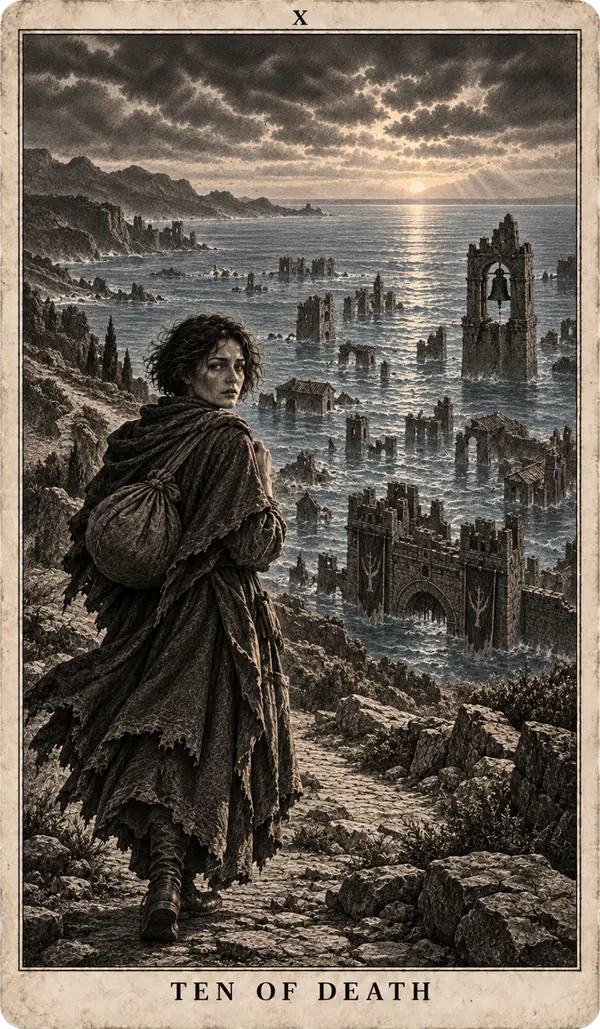 Four HorsemenTen of DeathStop asking the ended world to resume; take the next real step.
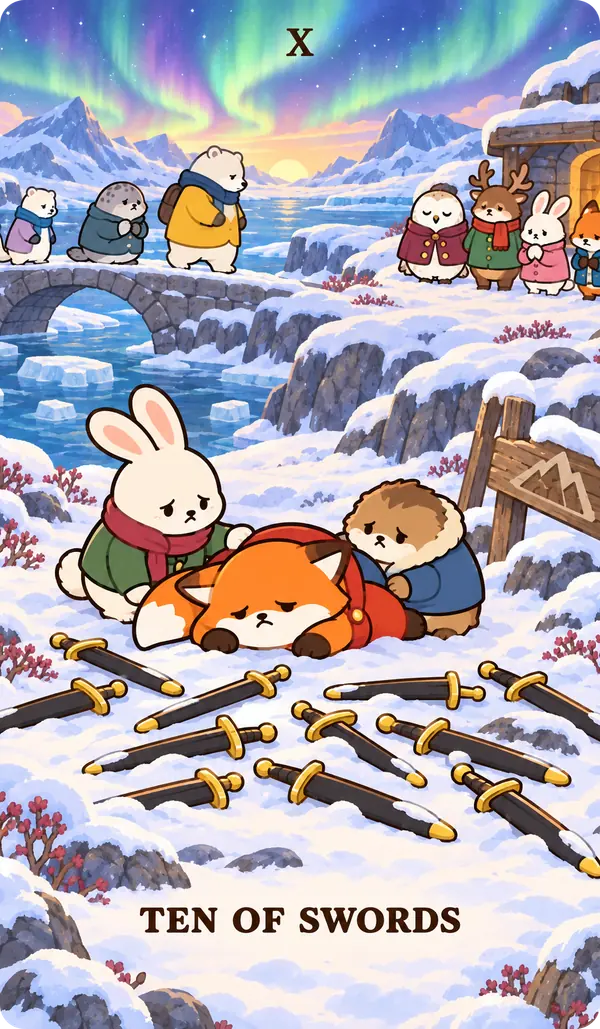 Four TrailsTen of SwordsPainful ending, exhaustion, lowest point.
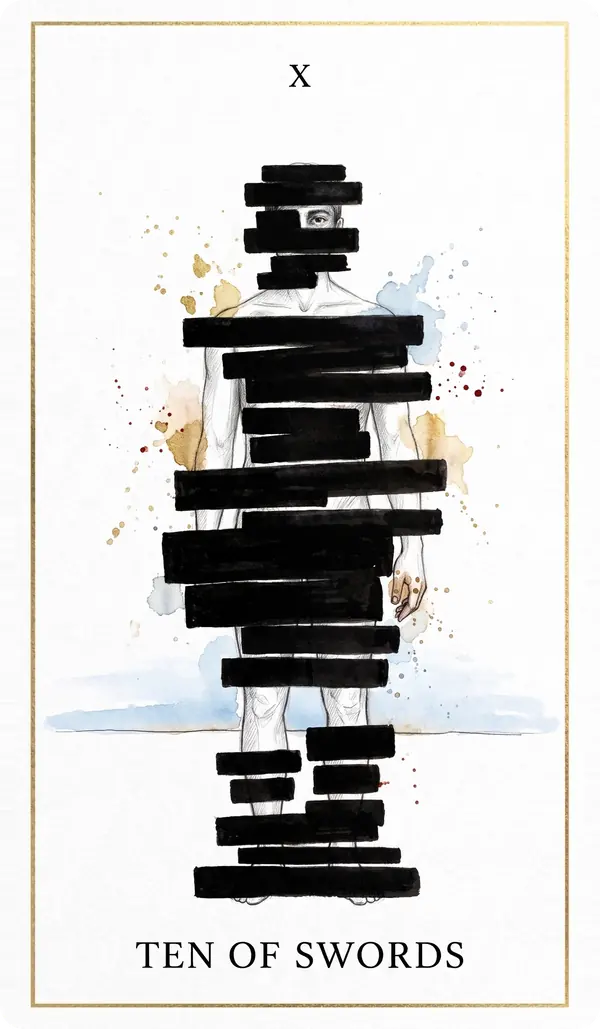 Colour of PowerTen of SwordsThe story is finished: you have been crossed out, and only up remains.
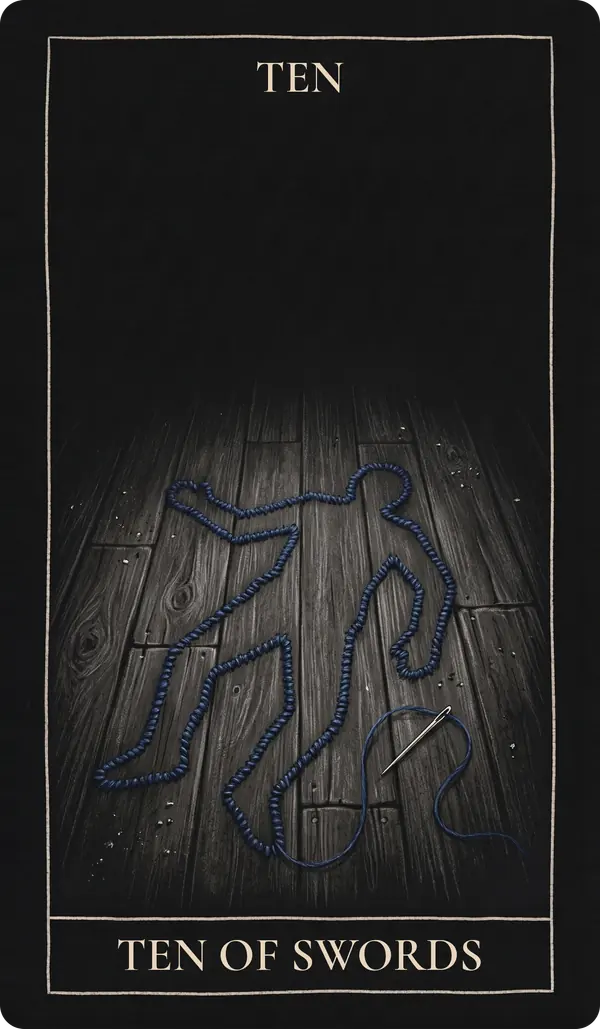 BoundTen of SwordsThe last word has been spoken; the body is gone, only the seam remains.
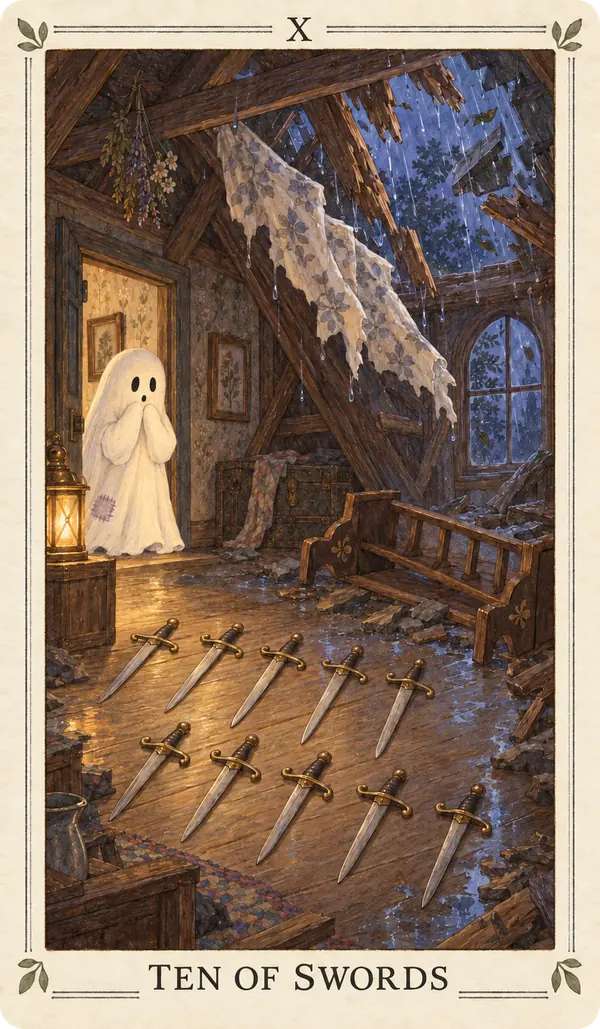 Cozy HauntTen of SwordsAdmit an ending and make the next place safer.
 Celestial Night SkyTen of SwordsThe end of a wrong account.
Where it appears
Questions about this card
Is Ten of Swords a yes or no card in The Living Threshold Tarot?
Ten of Swords leans no upright to continuing by the same broken means. The separated knife cannot hold another clip. Reversed, the answer is mixed as another support becomes possible or the old weight stays in place. Pause one tiring attempt and ask for a smaller way to shelter what still matters to you.
What does Ten of Swords mean for protection and boundaries?
The broken join may point to a protective method that has reached its limit. Paper and separate clips remain available around it, leaving care somewhere else to begin. Let the exhausted tool rest. Name what you still wish to shelter and put one extra weight aside before choosing a different small act of tending.
What does Ten of Swords mean reversed in The Living Threshold Tarot?
Resistance to an ending may keep weight on the broken join when Ten of Swords is reversed. The card may also show room for recovery once that method rests. Give the next act another support. Ask for help with a smaller way to keep what matters sheltered and leave one exhausted attempt quiet today.