Ten of Swords
Ten of Swords in Crimson Inferno · Minor Arcana
ConflictIn short
Acknowledge the ending instead of spending more strength defending what has failed.
Reversed
Slow recovery after defeat, or prolonging a dead arrangement.
- Swords
- Ten
- Air
- The Silenced Messenger
- defeat
- ending
- the point beyond denial
Upright
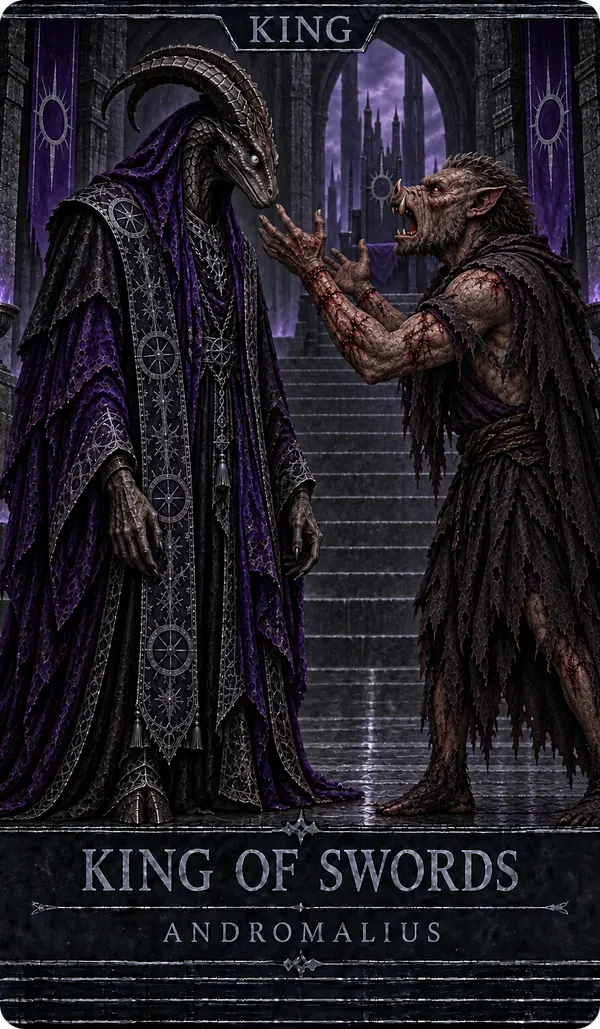
Raum kills the lower-court messenger on the tribunal steps to stop any more testimony. The ending has to be admitted, and strength kept for what comes after instead of spent defending what has already failed.
Survival starts from an exact sense of the limit.
A question to sit with
“What can no longer be restored, and what remains possible after that admission?”
One step
Write one plain sentence that names what can no longer be restored, and under it one thing still in your hands.
Reversed
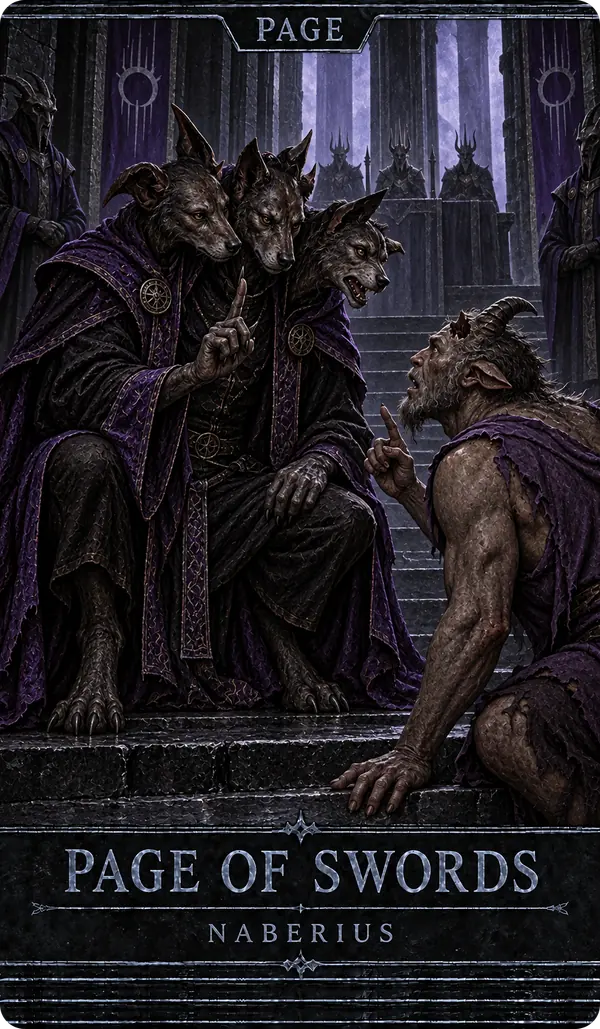
Raum kills to stop a testimony, yet Naberius still remembers the account. Reversed, recovery after defeat comes slowly, or a dead arrangement is kept going because the finality feels unbearable.
The death still has to be named, not covered over by a hopeful ending.
A question to sit with
“Can I start the slow climb back, or am I propping something up because letting it end feels unbearable?”
One step
Pick one arrangement you keep patching and write what holding it up costs you each week.
How this deck reads reversed cards
Reversed, a card may show excess, blockage, a hidden price or a hard release, and it is rarely a simple opposite. In the basalt city an upright card can already show a power through its misuse, and turning it over softens nothing in the picture. A mark may loosen or bite deeper, and the city does not promise which.
In love
Raum makes sure the messenger never reaches the hearing room; the open hand falls short of the threshold. In love, some hope may be past restoring, and saying so may be where honesty starts.
- Supports
- Admitting the limit without blame.
- Watch for
- Spending more strength on what cannot come back.
- One step
- Write, for yourself only, what you know can no longer be restored.
In love, recovery may be slow, or an arrangement may be kept going because its end feels unbearable.
- Supports
- Allowing recovery its own pace.
- Watch for
- Keeping a hollow arrangement alive out of dread.
- One step
- Write what keeping it going costs you, and what it still gives.
At work
At work, a plan or position may have met its end, and defending it longer may cost more strength.
- Supports
- An accurate account of what failed.
- Watch for
- Silence from those who saw what happened.
- One step
- List what is still in your hands after the loss.
As Raum turns from the body, an official in the doorway shields their face. At work, people may look away from an ending and keep propping up a project that seems to have stopped working.
- Supports
- Small, steady returns of energy.
- Watch for
- Patching a failed plan to avoid the final word.
- One step
- Check one ongoing task against the question of whether you would start it today.
One option may be gone for good, and the real choice may be what to do after admitting it.
- Supports
- Taking the lost option off the table.
- Watch for
- Choosing as if it were still possible.
- One step
- Cross out the option that cannot come back, and look at what is left.
The choice may lie between slow recovery and keeping something going for fear of finality.
- Supports
- Letting the ending be named.
- Watch for
- Choosing the familiar because the final word feels too heavy.
- One step
- Write the final word you are avoiding on paper, without acting on it.
Growth may begin at the point beyond denial, with an accurate limit.
- Supports
- Grief given its time.
- Watch for
- Hurrying past the ending.
- One step
- Give yourself one quiet hour to name what was lost.
Growth may be slow here, a return after defeat that takes its own time.
- Supports
- Noticing each small return of strength.
- Watch for
- Measuring yourself against how fast you think you should recover.
- One step
- Note one thing you can do today that you could not do a month ago.
Raum turns sharply on the corridor guard who saw the killing. At home, something may be past repair, and someone may be leaning on those who would say so out loud.
- Supports
- One person who names it.
- Watch for
- Relatives backing away instead of looking.
- One step
- Write down what you saw, for yourself, in plain words.
Recovery at home may be slow, or everyone may be holding on to an arrangement no one can bear to end.
- Supports
- Letting each person grieve at their own pace.
- Watch for
- Keeping up appearances around what no longer works.
- One step
- Ask one relative, gently, how they are really doing with it.
Yes or no
NoNoWhat you ask about may be past restoring, so the answer leans no; what comes after the admission is a separate question.
Supports
- Admitting the limit can free strength for what survives.
- An accurate account of the ending may be where survival starts.
Limits
- What failed may not come back however hard it is defended.
- Silence and looking away may be part of the picture.
One step
Ask yourself what you are still defending that cannot be restored.
Holding on to what no longer works may be costing more than it gives, so the answer leans no while it is propped up.
Supports
- Recovery may be under way, slowly.
- Naming the ending could release trapped strength.
Limits
- A finished arrangement may be kept going out of dread.
- Recovery may be slower than you want.
One step
See whether you are keeping something going only because ending it feels unbearable.
What is in the picture
Raum crouches over the dead lower-court messenger on the tribunal steps, withdrawing an abraded fist from beside the victim’s collapsed jaw. The victim’s open hand has fallen short of the hearing-room threshold; the body is limp, with blood on the mouth and stone. Raum turns sharply toward the corridor guard who has seen the killing. Officials pull back into the doorway, one shielding their own face.
The silencing and the witnesses’ retreat are unmistakable. Raum kills the messenger to prevent further testimony, with the corridor guard present. Naberius preserves the earlier account; the guard later describes the killing.
- crested raven head with a heavy beak
- abraded fist withdrawn
- messenger fallen across the steps
- open hand short of the threshold
- blood on the stone
- corridor guard recoiling with a raised hand
- officials drawing back into the doorway
- sun-disc banners
This card in other decks
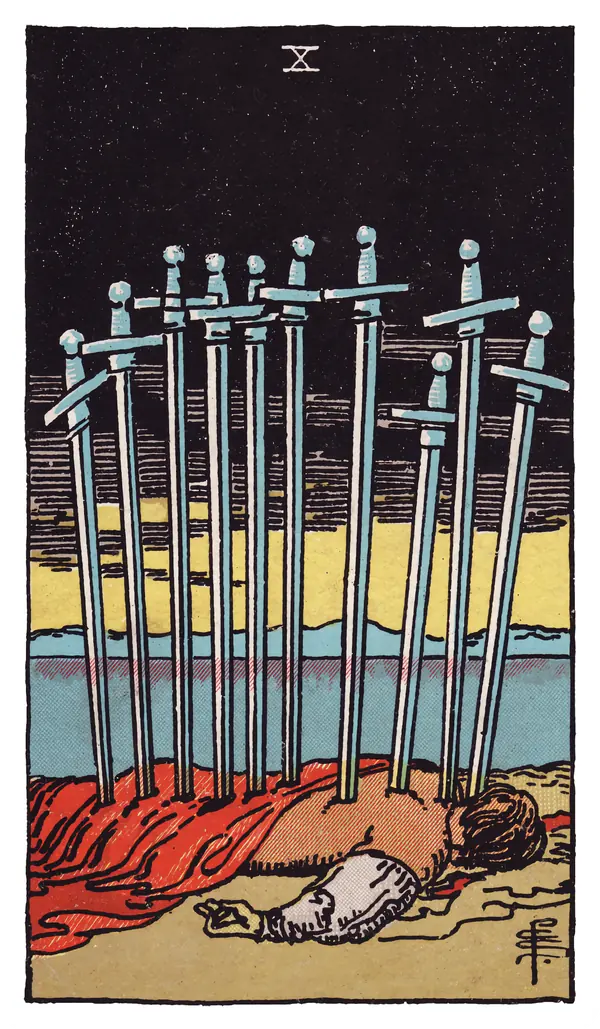 Rider–Waite–SmithTen of SwordsA painful ending may feel like rock bottom, though the dawn on the horizon shows the night is not the whole scene.
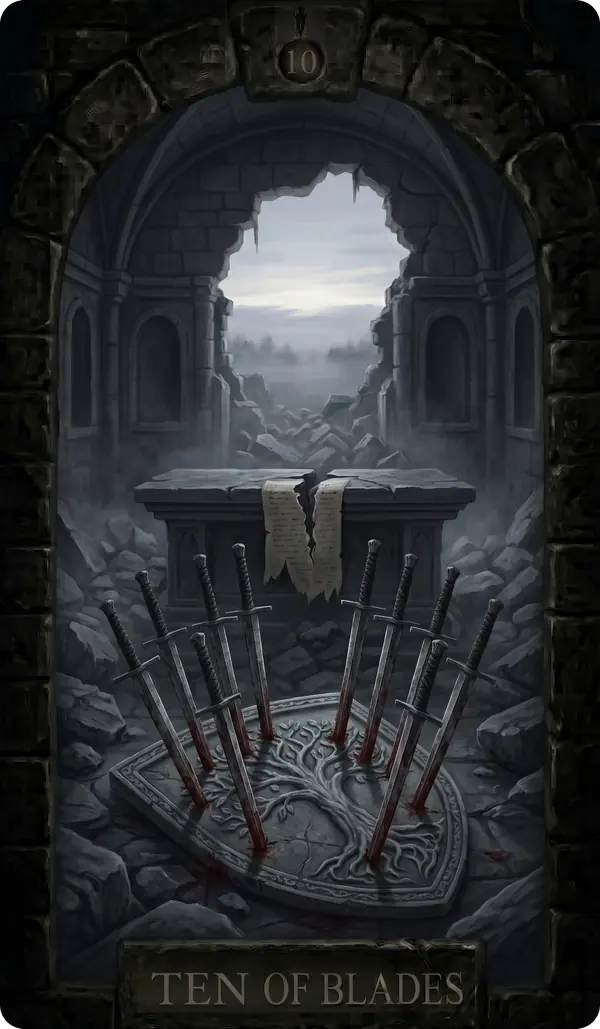 FamiliaTen of BladesThe old order has fallen completely, and there is relief in that: nothing is left to hold, and a new law can begin.
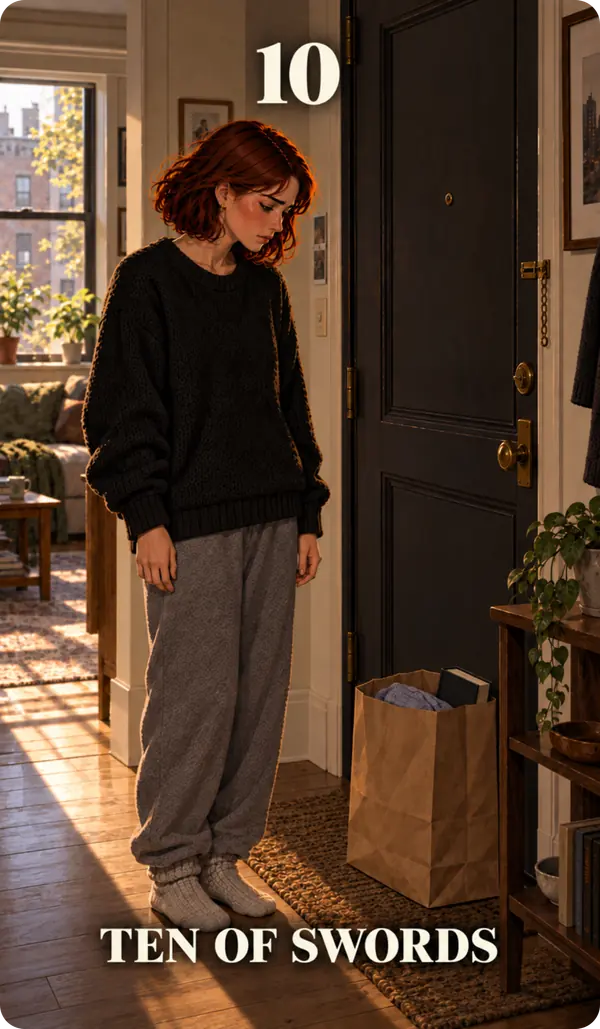 City of WindowsTen of SwordsAcknowledging the end of an old form of the relationship and following through on your own decision.
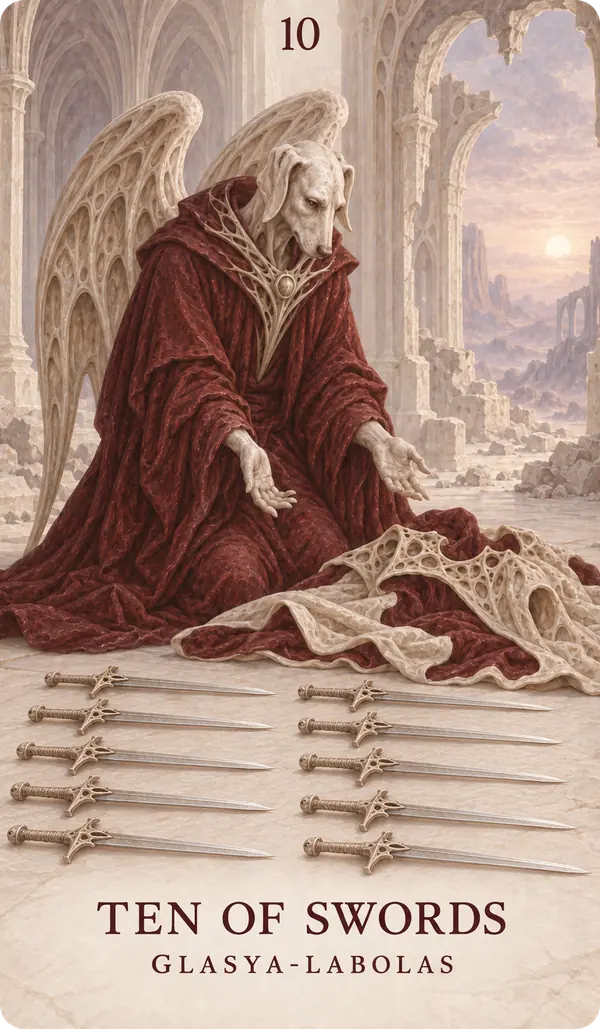 CarnalTen of SwordsA damaging pattern reaches its limit.
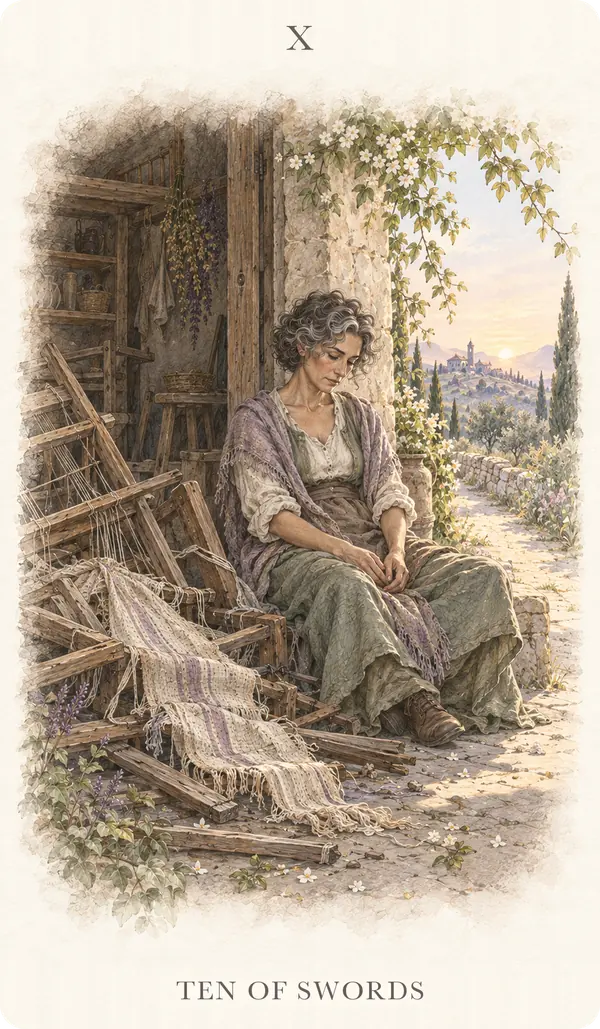 Everyday WondersTen of SwordsA definite ending that more effort alone will not repair.
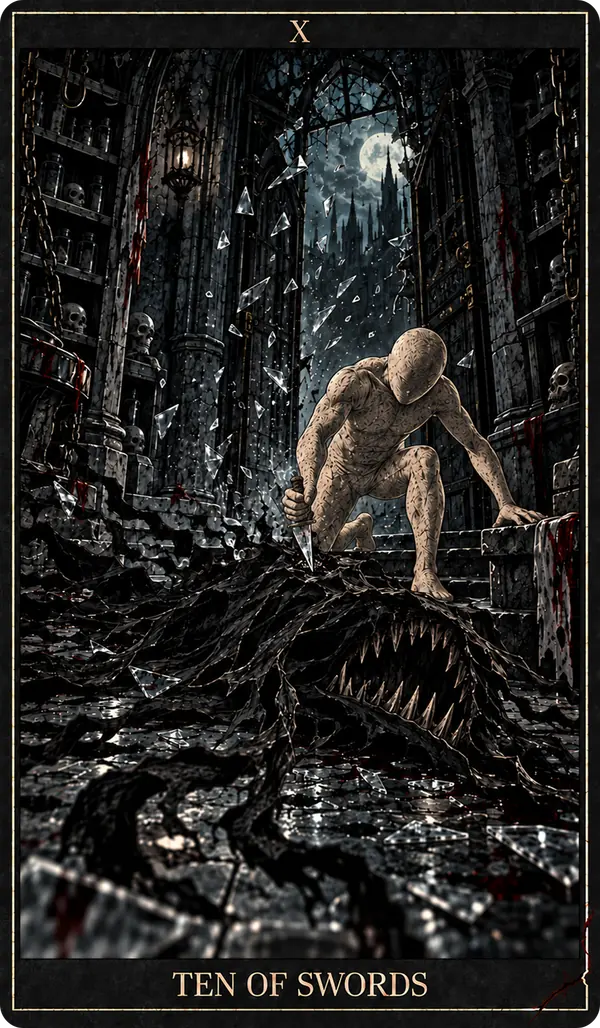 Mirror NightTen of SwordsFinish without denying the cost.
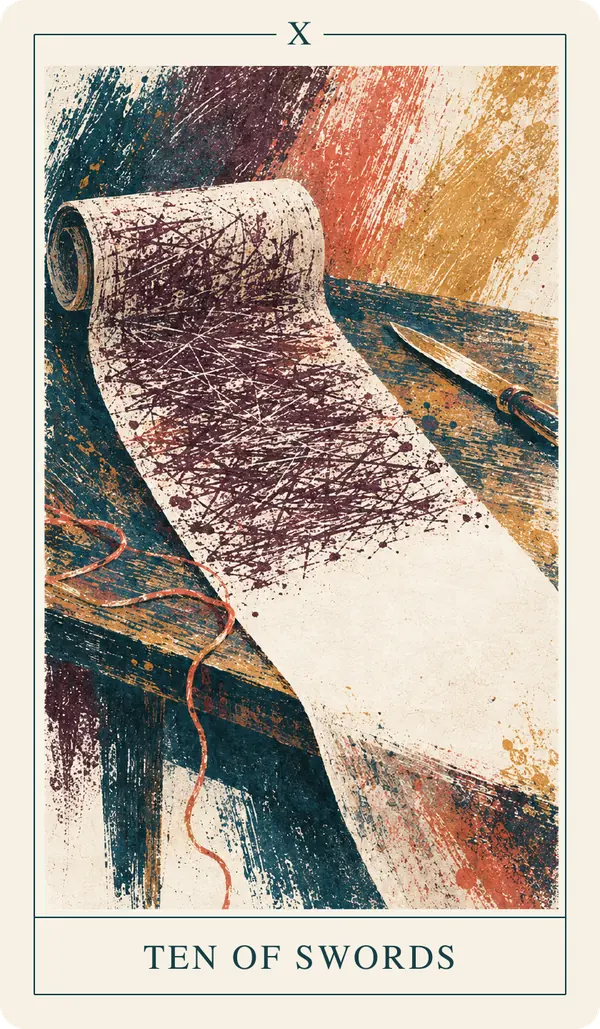 Self ContactTen of SwordsAn exhausted pattern may have reached its end; acknowledge completion.
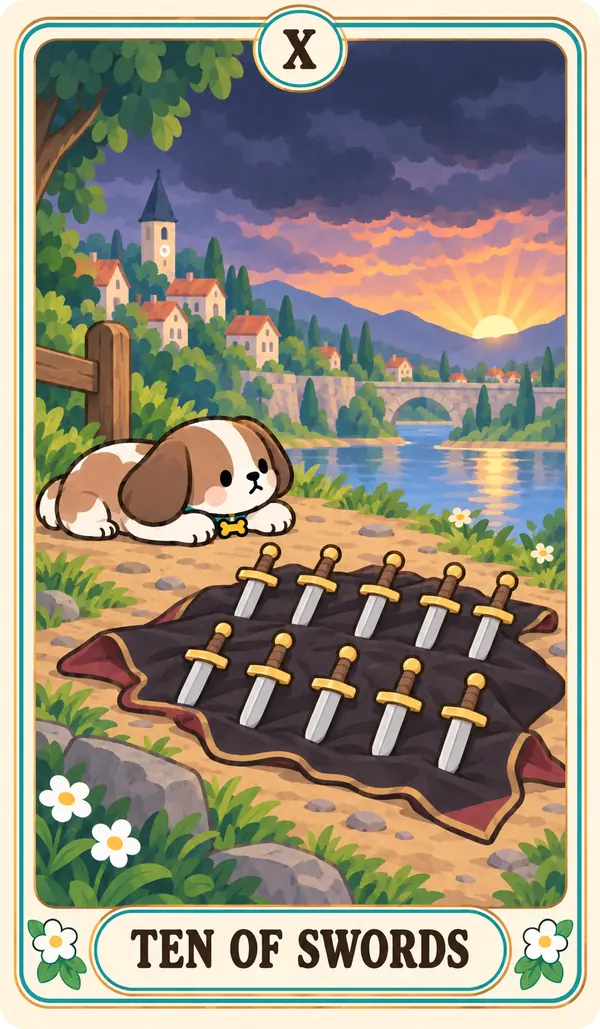 Shiba TownTen of SwordsA painful ending; the limit reached; no need to continue the struggle.
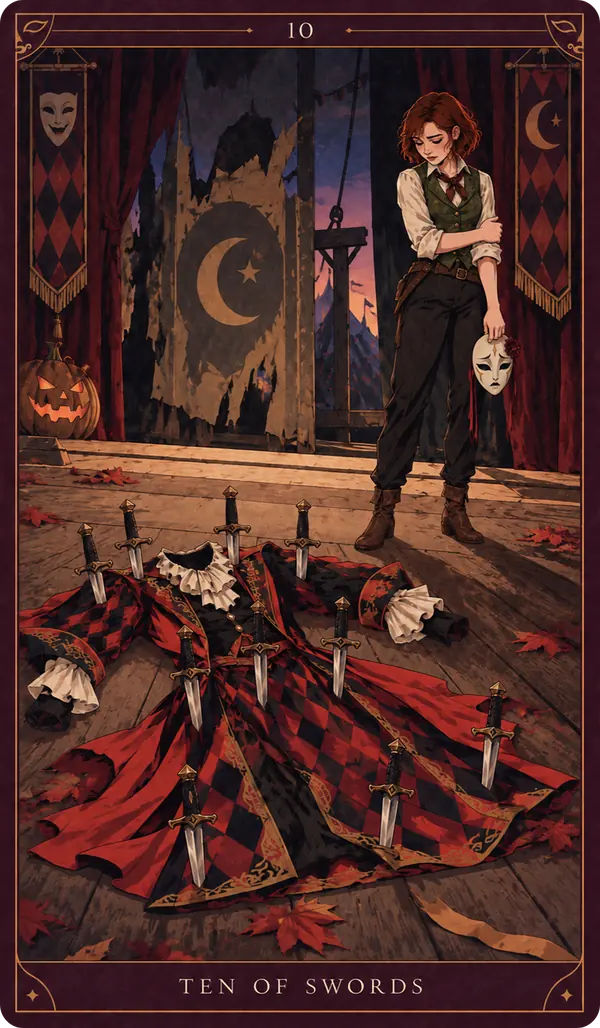 Velvet MasqueradeTen of SwordsA painful ending at the limit of a role.
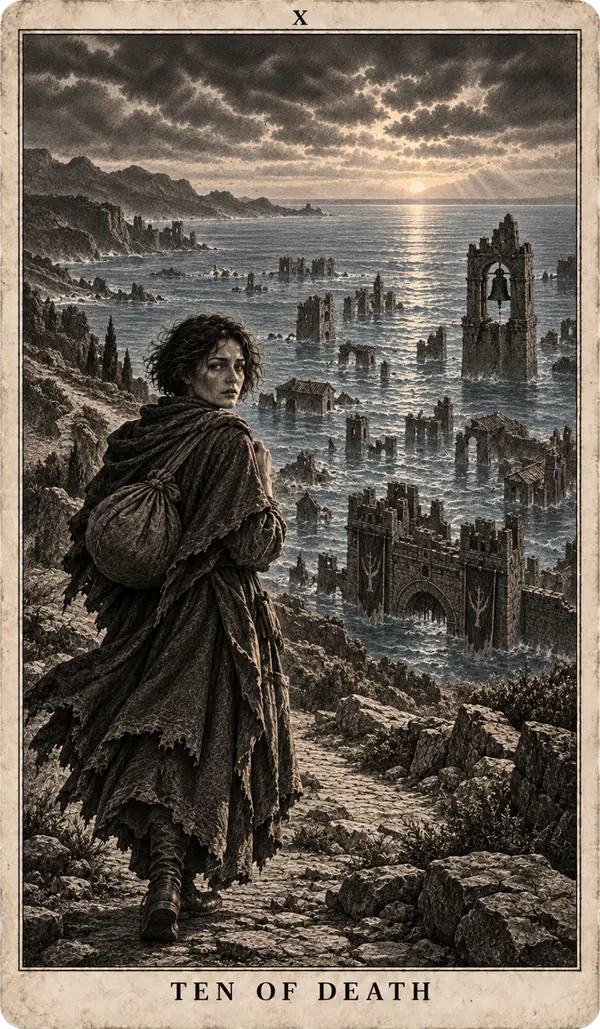 Four HorsemenTen of DeathStop asking the ended world to resume; take the next real step.
 Four TrailsTen of SwordsPainful ending, exhaustion, lowest point.
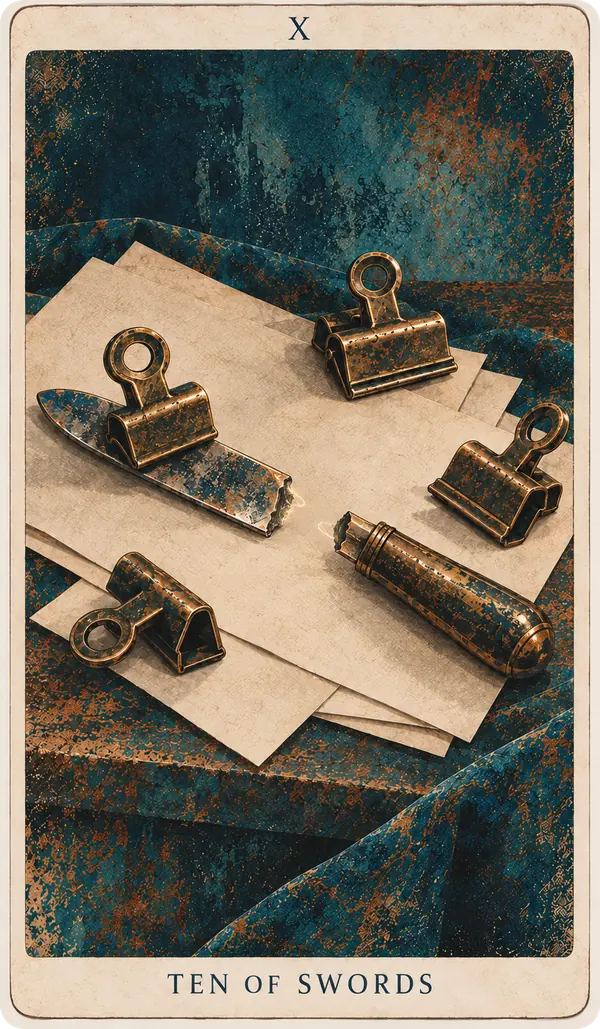 Living ThresholdTen of SwordsA broken method reaches its limit while useful material remains.
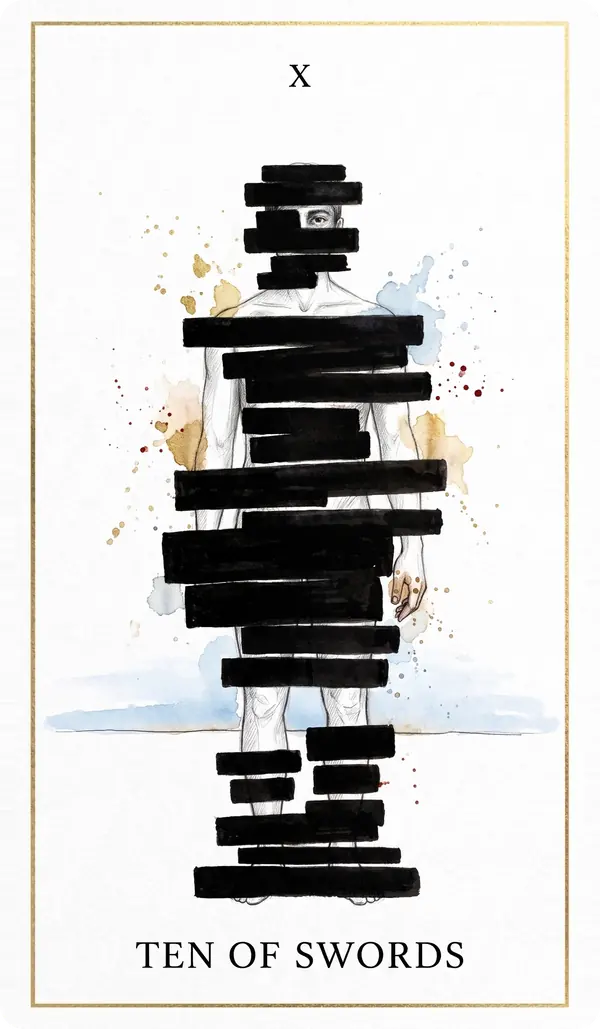 Colour of PowerTen of SwordsThe story is finished: you have been crossed out, and only up remains.
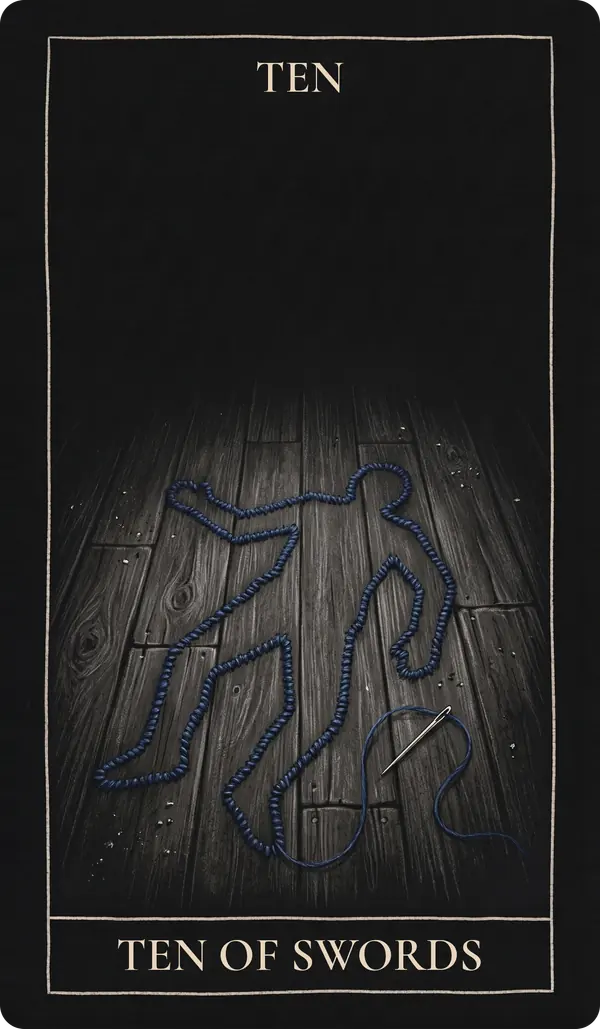 BoundTen of SwordsThe last word has been spoken; the body is gone, only the seam remains.
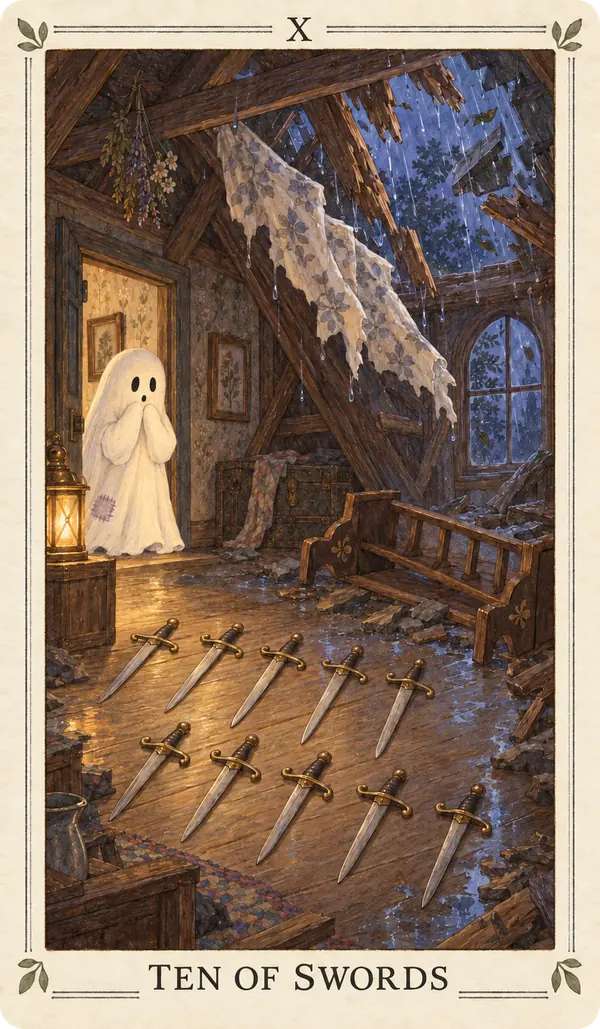 Cozy HauntTen of SwordsAdmit an ending and make the next place safer.
 Celestial Night SkyTen of SwordsThe end of a wrong account.
Where it appears
Questions about this card
Is Ten of Swords a yes or no card in Crimson Inferno?
Ten of Swords leans no, upright and reversed. Upright, what you ask about may be past restoring, and what comes after the admission is a separate question. Reversed, holding on to what no longer works may cost more than it gives. Ask yourself what you are still defending that cannot be restored.
What does Ten of Swords mean in love?
Some hope or arrangement in love may be past restoring when Ten of Swords appears upright, and naming that may be where honesty starts. Reversed, recovery may be slow, or an arrangement may be kept going because its end feels unbearable. Write, for yourself only, what you know can no longer be restored.
What does Ten of Swords mean reversed in Crimson Inferno?
Reversed, Ten of Swords means slow recovery after defeat, or prolonging an arrangement that may have run its course. Keeping a hollow arrangement alive out of dread is the pattern. Write what keeping it going costs you, and what it still gives.