Ten of Swords
Ten of Swords in Self Contact · Minor Arcana
GrowthIn short
An exhausted pattern may have reached its end; acknowledge completion.
Reversed
The ending may be repeatedly reenacted, or finality may be claimed too soon.
- Swords
- Ten
- Air
- The Finished Page
- the page after the last line
- an exhausted pattern
- acknowledging completion
Upright
An exhausted pattern may have reached its end; acknowledge completion.
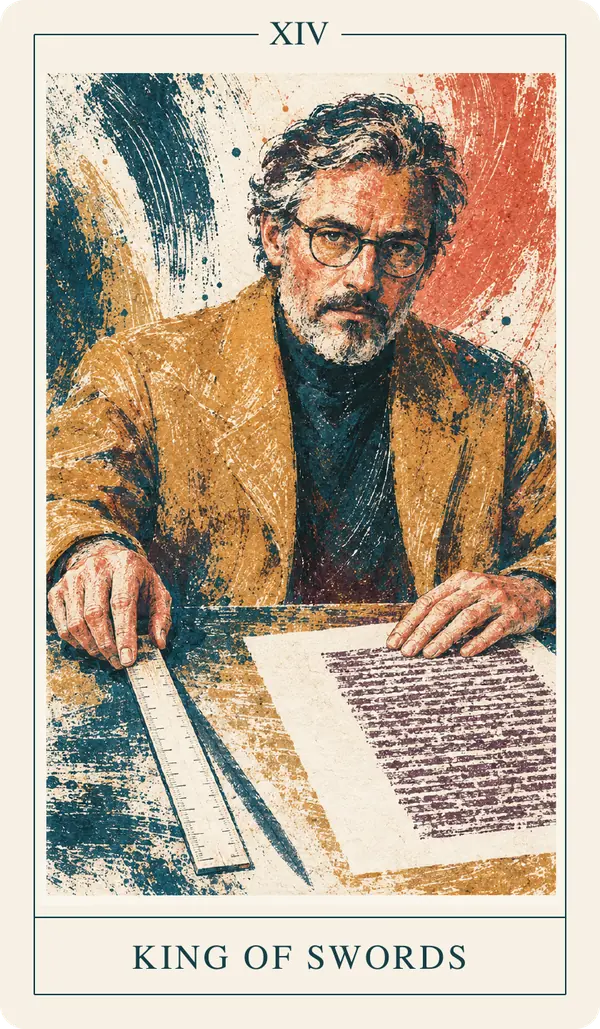
In the image the scribbles crowd the paper to the last line, and the letter opener lies apart, no longer in use.
A question to sit with
“What is finished even if I have not accepted it yet?”
One step
Name one pattern that feels used up, and write the date beside it.
Reversed
The ending may be repeatedly reenacted, or finality may be claimed too soon.
Turned over, the marks run back from the end of the roll, as if the last stretch were rewritten, or rolled up while still wet.
A question to sit with
“Is the ending as final as I have called it, or am I rewriting it again and again?”
One step
Notice one time today you replay an old ending, and mark it with a single tick on paper.
How this deck reads reversed cards
Reversed, the same brushstroke meets resistance. The hand on the cloth may hold too tightly, pull away or keep its feeling to itself, and the quality of the card turns into a blockage, an excess or a quiet inward process. It is not the opposite of the upright card and not a worse fate, only the same gesture under strain.
In love
An old pattern in love may have reached the end of its roll, the marks running out where blank paper begins.
- Supports
- Acknowledging that one way of relating is complete.
- Watch for
- Writing the same story again in smaller letters.
- One step
- Name one pattern in love you are tired of repeating, and write it on paper you can fold away.
Old hurts in love may be reenacted over and over, or something could be called finished before it truly is.
- Supports
- Letting a painful scene end in your mind.
- Watch for
- Declaring it over in a moment of anger.
- One step
- When you replay an old scene tonight, stop at the last line and put it down.
At work
An exhausted way of working may be at its last line; the blank stretch after it could be space to rest before beginning.
- Supports
- Letting a finished phase be finished.
- Watch for
- Squeezing more out of an approach that has run out.
- One step
- Close one task or file that is done, and mark it complete.
A setback at work may be relived in every meeting, or a project could be called finished before it has run its course.
- Supports
- Checking whether it is really over.
- Watch for
- Replaying a defeat until it defines you.
- One step
- Put one stalled project in front of a colleague and see whether it truly has no next step.
Part of the choice may already be settled, the page filled to its end; seeing that could make the rest easier.
- Supports
- Accepting what is complete.
- Watch for
- Reopening a finished question.
- One step
- Cross off one option that looks written to the end of its roll.
An ending you keep reenacting may be distorting the choice, or something may be called final that is not.
- Supports
- Separating the finished from the paused.
- Watch for
- Making a final call in exhaustion.
- One step
- Wait a day before calling anything final.
Setting the letter opener aside and looking at the blank page without rushing to fill it may be the growth.
- Supports
- Rest after an ending.
- Watch for
- Rushing to fill the blank space.
- One step
- Spend a few minutes with a blank page today, and leave it blank.
Reenacting the same ending, writing on past the end of the roll, may be where growth stalls.
- Supports
- Turning toward the blank stretch.
- Watch for
- Making a home in the last chapter.
- One step
- Put one line on the blank paper about what could begin, without committing to it.
A worn family pattern may be at its end, and naming that gently could let everyone breathe.
- Supports
- Quiet acknowledgment that a page may be full.
- Watch for
- Holding on to an old family script out of duty.
- One step
- Notice one family habit that feels finished, and let yourself say so, if only to yourself.
An old family ending may be repeated at each gathering, or someone could declare a matter closed too soon.
- Supports
- Letting old scenes rest.
- Watch for
- Retelling the family ending at every meal.
- One step
- If an old ending comes up at the next family gathering, gently turn the talk elsewhere.
Yes or no
NoMixedWhat you ask about may belong to a pattern that has run its course, so this leans no.
Supports
- Acknowledging an end may free attention.
- A blank stretch lies beyond the last line.
Limits
- Something here may already be spent.
- Pushing on may only repeat the pattern.
One step
Ask whether this is still alive or only continuing out of habit.
The end may be real or declared too early, so the answer is mixed.
Supports
- It may not be as final as it feels.
- Seeing the replay can help stop it.
Limits
- An ending may keep being relived.
- Calling it over too soon is possible too.
One step
Separate what has really ended from what only feels finished.
What is in the picture
Dense marks run to the end of a roll of paper.
A blank section opens beyond them; a letter opener has been set aside. DEATH marks an ending that changes form. ACE OF SWORDS introduces a new clear opening after the old argument is spent.
- a roll of paper covered in dense plum scribbles
- a blank stretch of paper beyond the marks
- a letter opener laid on the table
- a loose coral thread
- a dark wooden table edge
This card in other decks
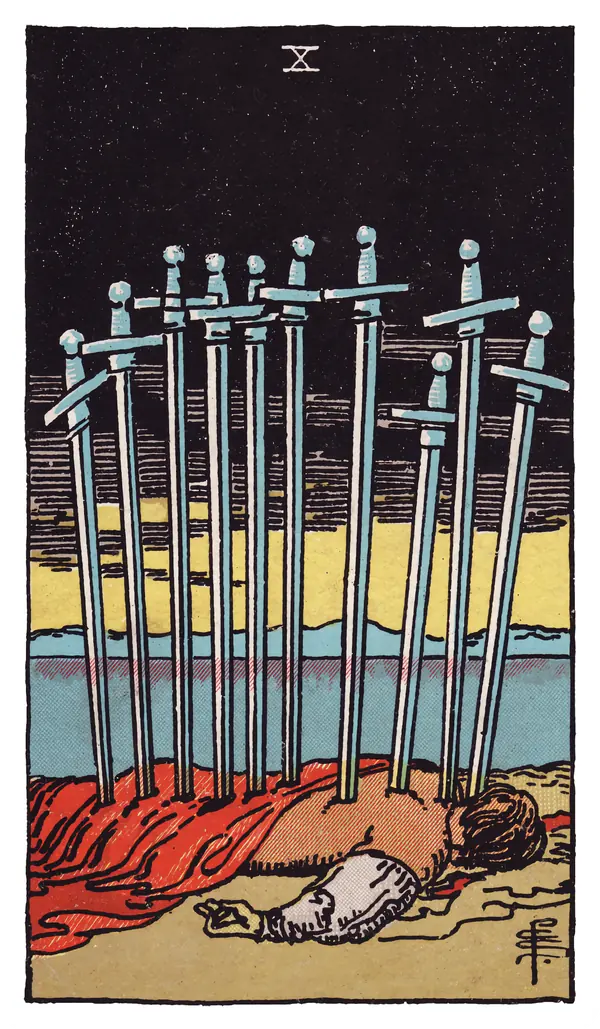 Rider–Waite–SmithTen of SwordsA painful ending may feel like rock bottom, though the dawn on the horizon shows the night is not the whole scene.
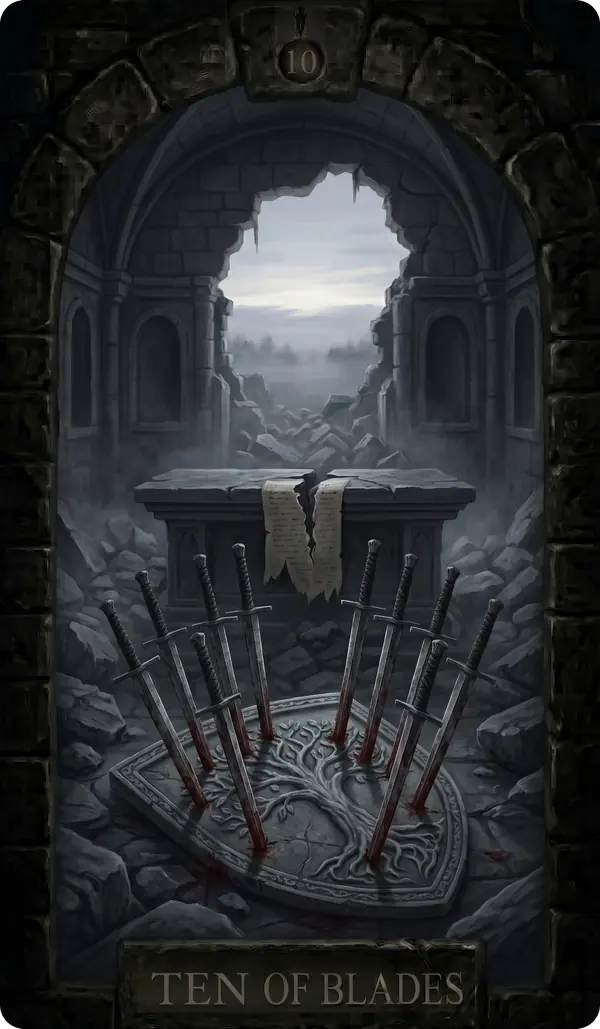 FamiliaTen of BladesThe old order has fallen completely, and there is relief in that: nothing is left to hold, and a new law can begin.
 City of WindowsTen of SwordsAcknowledging the end of an old form of the relationship and following through on your own decision.
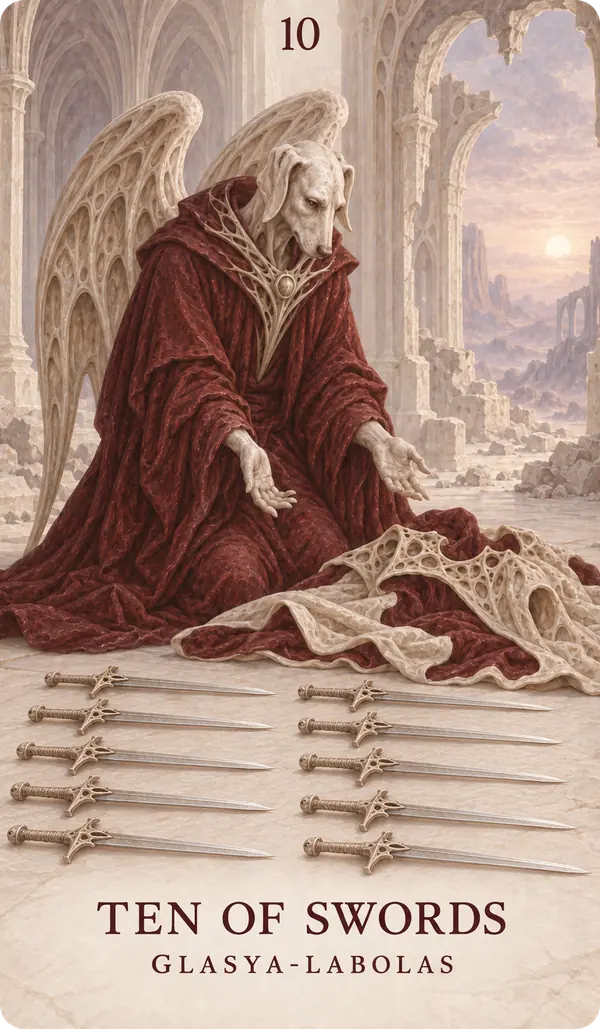 CarnalTen of SwordsA damaging pattern reaches its limit.
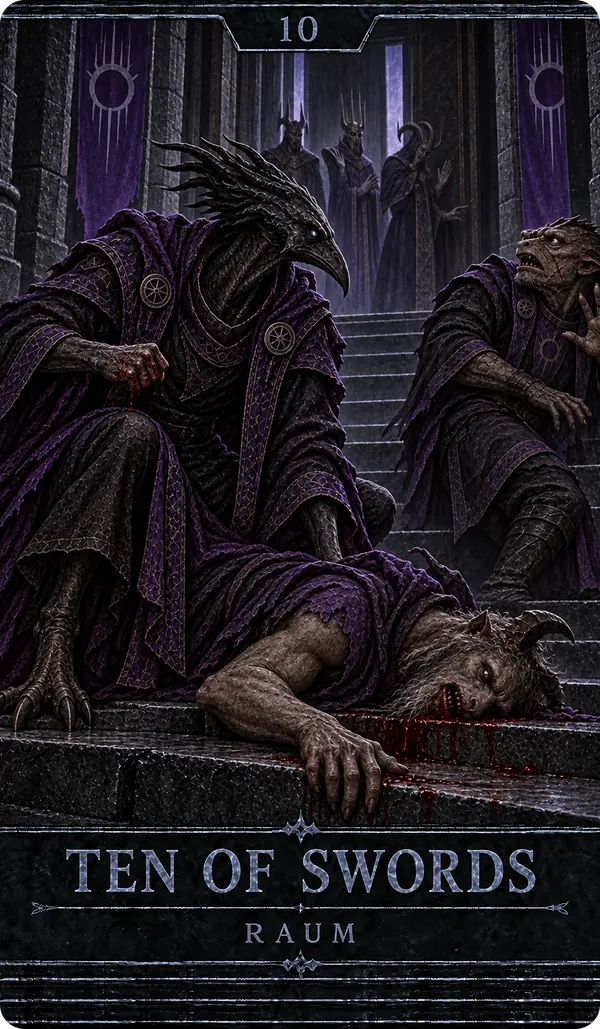 Crimson InfernoTen of SwordsAcknowledge the ending instead of spending more strength defending what has failed.
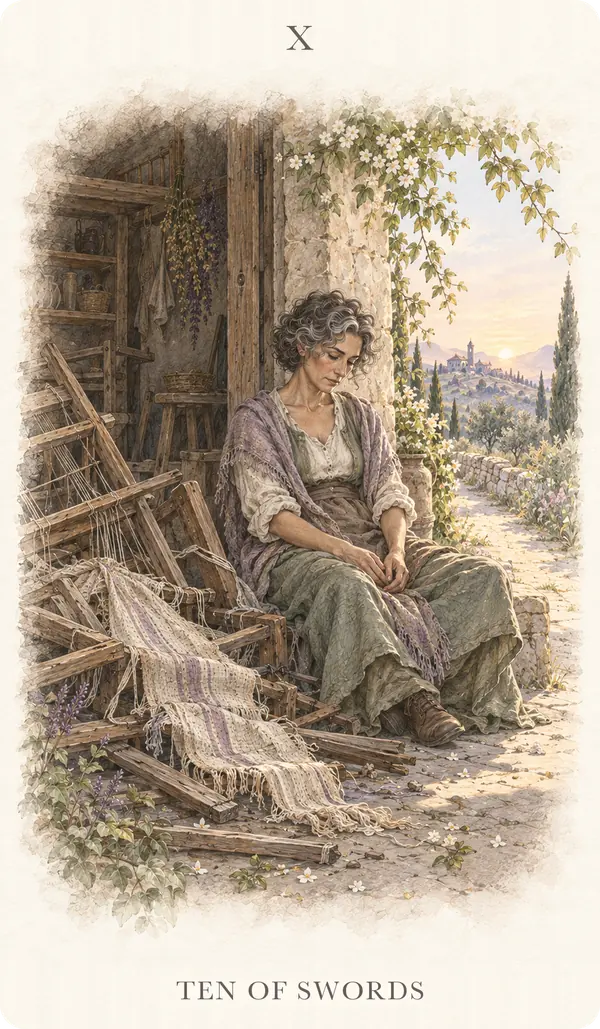 Everyday WondersTen of SwordsA definite ending that more effort alone will not repair.
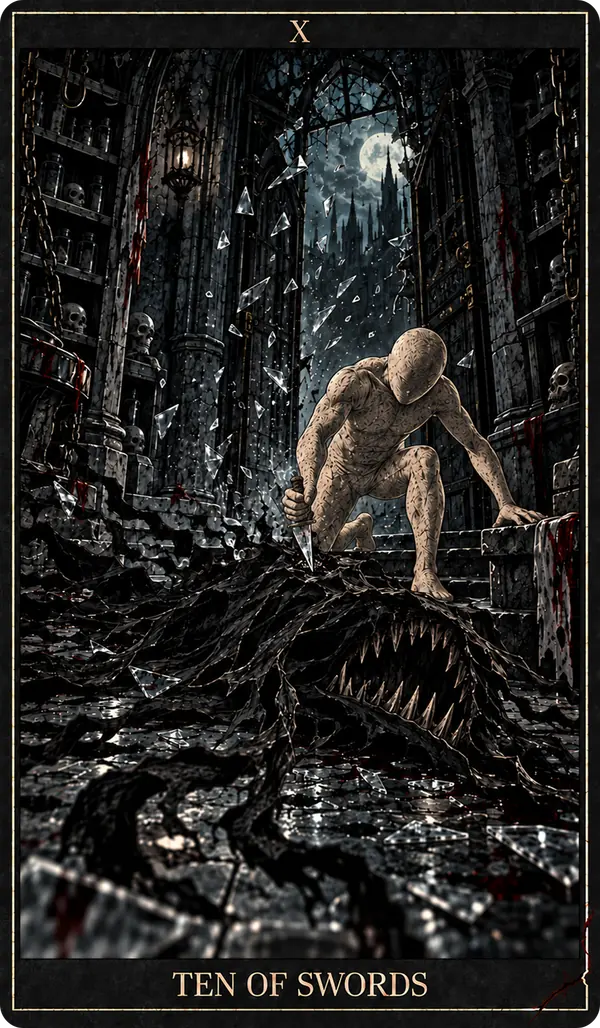 Mirror NightTen of SwordsFinish without denying the cost.
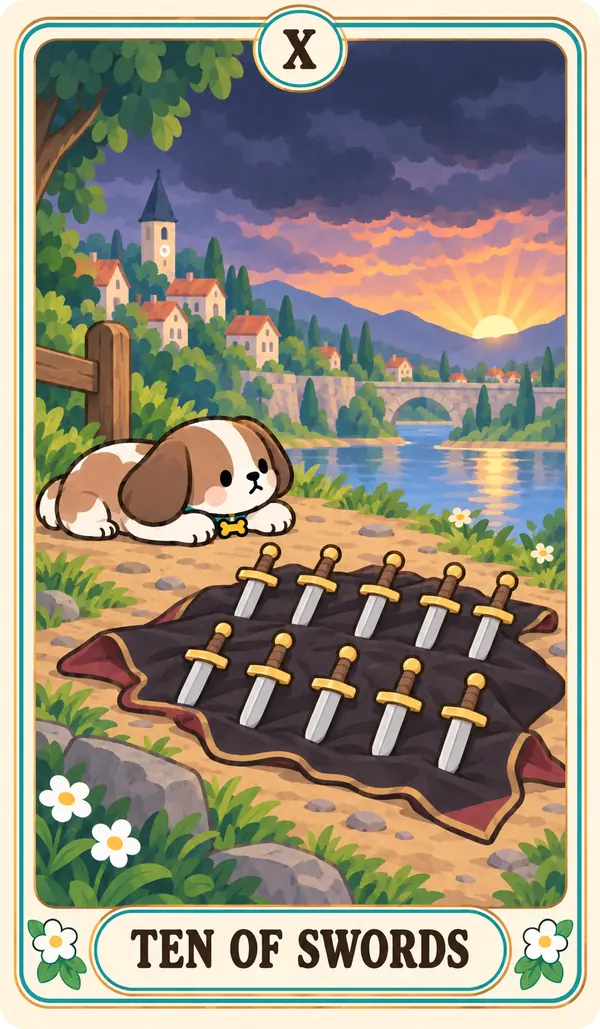 Shiba TownTen of SwordsA painful ending; the limit reached; no need to continue the struggle.
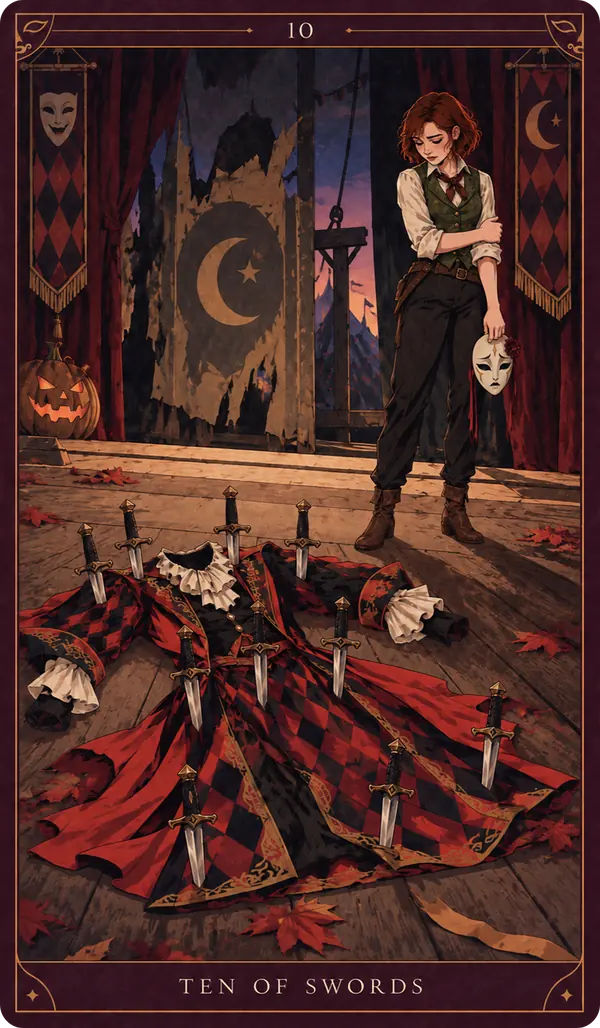 Velvet MasqueradeTen of SwordsA painful ending at the limit of a role.
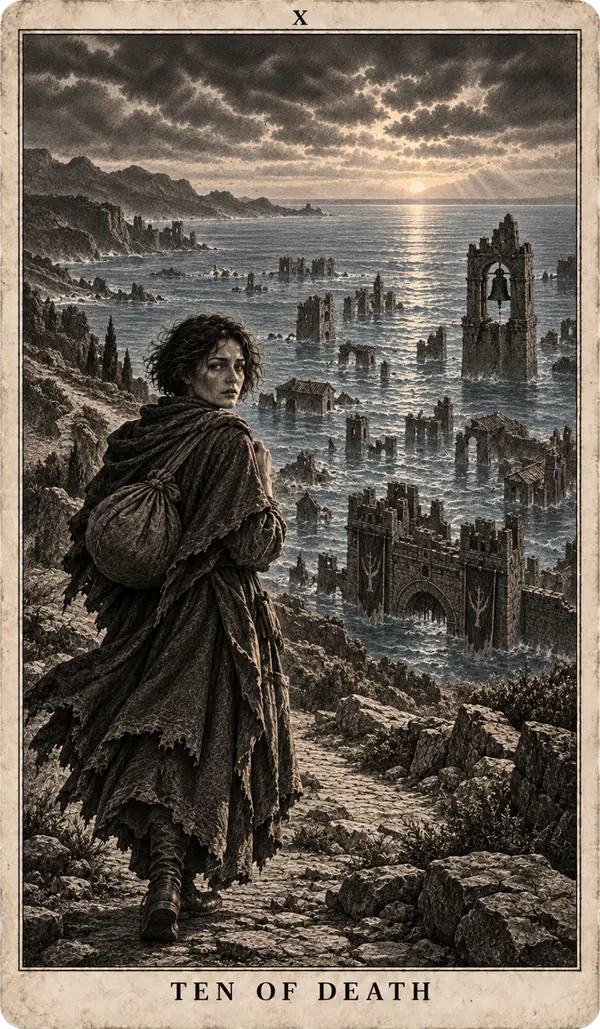 Four HorsemenTen of DeathStop asking the ended world to resume; take the next real step.
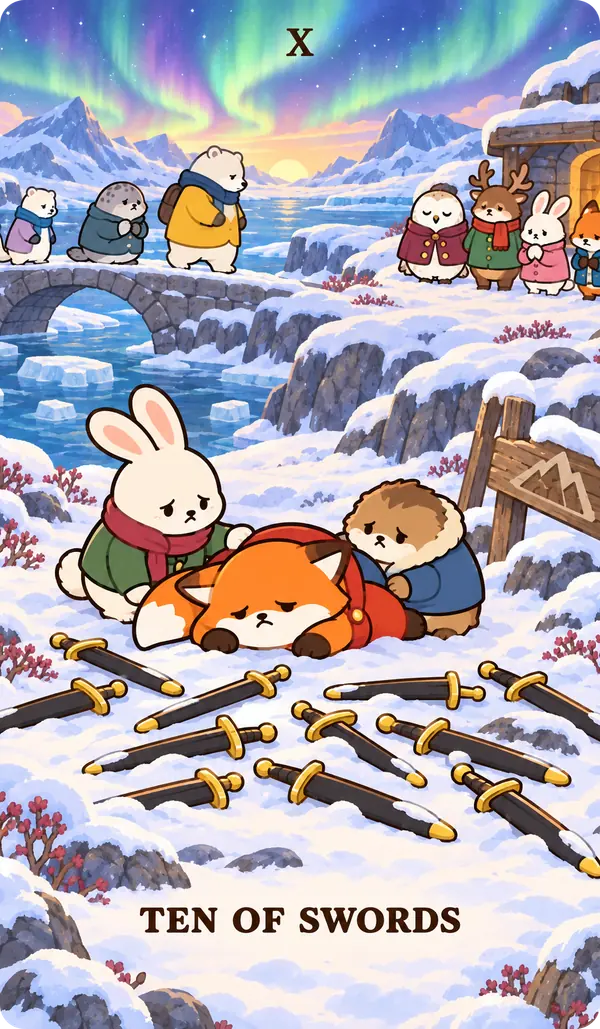 Four TrailsTen of SwordsPainful ending, exhaustion, lowest point.
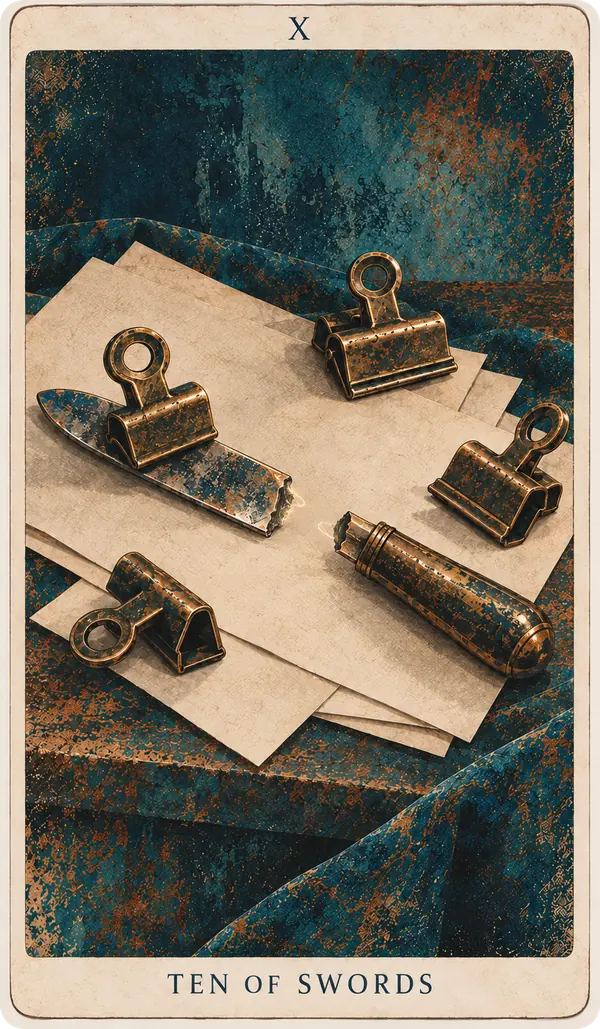 Living ThresholdTen of SwordsA broken method reaches its limit while useful material remains.
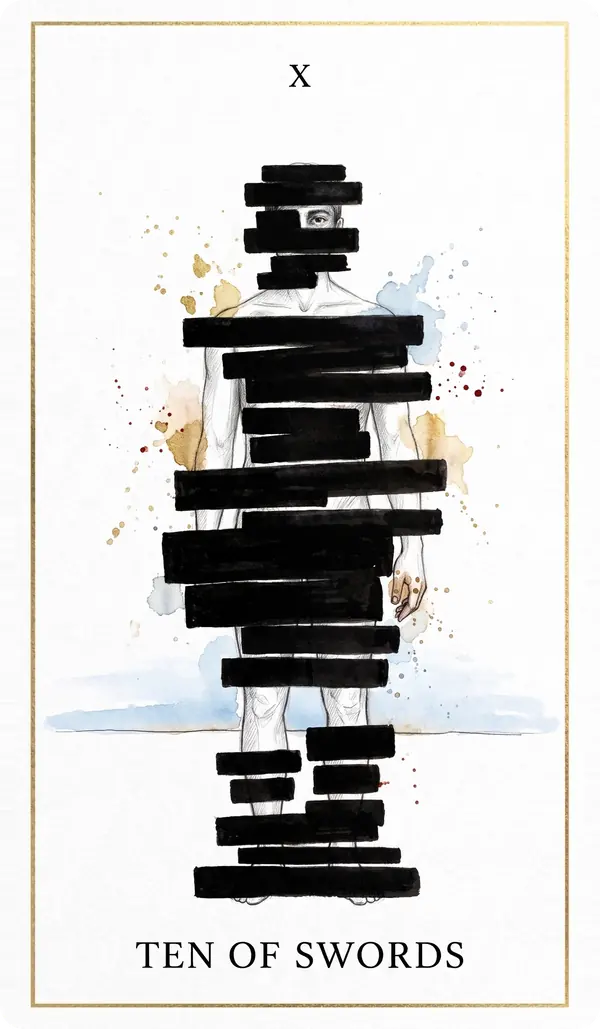 Colour of PowerTen of SwordsThe story is finished: you have been crossed out, and only up remains.
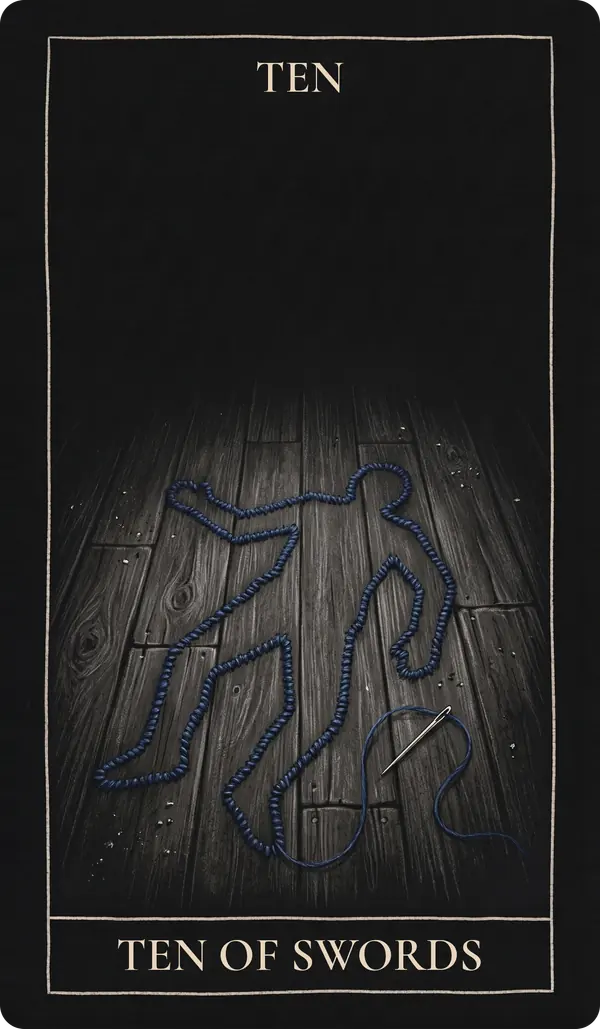 BoundTen of SwordsThe last word has been spoken; the body is gone, only the seam remains.
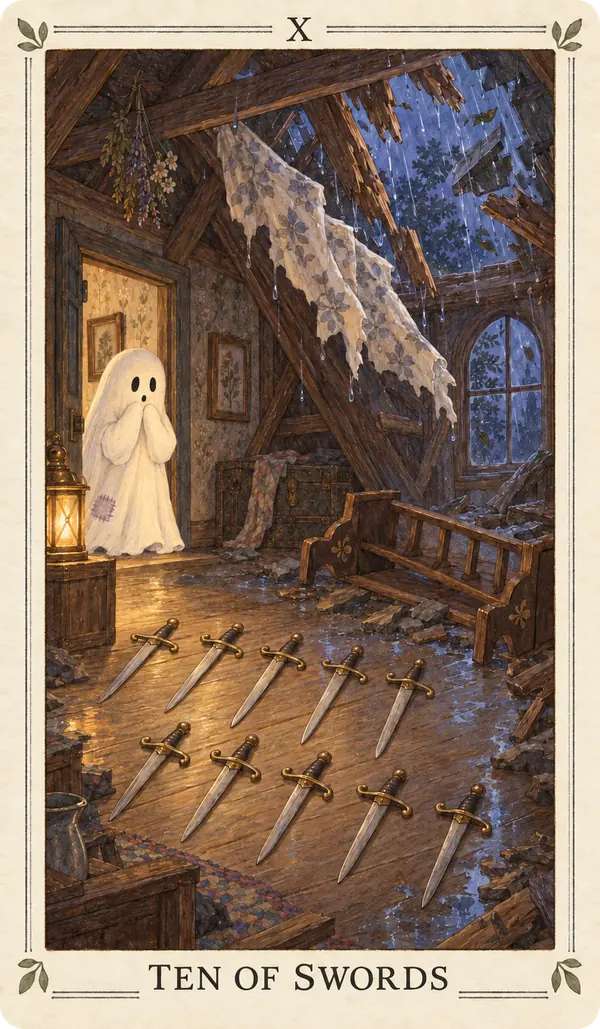 Cozy HauntTen of SwordsAdmit an ending and make the next place safer.
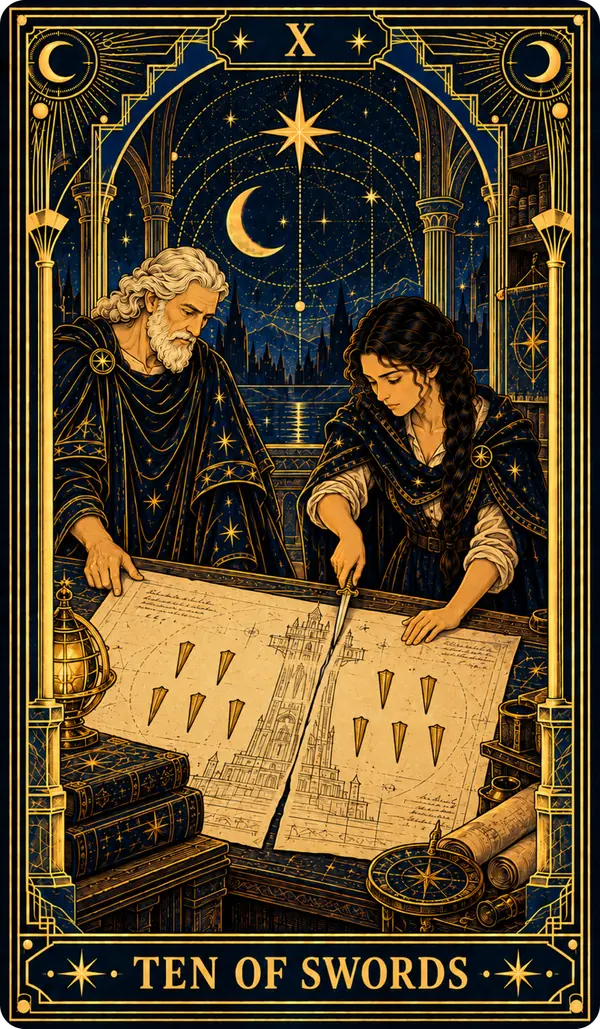 Celestial Night SkyTen of SwordsThe end of a wrong account.
Where it appears
Questions about this card
Is Ten of Swords a yes or no card in Self Contact?
What you ask about may belong to a pattern that has run its course, so the Ten of Swords leans no upright. Reversed, it is mixed: the end may be real or declared too early. Ask whether this is still alive or only continuing out of habit.
What does Ten of Swords mean in love?
An old pattern in love may have reached the end of its roll, the marks running out where blank paper begins. Acknowledging that one way of relating is complete comes first. Name one pattern you are tired of repeating, and write it on paper you can fold away.
What does Ten of Swords mean reversed in Self Contact?
When it lands reversed, the Ten of Swords shows an ending reenacted again and again, or finality claimed too soon. Separate what has really ended from what only feels finished. When you replay an old scene tonight, stop at the last line and put it down.