Ten of Swords
Ten of Swords in Velvet Masquerade · Minor Arcana
RelationshipsIn short
A painful ending at the limit of a role.
Reversed
An ending denied, or a first response beyond it.
- Swords
- Ten
- Air
- The Dismissed Performer
- painful ending
- defeat
- the limit of a role
Upright
A painful ending, defeat and reaching the limit of an arrangement. Acknowledge the ending and what it has cost.
Step outside the exhausted role far enough to consider what remains available to rebuild.
Nell stands beyond the pinned costume; the mask of public blame need not become the only face you recognise as yours.
A question to sit with
“What has ended, and what part of me remains able to respond?”
One step
Put a note about an exhausting role aside for tonight. Name one ordinary thing you can still choose.
Reversed
Refusing the ending or beginning to rise after it. An ending may be denied or taken as a permanent verdict on the self.
Return to the actual cause and allow the next action to have a different basis.
The daggers remain in the empty cloth while Nell can respond from beyond it, even before the accusation is answered.
A question to sit with
“Have I made the rejected role the whole measure of who I am?”
One step
Describe a role that feels spent without calling yourself a failure. Leave room for a small different action.
How this deck reads reversed cards
Reversed, the scene holds back, goes too far, hides or begins to change. A frightening face can still help either way up. Sometimes a reversal opens a clasp or lets a feeling move; sometimes a pause turns into a hiding place, or a welcome starts asking too much. What changes is the act, not the face.
In love
The empty costume may show a painful limit in a shared role, with fear of blame obscuring the people still beyond it.
- Supports
- Naming what a way of relating has cost without making its ending a verdict on either person.
- Watch for
- Letting the rejected performance speak for every possible form of closeness.
- One step
- Describe an exhausting expectation in a shared routine and ask for a small different way to spend tonight.
The rejected costume may still define the bond’s story, or a smaller way of meeting may be forming beyond that role.
- Supports
- Hearing the cost without insisting that the old performance resume.
- Watch for
- Using a different invitation to dress the same exhaustion in a new mask.
- One step
- Suggest a brief, ordinary time together that does not ask either person to perform the old expectation.
At work
Public blame may fasten a work identity to a failed arrangement, like the ten daggers holding a costume after its wearer has stepped away.
- Supports
- Distinguishing the exhausted role from what you can still bring to another piece of work.
- Watch for
- Accepting the first accusation as the full account of responsibility.
- One step
- Set an unfinished work question aside for tonight and name a skill you still have outside that role.
A first response after a work defeat may be possible, though the public accusation still clings to the dismissed costume.
- Supports
- Basing a new action on what actually failed.
- Watch for
- Trying to restore the impressive role before understanding its limit.
- One step
- Describe the cause you can actually name and choose a small piece of work with a different basis.
The pinned fabric may show an option that has reached its painful limit, even while its promised face remains tempting.
- Supports
- Admitting the cost of continuing the same performance.
- Watch for
- Choosing the old costume again merely to avoid being seen beyond it.
- One step
- Describe the part of the option that no longer works and pause before promising to repeat it.
The choice may lie between denying the pinned role’s ending and trying an available action outside its familiar face.
- Supports
- Leaving room for a different response that need not repair the entire stage.
- Watch for
- Making every new possibility prove that the old verdict was false.
- One step
- Choose a small reversible action that does not depend on reviving the exhausted arrangement.
Standing beyond the empty role may ask you to recognise hurt without letting a public mask name your whole self.
- Supports
- Giving an ending a truthful place beside the abilities it has not removed.
- Watch for
- Trying to redeem the whole performance before allowing an ordinary day outside it.
- One step
- Write a few plain words about what the role meant to you, then do a familiar thing that does not require it.
The fear of being the rejected costume may be loosening, or fastening itself to every attempt to begin again.
- Supports
- Naming an ending in words that leave the person beyond it visible.
- Watch for
- Demanding a triumphant return before a small recovery can matter.
- One step
- Name a role that feels spent in one sentence and a part of yourself that sentence does not describe.
An empty costume may show a family role at its limit, with fear of blame making the ending hard to name.
- Supports
- Speaking about an exhausting expectation without accusing the whole family.
- Watch for
- Treating a painful change in the role as failure of the person who wore it.
- One step
- Name an expectation that has become too heavy to a trusted relative and ask for a small pause in it.
A handed-down role may be kept alive by shame, or its painful limit may finally be speakable at home.
- Supports
- Allowing a family expectation to change without treating anyone as an empty costume.
- Watch for
- Repeating the old performance to prove that no disappointment occurred.
- One step
- Talk with a trusted relative about a small expectation you could pause for one evening.
Yes or no
NoMixedTen daggers fix an exhausted costume to the stage, so the answer leans no to continuing the same arrangement unchanged.
Supports
- The costume is empty and its wearer stands beyond it.
- An exhausted role can be named without becoming your whole identity.
Limits
- The public ending carries a real cost.
- Trying to continue the same performance may ignore the limit already reached.
One step
Describe what has reached its limit and name an ordinary choice still available outside that role.
Standing beyond the pinned cloth leaves room for a response, while denial may still call you back to the exhausted role; the answer is mixed.
Supports
- A first response beyond the rejected role may be taking shape.
- The cause can be examined separately from the public blame.
Limits
- The old mask may still be treated as a permanent verdict.
- Denial can make a different invitation look like the same costume restored.
One step
Set a note about the old role aside for tonight and name a small different response you could try.
What is in the picture
Nell’s dismissed performance costume lies flat on the empty stage with ten daggers pinning its fabric to the boards; she stands beyond it without the role, after being publicly blamed for the failure.
The ten blades pierce an empty costume. Nell stands beyond the rejected role, hurt by its ending and still able to respond.
- empty red and black performance costume
- ten daggers pinning fabric to stage boards
- visitor standing beyond the costume
- ivory mask held at her side
- damaged moon-and-star scenery
- fallen autumn leaves
This card in other decks
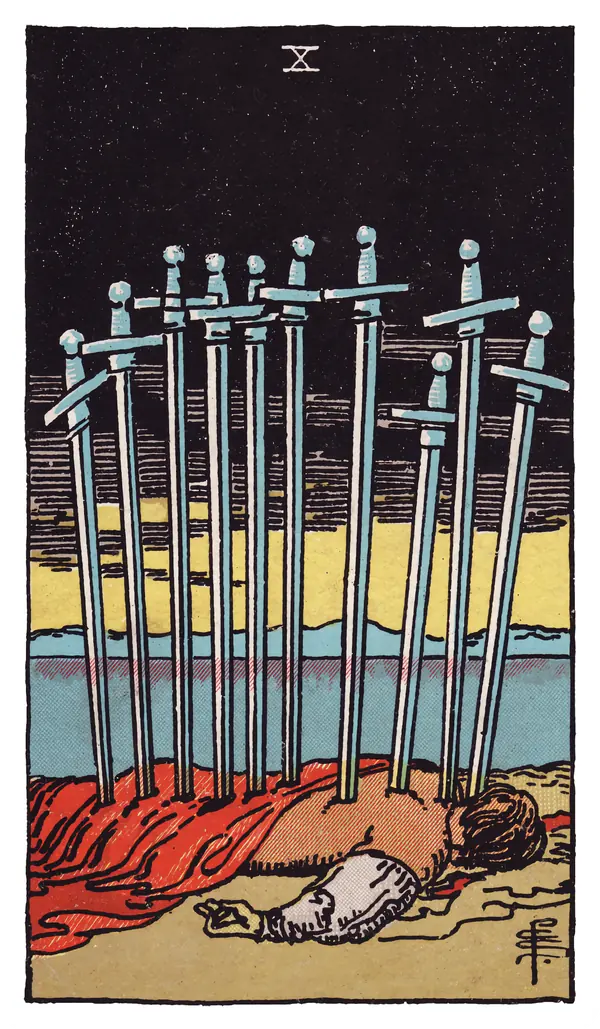 Rider–Waite–SmithTen of SwordsA painful ending may feel like rock bottom, though the dawn on the horizon shows the night is not the whole scene.
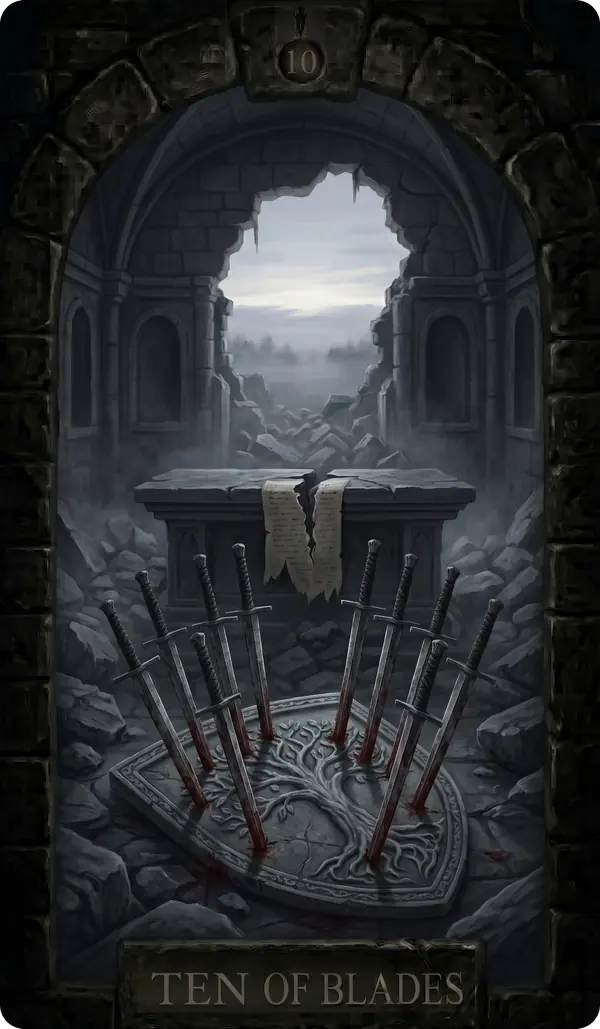 FamiliaTen of BladesThe old order has fallen completely, and there is relief in that: nothing is left to hold, and a new law can begin.
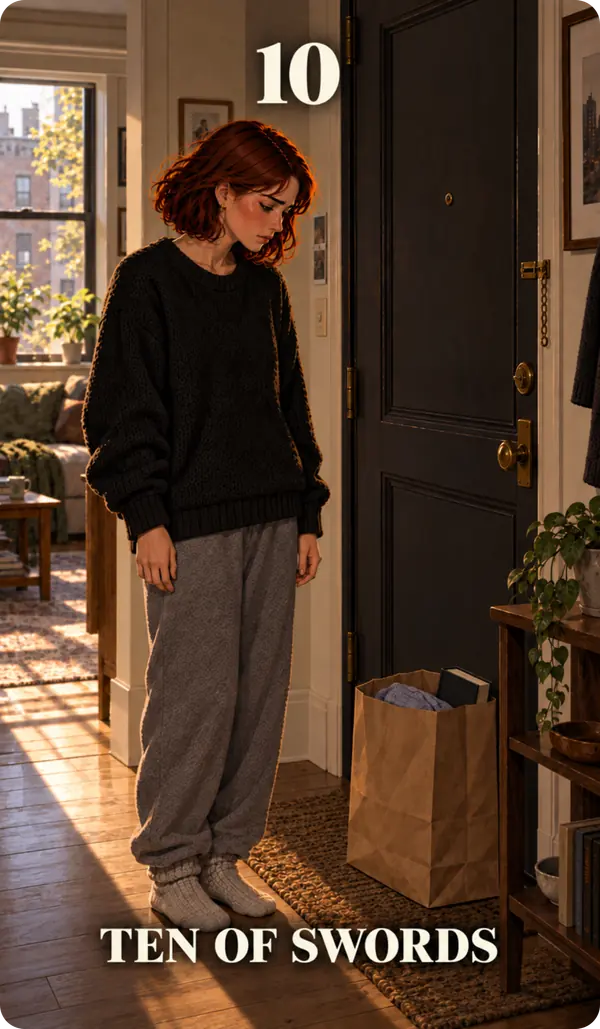 City of WindowsTen of SwordsAcknowledging the end of an old form of the relationship and following through on your own decision.
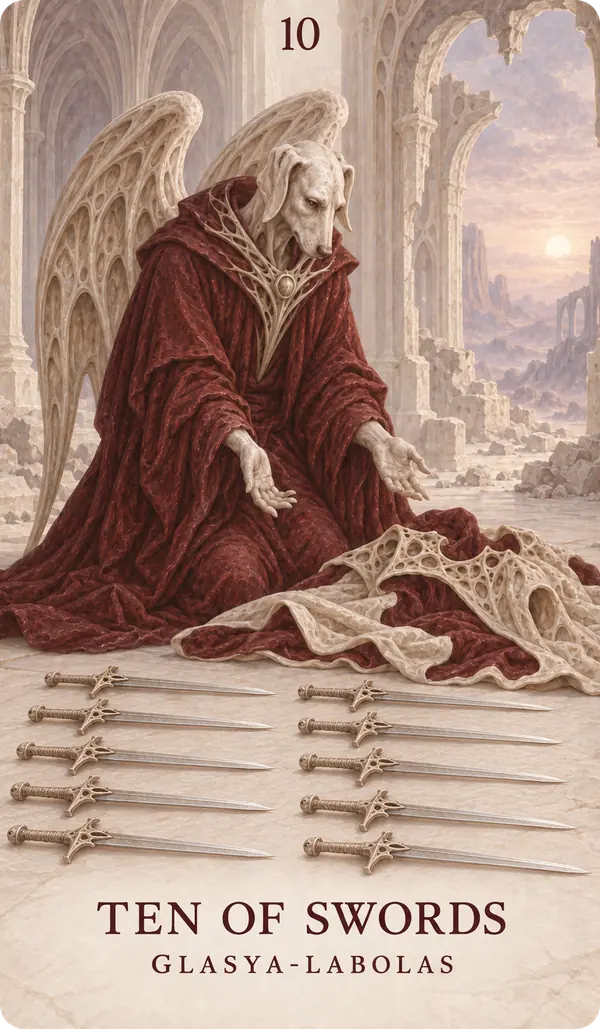 CarnalTen of SwordsA damaging pattern reaches its limit.
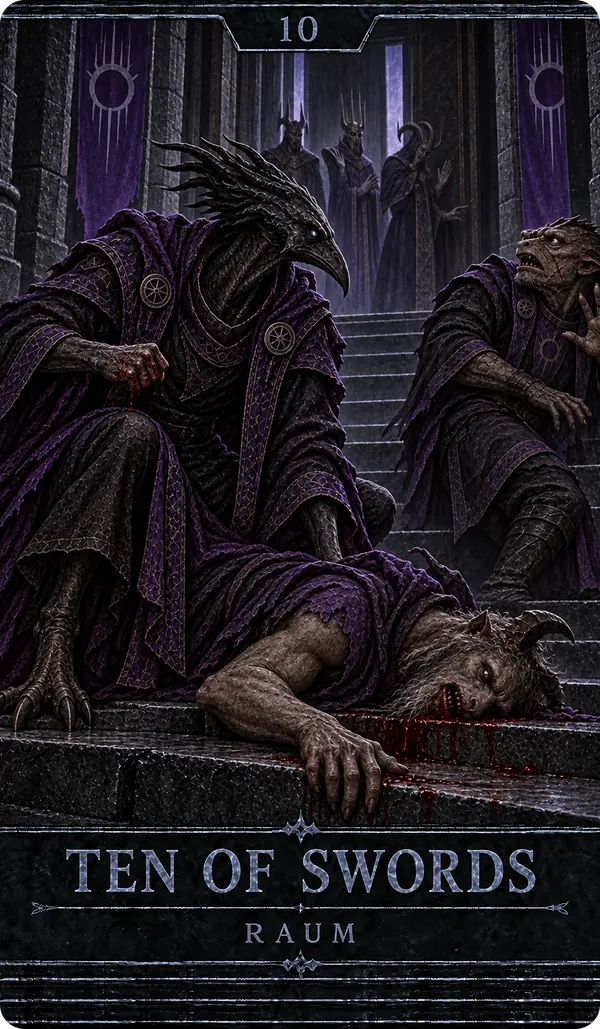 Crimson InfernoTen of SwordsAcknowledge the ending instead of spending more strength defending what has failed.
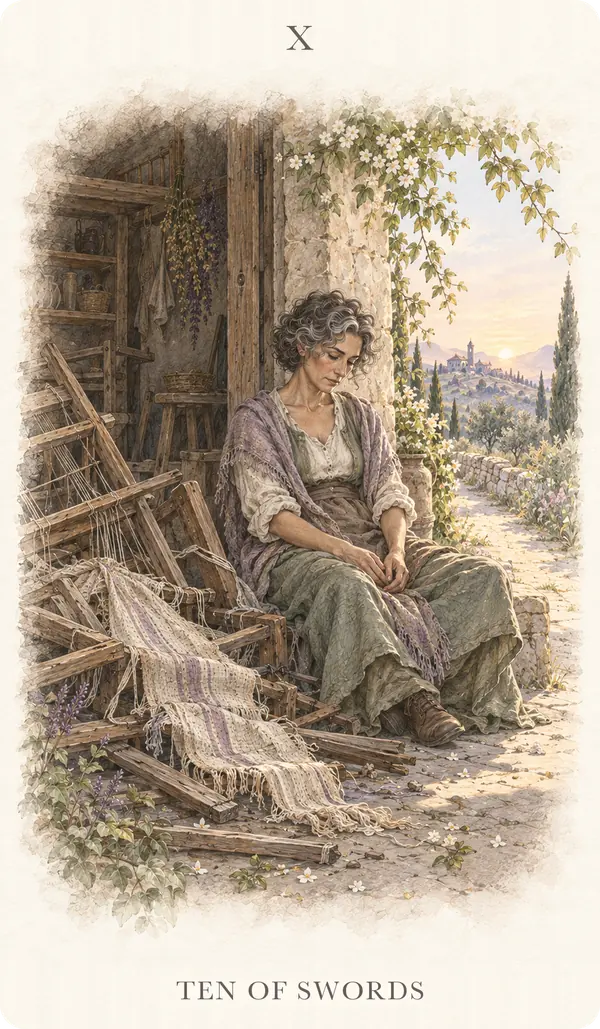 Everyday WondersTen of SwordsA definite ending that more effort alone will not repair.
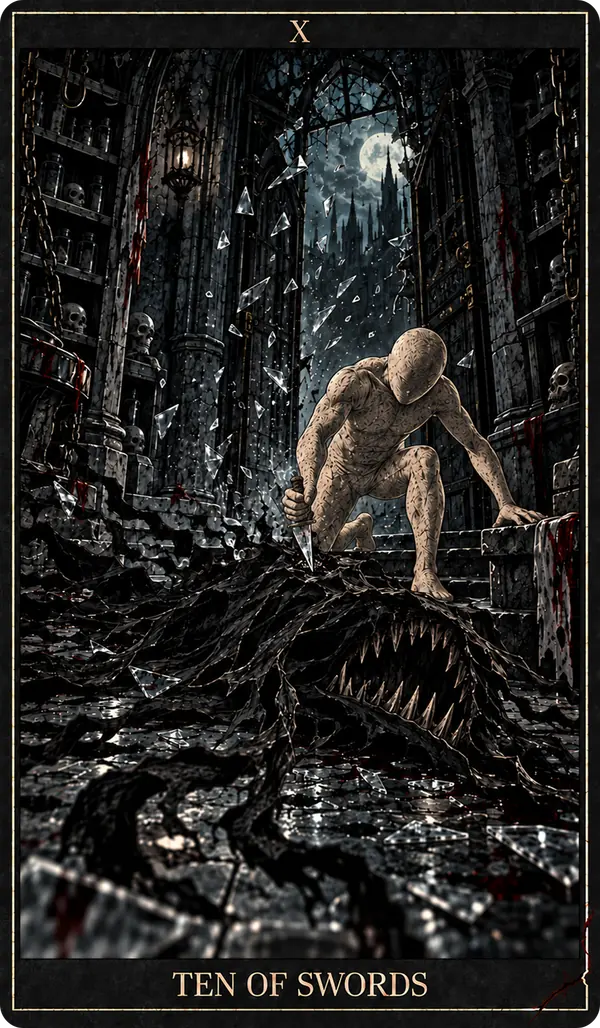 Mirror NightTen of SwordsFinish without denying the cost.
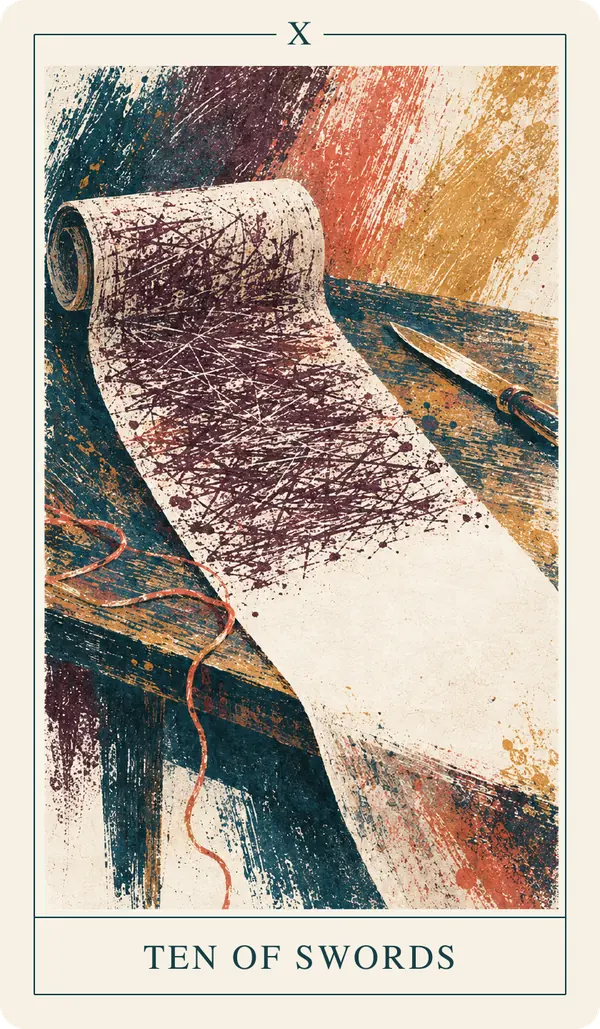 Self ContactTen of SwordsAn exhausted pattern may have reached its end; acknowledge completion.
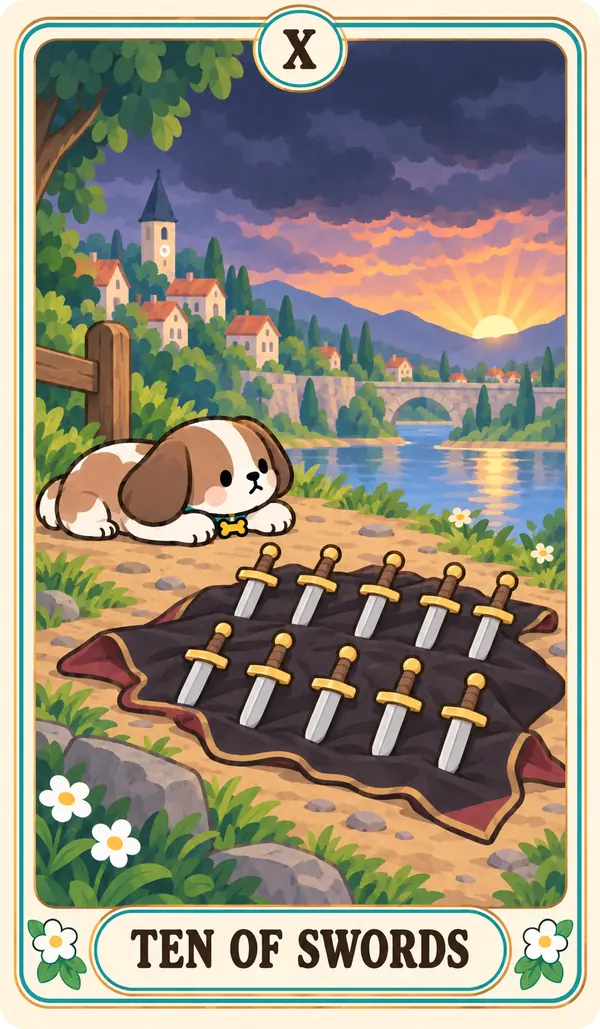 Shiba TownTen of SwordsA painful ending; the limit reached; no need to continue the struggle.
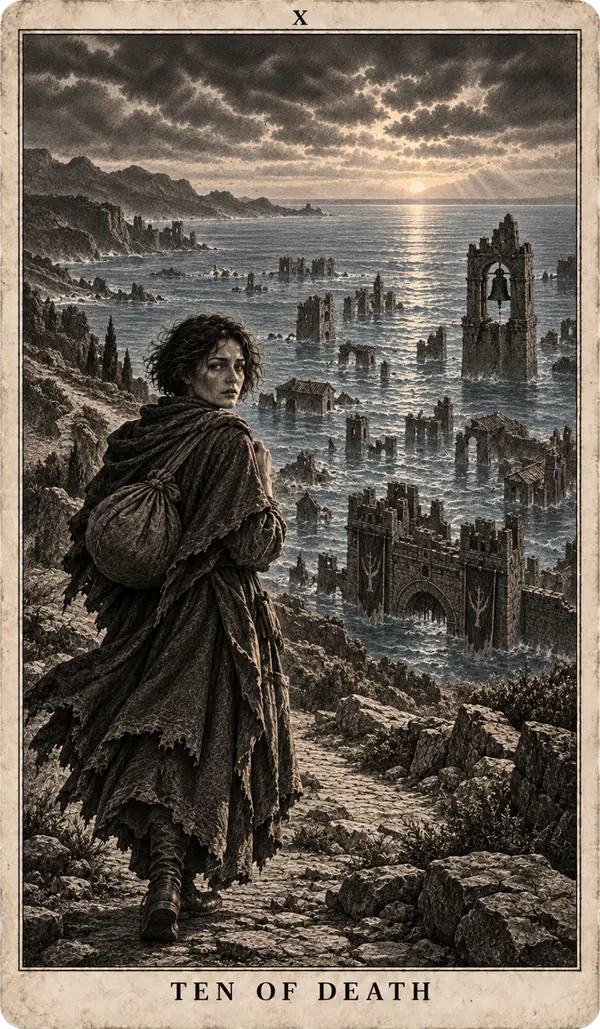 Four HorsemenTen of DeathStop asking the ended world to resume; take the next real step.
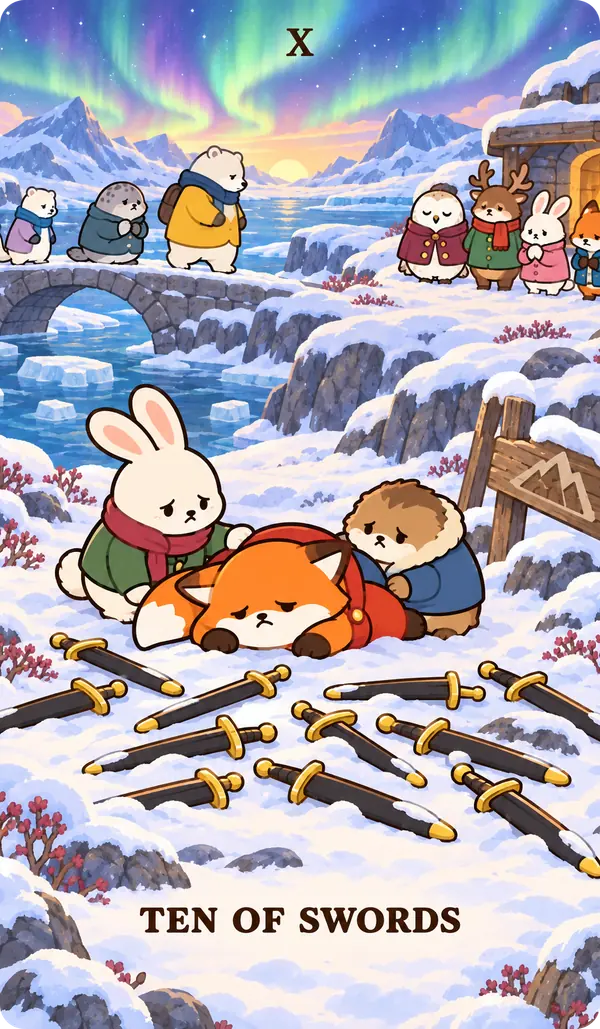 Four TrailsTen of SwordsPainful ending, exhaustion, lowest point.
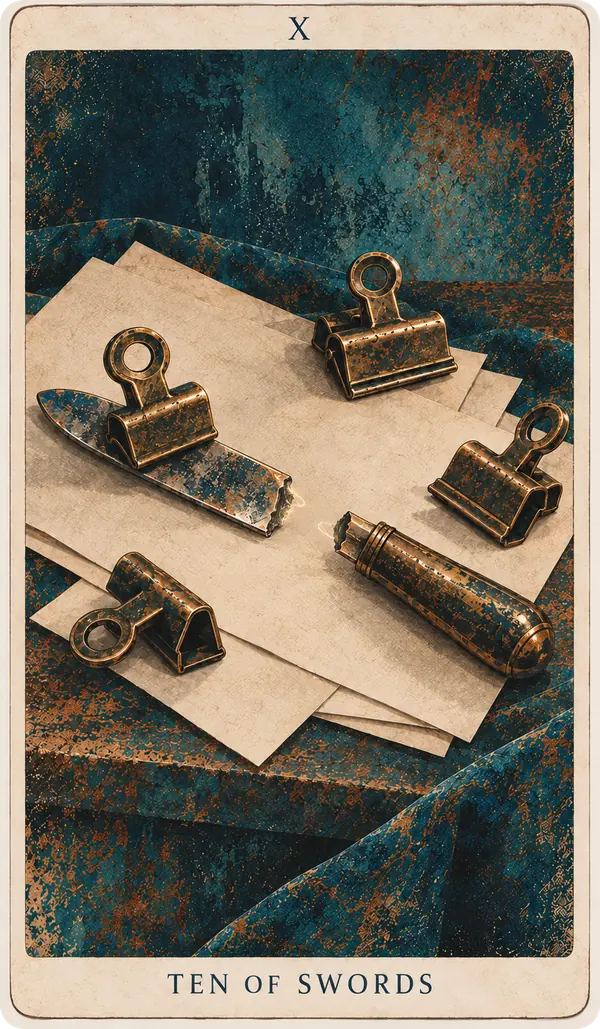 Living ThresholdTen of SwordsA broken method reaches its limit while useful material remains.
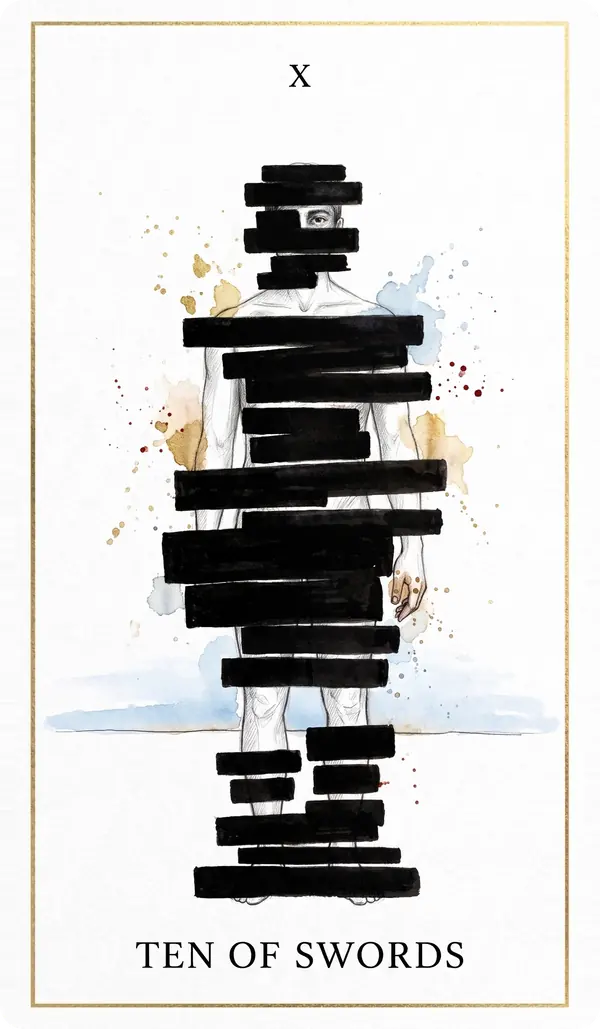 Colour of PowerTen of SwordsThe story is finished: you have been crossed out, and only up remains.
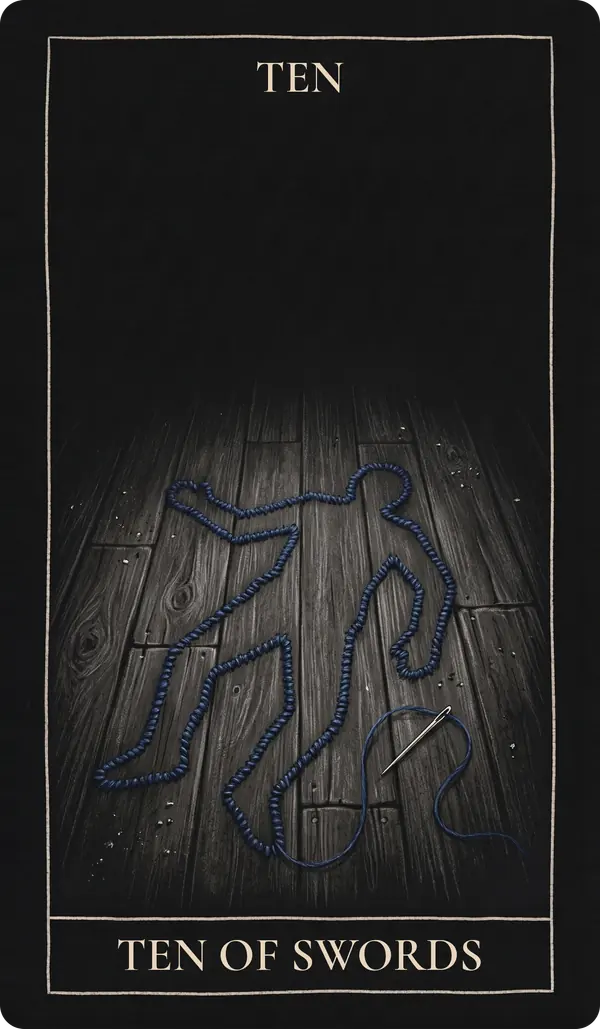 BoundTen of SwordsThe last word has been spoken; the body is gone, only the seam remains.
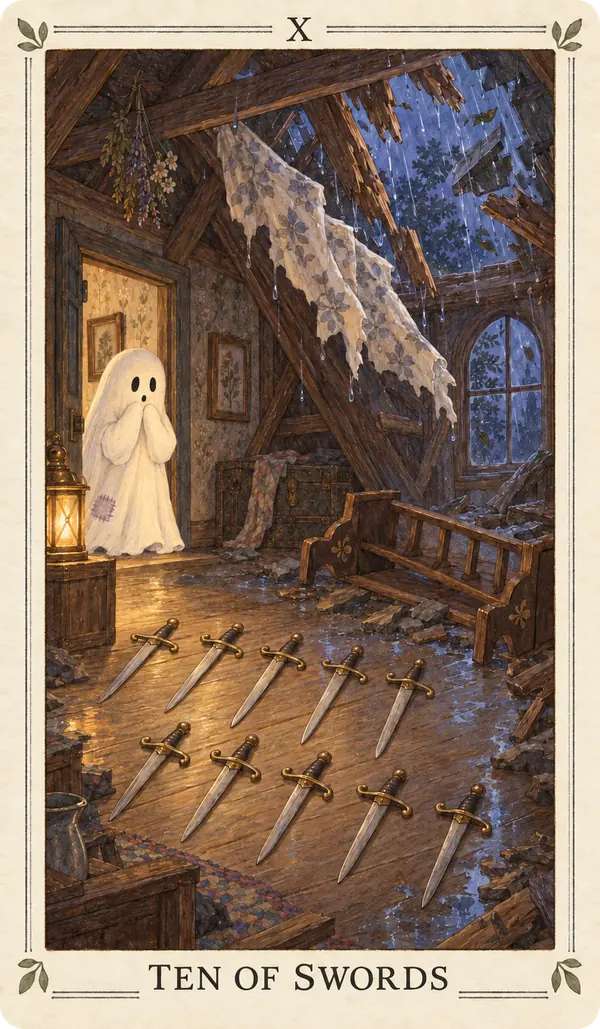 Cozy HauntTen of SwordsAdmit an ending and make the next place safer.
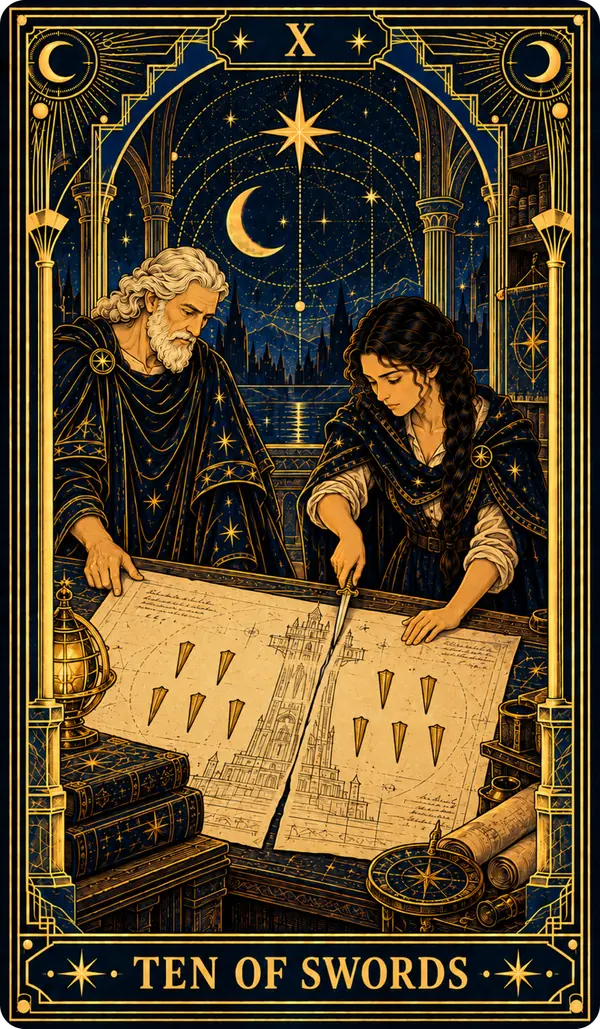 Celestial Night SkyTen of SwordsThe end of a wrong account.
Where it appears
Questions about this card
Is Ten of Swords a yes or no card in Velvet Masquerade?
Ten of Swords leans no upright to continuing the same exhausted role unchanged. The costume is pinned to the stage while its wearer stands beyond it. Reversed, the answer is mixed between denying the ending and finding a first response. Name the part you cannot keep performing and pause before agreeing to repeat it.
What does Ten of Swords reveal about fear and masks?
Ten daggers hold a costume flat while the uncovered wearer stands apart. The card may reveal fear that the end of a role leaves no self beyond it, or an appealing promise that draws you back into the same painful part. Say what no longer fits and ask for time before answering another invitation.
What does Ten of Swords mean reversed in Velvet Masquerade?
Beyond the pinned cloth, the reversed Ten of Swords may describe a first response after a difficult ending. It can also point to denial that keeps calling the wearer back to the discarded part. Choose one small thing you can do without that role tonight and tell a trusted person what you would like help with.