Five of Death
Five of Swords in Four Horsemen · Minor Arcana
LossIn short
Face the loss without abandoning the living beside it.
Reversed
Turning pain into blame, or refusing the witness who remains.
- Death
- Five
- Air
- The Shore Mourner
- facing the loss
- staying with the living
- letting a witness remain
Upright
Face the loss without abandoning the living beside it. The sea has drawn back and left the covered bodies along the shore.
The woman kneels at one of them, holding a strip of blue fabric she knows. A few steps off, a witness stands without coming closer and cannot mend anything.
Whatever is still possible here lies between those two, the one who recognised and the one who stayed.
A question to sit with
“What remains possible between those who survived?”
One step
If someone is standing near your grief without knowing how to come closer, let them know one small way they could.
Reversed
Turning pain into blame, or refusing the witness who remains. Grief this sudden looks for somewhere to go, and the person standing closest can become its target.
Or the kneeling woman may wave the witness away, as if anyone who survived had no right to stand near. Either way, the only other living person on that shore is pushed off.
The sea cannot be held to account, and the witness is still within reach.
A question to sit with
“Where is my grief landing, and am I pushing away the one who stayed?”
One step
Notice where anger about a loss has been landing and whether it belongs there, then say one kind sentence to the person who stayed nearest.
How this deck reads reversed cards
Reversed, the act on the card turns inward, meets an obstacle, grows harsher or shows its price. On this road a reversal is not automatically the opposite, and not automatically something worse.
In love
A relationship may be facing a loss that cannot be repaired, with both partners still beside each other.
- Supports
- Staying near even when there is nothing to fix.
- Watch for
- Grieving so privately that your partner cannot reach you.
- One step
- Let your partner sit with you once without either of you needing to speak.
Pain may be turning into blame between partners, or one of you may be pushing the other away.
- Supports
- Separating the loss from the person beside you.
- Watch for
- Blaming your partner for what neither of you caused.
- One step
- When anger rises, name the loss first, before you speak to your partner about anything else.
At work
Across a whole team a loss may be felt, most of all by a few.
- Supports
- Colleagues who stand nearby without pretending to repair anything.
- Watch for
- Returning to business before anyone has faced it.
- One step
- Check quietly on the colleague closest to the loss.
At work, grief may be coming out as blame aimed at whoever is nearest.
- Supports
- A calm person who does not take the bait.
- Watch for
- Looking for someone to hold responsible for what no one could stop.
- One step
- Before assigning fault at work, ask whether the fault is real or only needed.
Among those who survived a loss, a choice may have to be made with no option that repairs it.
- Supports
- Asking what is still possible between those who remain.
- Watch for
- Choosing as though nothing can matter now.
- One step
- List what is still possible with the people who remain.
A choice may be driven by anger that belongs to a loss rather than to the options.
- Supports
- Waiting until the anger has cooled.
- Watch for
- Deciding in order to punish someone.
- One step
- Write the choice down, then note whether anger or the options are doing the choosing.
Facing a loss while keeping company with the living may be what you are learning.
- Supports
- A witness who stays.
- Watch for
- Pulling away from everyone who came through it with you.
- One step
- Spend some time this week with someone who shares the loss.
The lesson may be that grief and blame are easy to confuse.
- Supports
- Letting someone stay who could not help.
- Watch for
- Pushing the witness away because they survived.
- One step
- Thank one person who stayed near, even if they could not help.
One member of a family may feel a loss more sharply than the rest.
- Supports
- Relatives who stay close without trying to fix it.
- Watch for
- Leaving the one who grieves most to grieve alone.
- One step
- Sit with the relative who feels the loss most, and let them lead.
In a family, a loss may turn into accusations, or someone may refuse all comfort.
- Supports
- One relative who refuses to take sides.
- Watch for
- Holding a grudge in place of grief.
- One step
- Say one sentence to a relative that has nothing to do with blame.
Yes or no
MixedNoThe loss stays what it is and the living are still near, so the answer is mixed.
Supports
- A witness is still standing close.
- The loss can be faced with someone present.
Limits
- Nothing can repair what the sea took.
- The one nearby may not know how to approach.
One step
Look at what is still possible between you and the people who remain.
Blame and refusal push away the one person still standing there, so the answer leans no for now.
Supports
- The witness is still on the shore.
- Anger can be set down where it does not belong.
Limits
- Blame may be landing on the nearest person.
- Comfort may be refused before it is offered.
One step
Check whether the person you are angry with is the one who caused the loss.
What is in the picture
After the sea recedes, a woman kneels among covered bodies on the shore. She holds a strip of familiar blue fabric beneath a shroud. A witness remains a few steps away, unable to approach. Recognition makes a public catastrophe painfully particular.
The witness must find a way to remain present without claiming to repair the loss.
- covered bodies on the shore
- woman kneeling beside a shroud
- strip of blue fabric
- witness standing apart
- receded sea and wet sand
- stranded boat
- harbour wall and broken towers
This card in other decks
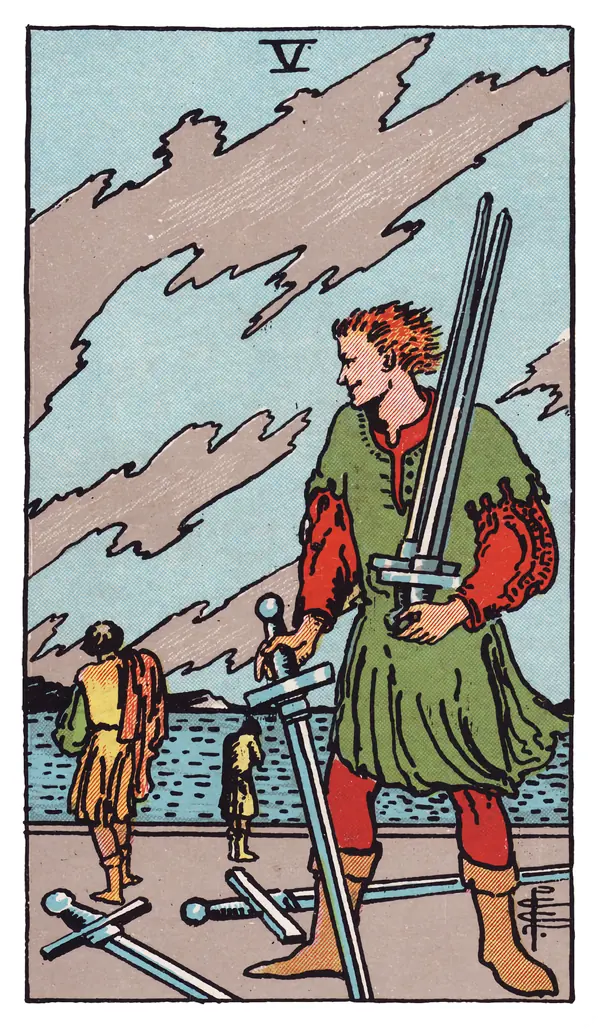 Rider–Waite–SmithFive of SwordsA win here may cost more in relationships or goodwill than it’s worth.
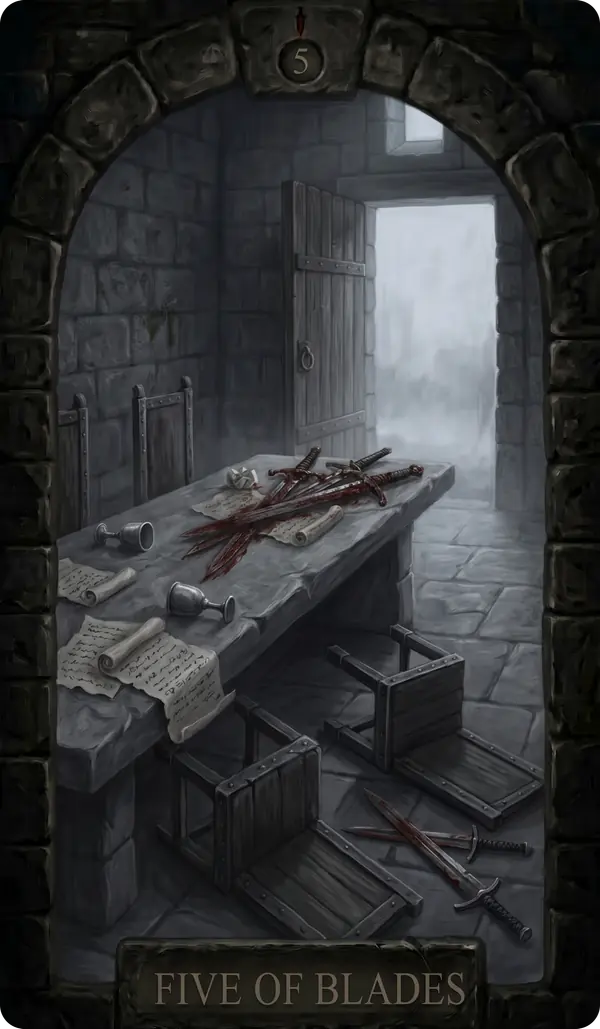 FamiliaFive of BladesThe dispute is won fairly, and the price shows at once: there is no one left to sit at the table.
 City of WindowsFive of SwordsNoticing the price of winning with words, and stepping out of the contest.
 CarnalFive of SwordsWinning a conflict can leave the shared ground damaged.
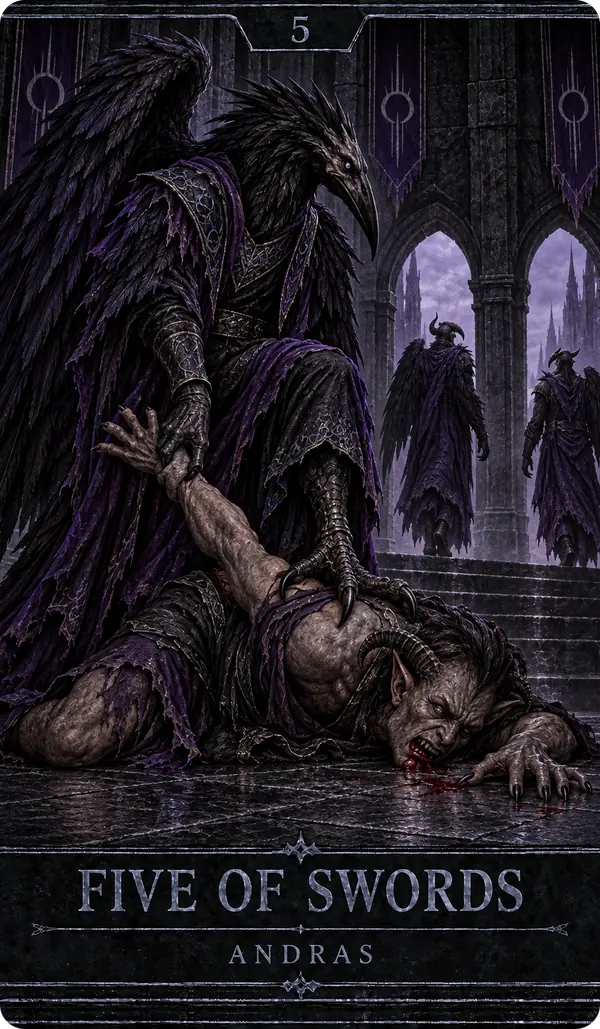 Crimson InfernoFive of SwordsAssess the cost of prevailing.
 Everyday WondersFive of SwordsWinning the argument at the cost of the relationship.
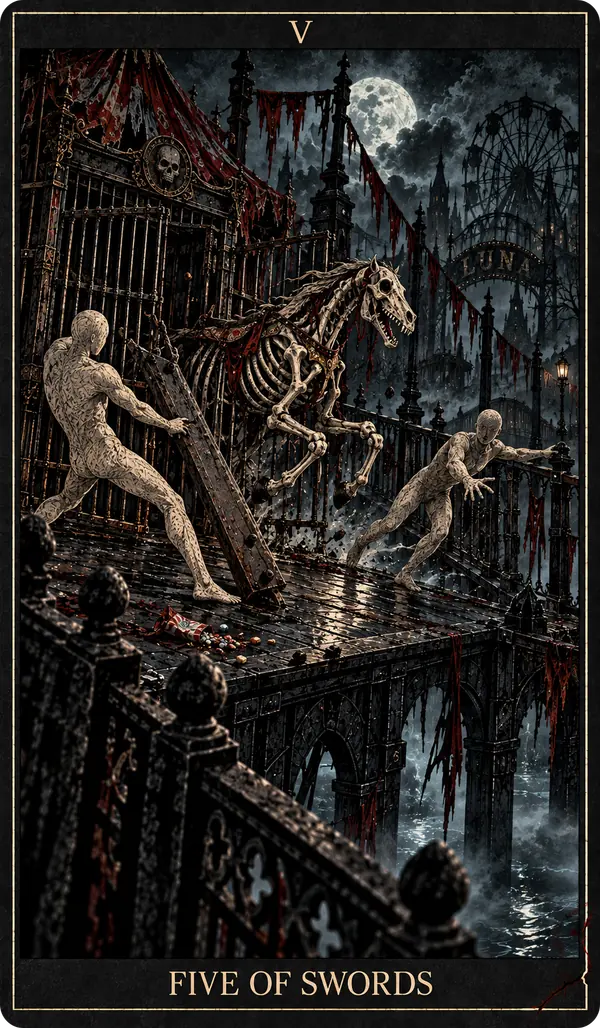 Mirror NightFive of SwordsCount the cost of a narrow victory.
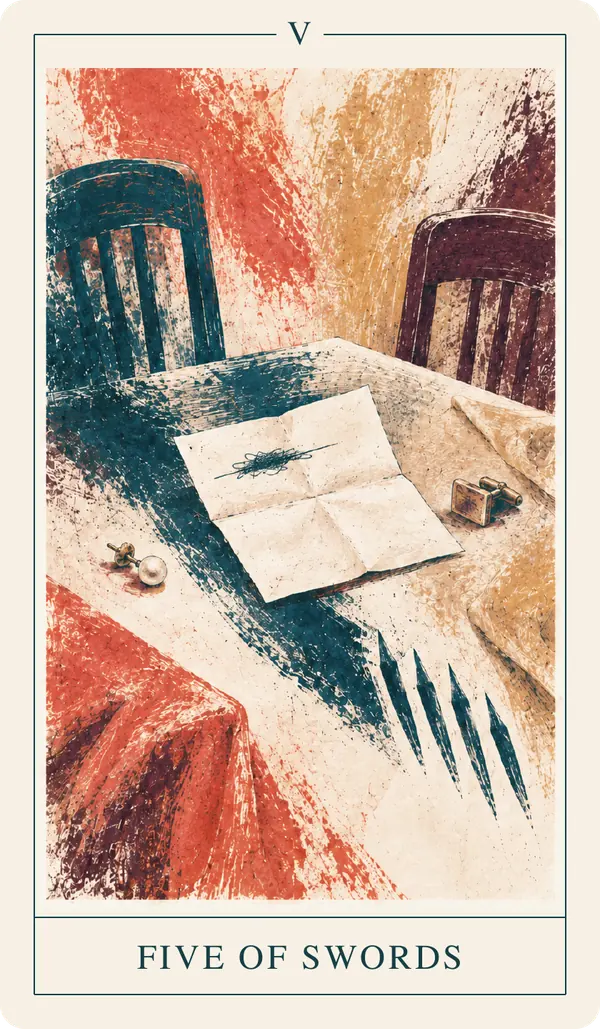 Self ContactFive of SwordsNotice the cost of winning and decide whether to disengage or repair.
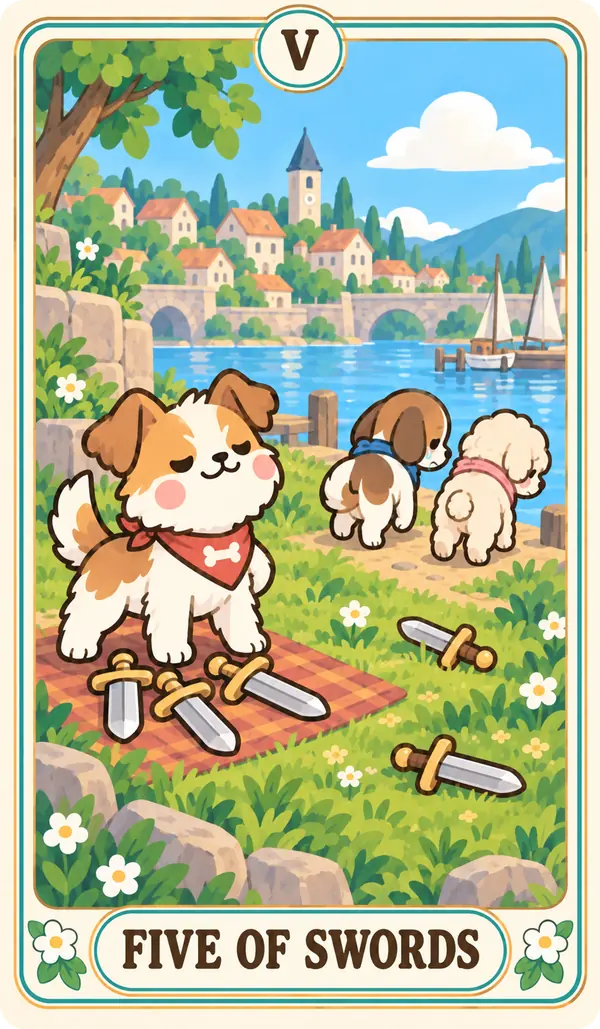 Shiba TownFive of SwordsA hollow victory; conflict; the cost of being right.
 Velvet MasqueradeFive of SwordsA victory that may cost trust.
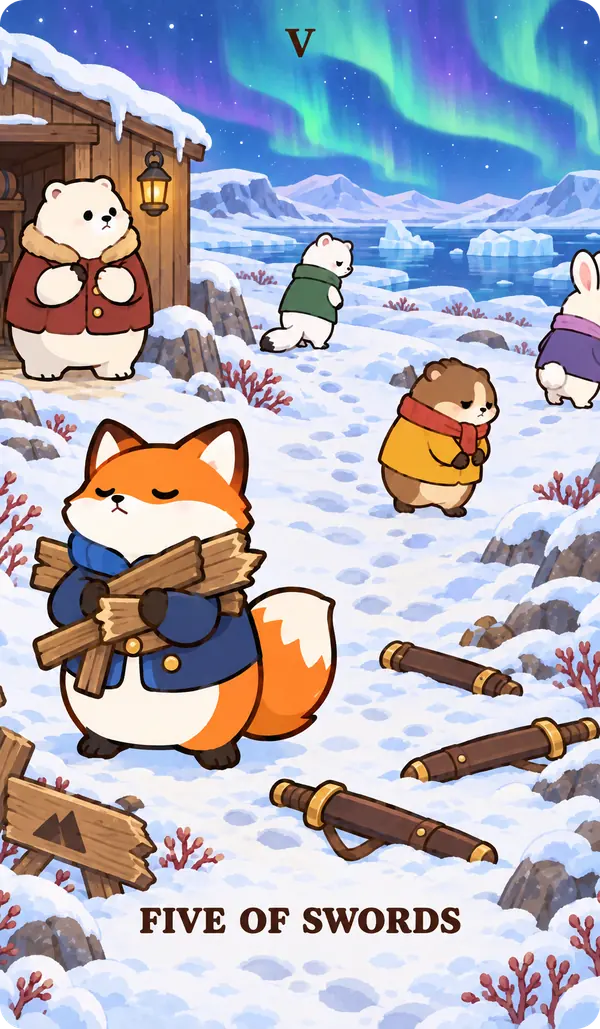 Four TrailsFive of SwordsHollow victory, conflict, damaged trust.
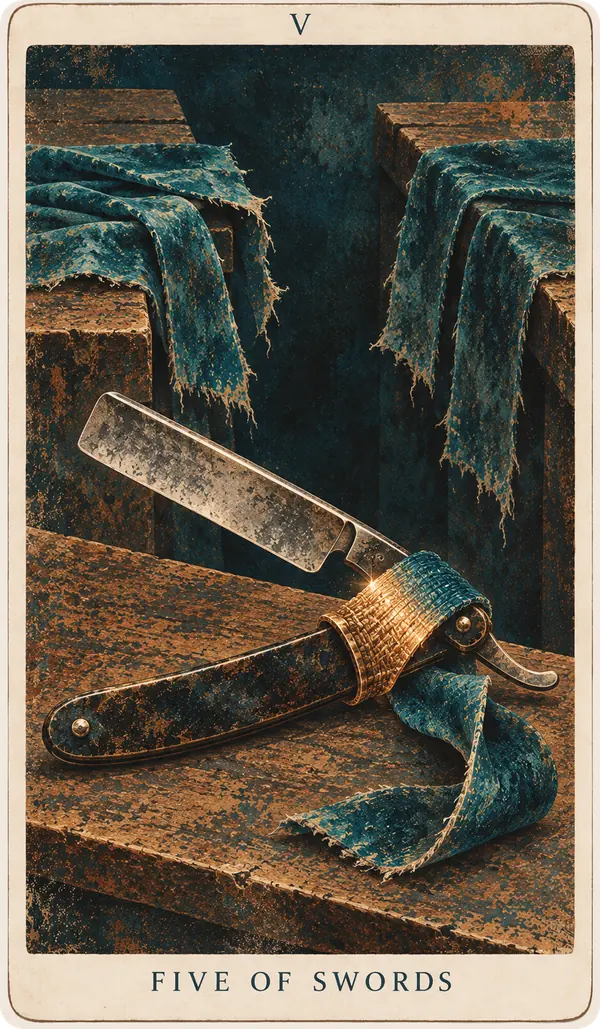 Living ThresholdFive of SwordsThe strip of cloth the razor cut and claimed shines while the shared cloth shelter falls apart.
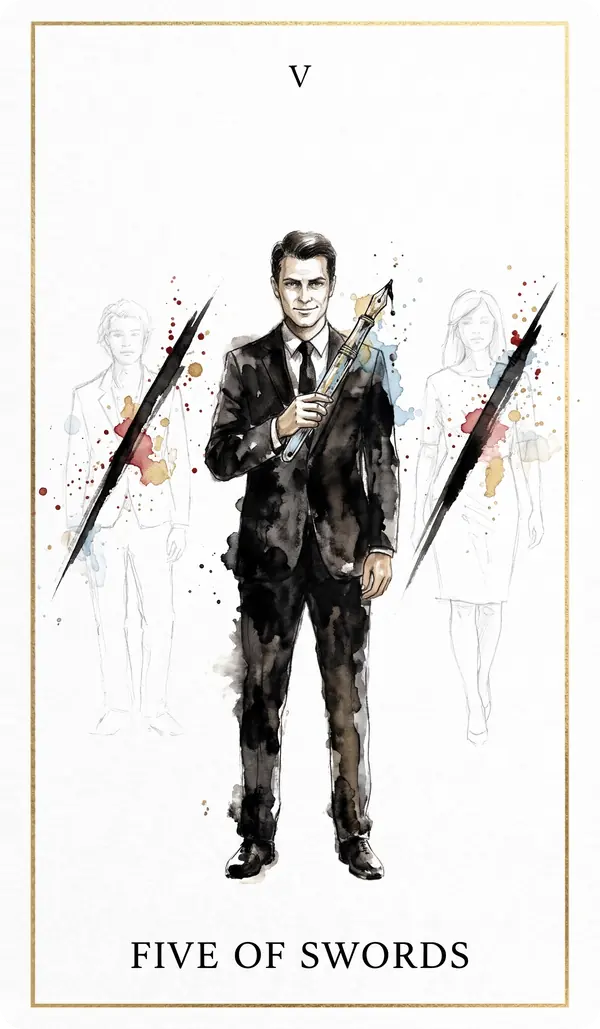 Colour of PowerFive of SwordsYou won by crossing them out; count what the win cost you.
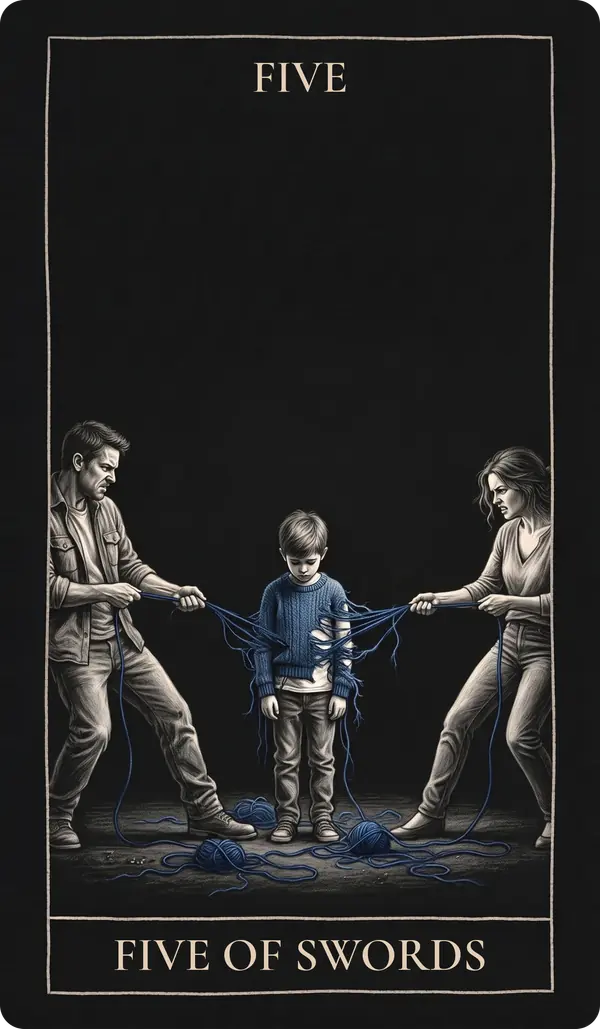 BoundFive of SwordsA quarrel won, while the one in the middle comes apart.
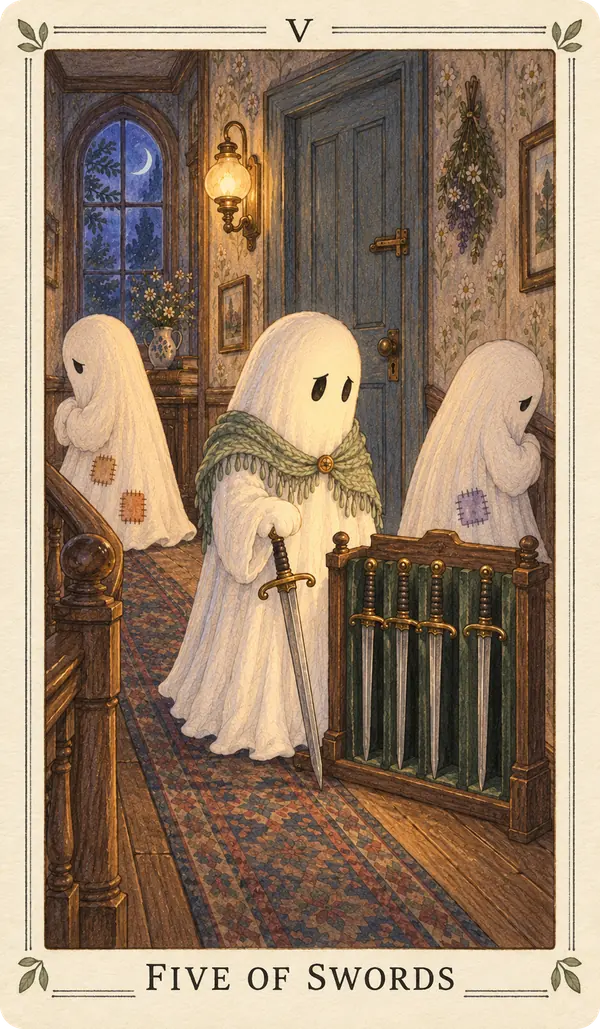 Cozy HauntFive of SwordsCount the human cost of being right.
 Celestial Night SkyFive of SwordsA fact spoken without humiliation.
Where it appears
Questions about this card
Is Five of Swords a yes or no card in Four Horsemen?
Asked as a yes or no card, Five of Swords is mixed upright: the loss stays what it is and the living are still near. Reversed, it leans no for now, because blame and refusal push away the one person still standing there. Look at what is still possible between you and the people who remain.
What does Five of Swords mean in love?
In love, Five of Swords may point to a relationship facing a loss that cannot be repaired, with both partners still beside each other. Reversed, pain may turn into blame, or one of you may push the other away. Let your partner sit with you once without either of you needing to speak.
What does Five of Swords mean reversed in Four Horsemen?
Reversed, Five of Swords describes turning pain into blame, or refusing the witness who remains. The person standing a few steps off in the picture has not left. When anger rises, name the loss first, and check whether the person you are angry with is the one who caused it.