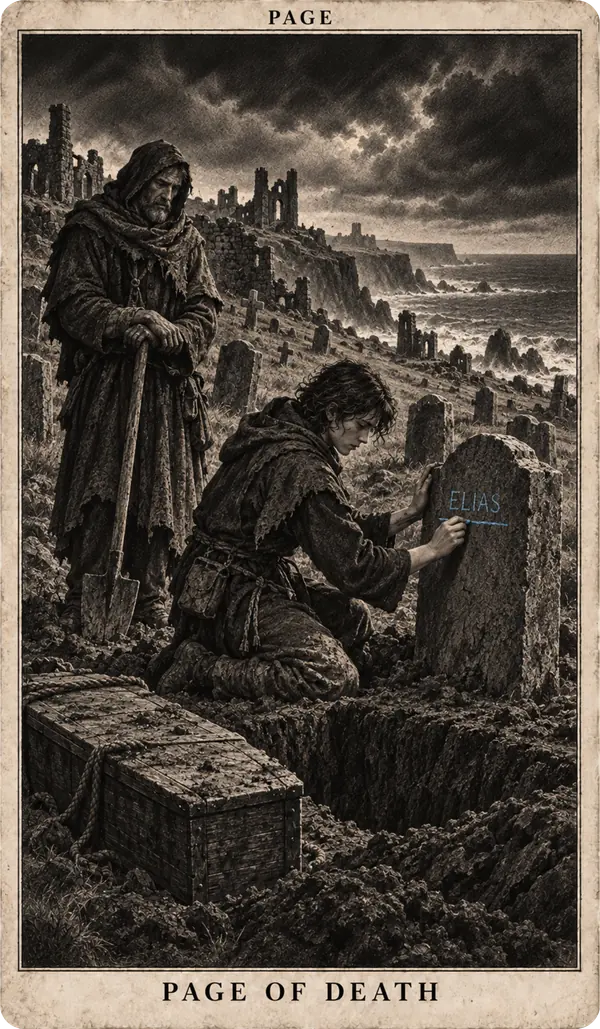
King of Death
King of Swords in Four Horsemen · Minor Arcana
LossIn short
Meet an unavoidable truth without abandoning your duty.
Reversed
Confusing authority with exemption from the limits everyone shares.
- Death
- King
- Air
- The Last Landing
- meeting an unavoidable truth
- staying answerable to one’s work
- a hand kept on the oar
Upright
Meet an unavoidable truth without abandoning your duty. At the last landing, the ferryman stands in his boat and faces the rider across its edge.
The pale horse waits on the pier, and he keeps one hand on the oar. The ferryman who carried others across in Six now meets the rider from the Ace.
He cannot choose who arrives here, and he is still the one who rows.
A question to sit with
“What is still mine to do when I cannot change the outcome?”
One step
Write down one thing you cannot change and, next to it, one part of your work around it that is still yours to do.
Reversed
Confusing authority with exemption from the limits everyone shares. Years at the oar can make a ferryman feel he stands outside the crossing he runs.
The limit on the pier applies to the one holding the oar as well.
Authority that forgets this makes decisions for others as though the same limit did not touch the one making them.
A question to sit with
“Which limit do I set for others that I have excused myself from?”
One step
Notice one place where you ask others to accept a limit you do not accept yourself, and write it down.
How this deck reads reversed cards
Reversed, the act on the card turns inward, meets an obstacle, grows harsher or shows its price. On this road a reversal is not automatically the opposite, and not automatically something worse.
In love
In love, some limits may be beyond either of you, and your part is still yours.
- Supports
- Staying present where you cannot fix.
- Watch for
- Blaming each other for what nobody controls.
- One step
- Name together one thing you cannot change and one thing you can each do.
A partner may act as though the usual limits do not apply to them.
- Supports
- Equal rules for both.
- Watch for
- Rank or status used to avoid hard facts.
- One step
- Name one rule in the relationship that should apply to both of you equally.
At work
You may be answerable at work for a situation you cannot alter.
- Supports
- Clear judgement and a steady hand.
- Watch for
- Abandoning your post because you cannot change the result.
- One step
- Write down what is still your duty in the situation, and do the first part of it.
Authority at work may be used to escape limits that others must accept.
- Supports
- Leaders who follow their own rules.
- Watch for
- Exemption presented as responsibility.
- One step
- Check one rule you set for others and see whether you keep it too.
How to act when the result is beyond your control may be what the choice turns on.
- Supports
- Knowing where your duty lies.
- Watch for
- Refusing to act because you cannot win.
- One step
- Choose the action you could stand behind whatever happens.
A choice may be made as though your position protects you from what follows.
- Supports
- Asking what you would expect of anyone else.
- Watch for
- Deciding for others what you would not accept yourself.
- One step
- Imagine someone without your authority making this choice, and note what changes.
Growth may mean holding responsibility without needing control.
- Supports
- Humility about limits.
- Watch for
- Despair dressed as realism.
- One step
- Each evening this week, note one thing you did well within your limits.
No role puts anyone beyond shared limits, and you may be learning that now.
- Supports
- Honest feedback from the people you lead.
- Watch for
- Pride that confuses power with safety.
- One step
- Ask one person you are responsible for where you seem to exempt yourself.
A family may face a limit together, with one person still answerable for what can be done.
- Supports
- Shared acceptance of what nobody can change.
- Watch for
- Leaving one person to carry every decision.
- One step
- Ask who in the family is carrying the most responsibility, and offer to share one task.
The head of a household may behave as though family rules apply only to others.
- Supports
- Rules everyone keeps.
- Watch for
- Children learning that power means exemption.
- One step
- Keep one house rule yourself this week, the same as everyone.
Yes or no
MixedNoYou can act well but cannot alter what arrives, so the answer is mixed.
Supports
- Your duty is still yours.
- Clear judgement is available.
Limits
- The result may be out of your hands.
- The limit applies to you as well.
One step
Separate what you can change from what you can only meet.
A choice that assumes exemption from shared limits leans no.
Supports
- Admitting the limit is still possible.
- Others can hold you to account.
Limits
- Authority may be mistaken for exemption.
- Rules may be kept for others only.
One step
Picture someone without your position giving this answer, and see whether you would accept it.
What is in the picture
At the last landing, the ferryman faces Death across the edge of his boat. The pale horse stands on the pier, its rider waiting. The ferryman keeps a hand on his oar. He has reached a crossing where his duty remains even though he cannot alter who has arrived.
The ferryman meets the same limit as everyone he has carried and remains answerable to his work.
- ferryman with his oar
- boat at the last landing
- pale horse on the pier
- hooded rider in black
- tattered banner on a wooden post
- drowned city of towers
- dark blue channel
This card in other decks
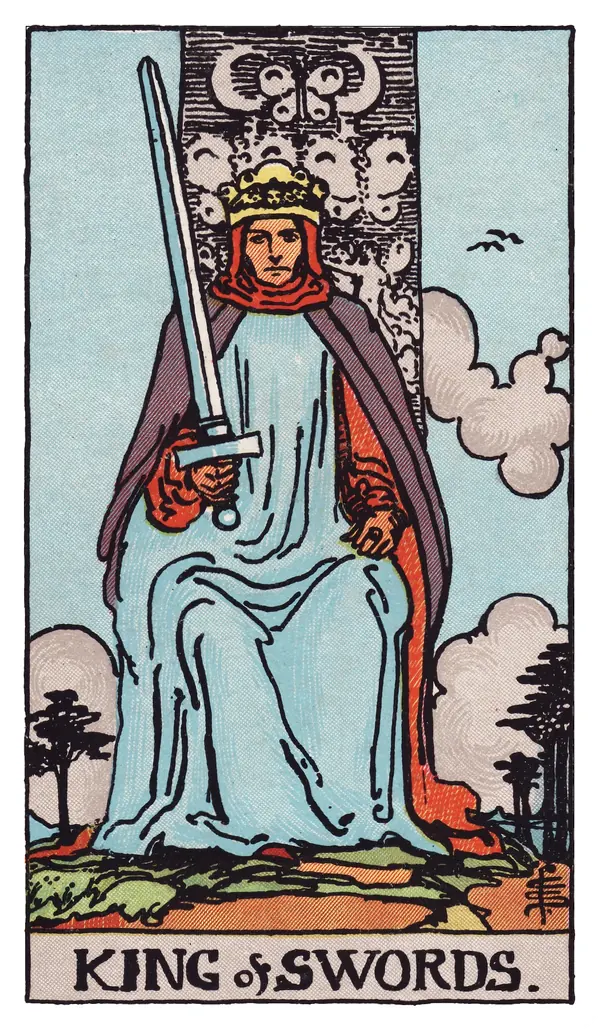 Rider–Waite–SmithKing of SwordsClear, rational judgment and fair authority are available right now, worth applying with real discipline.
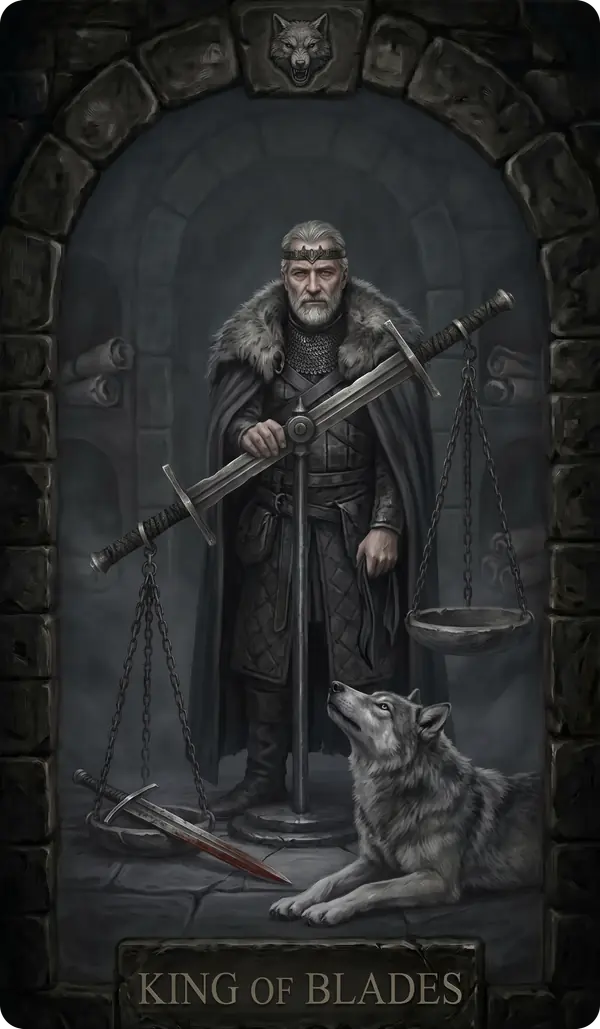 FamiliaKing of BladesThe scales are tipped by someone ready to answer for the tipping, and that is why the judgment finally ends.
 City of WindowsKing of SwordsApplying one measure to yourself and to others, telling testimony apart from guesswork, and answering for your words.
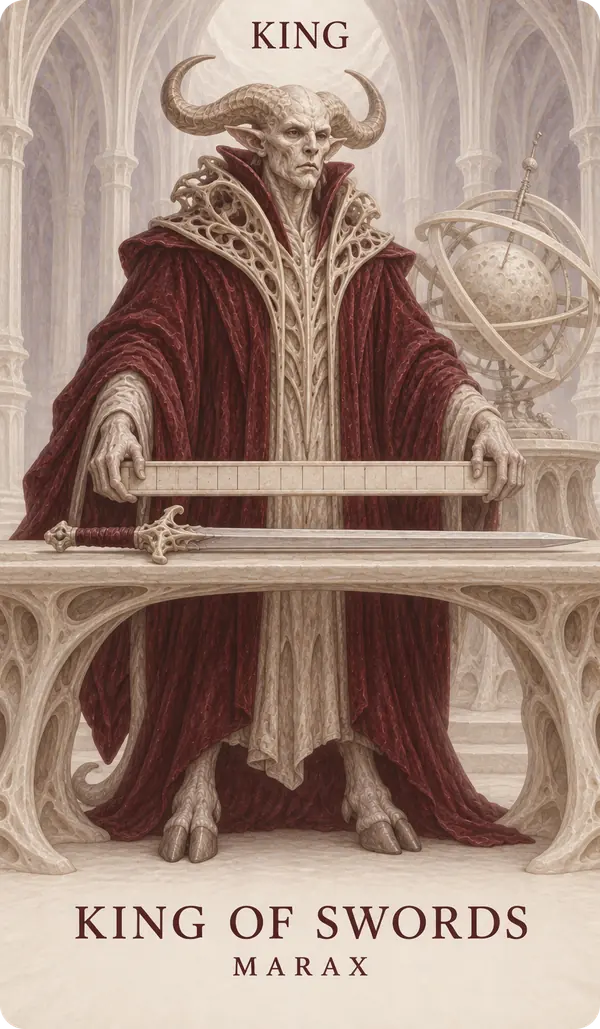 CarnalKing of SwordsJudgment organized into a consistent standard.
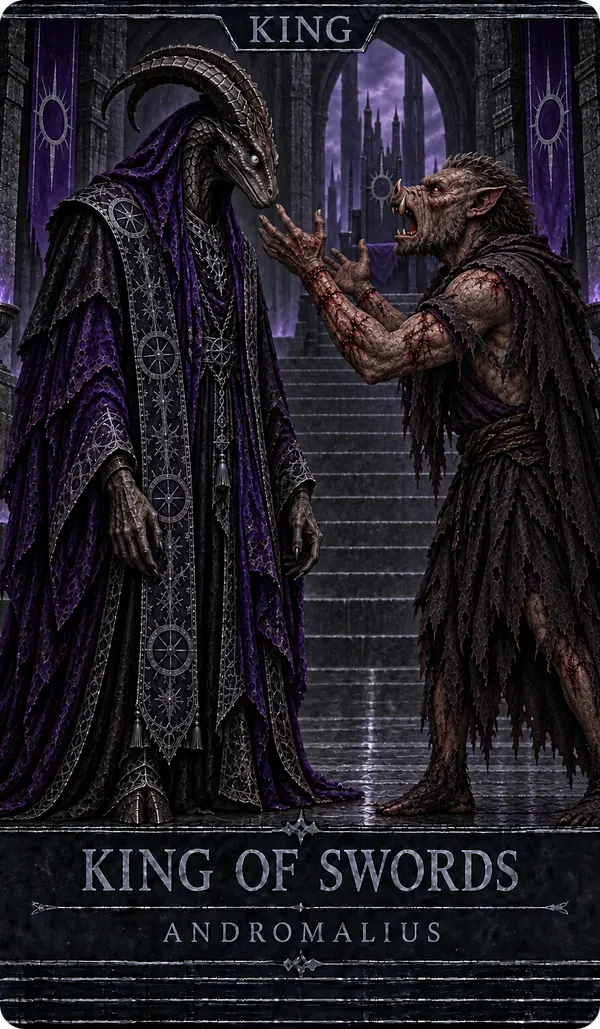 Crimson InfernoKing of SwordsUse reason with accountability.
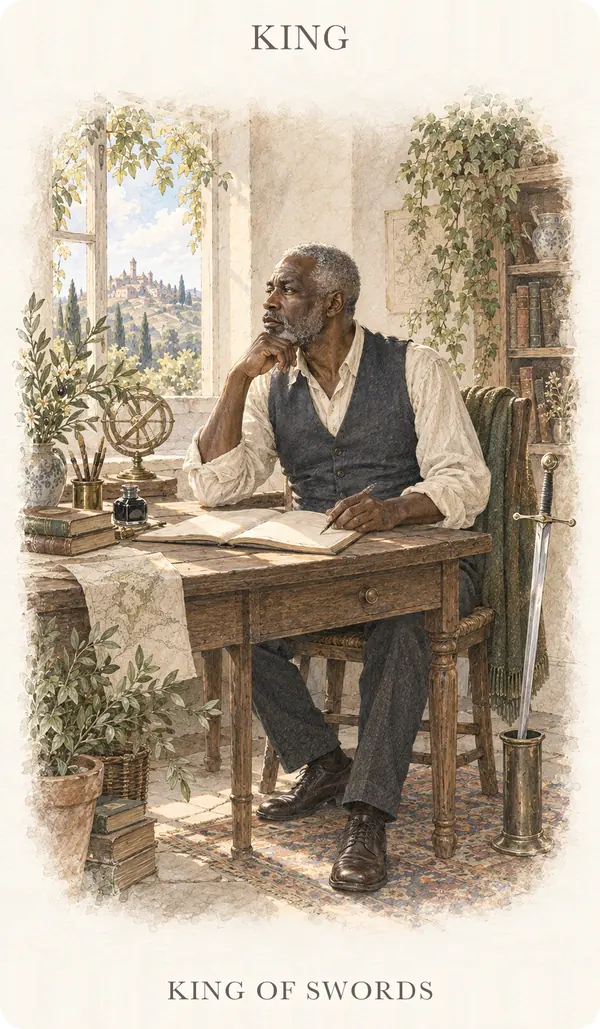 Everyday WondersKing of SwordsTaking responsibility for your judgments and welcoming questions.
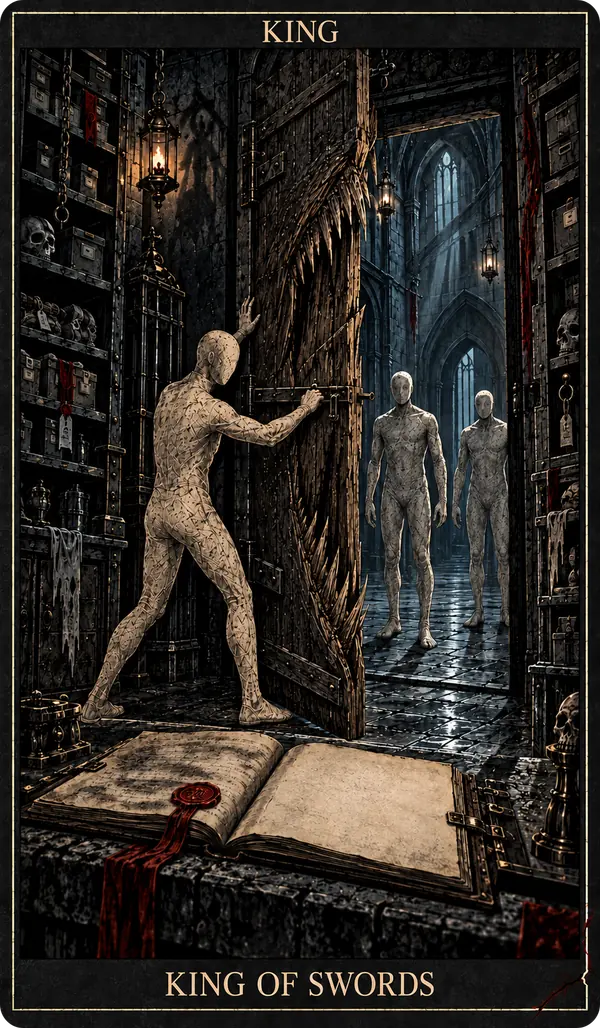 Mirror NightKing of SwordsLet others examine what is known and what remains uncertain.
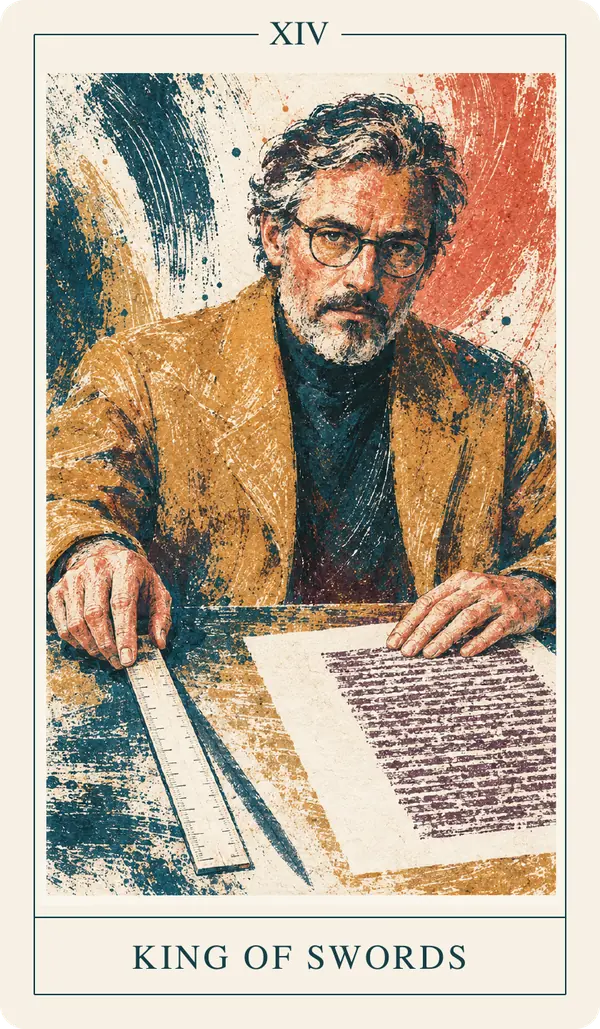 Self ContactKing of SwordsApply reason consistently, including to your own preferred explanation.
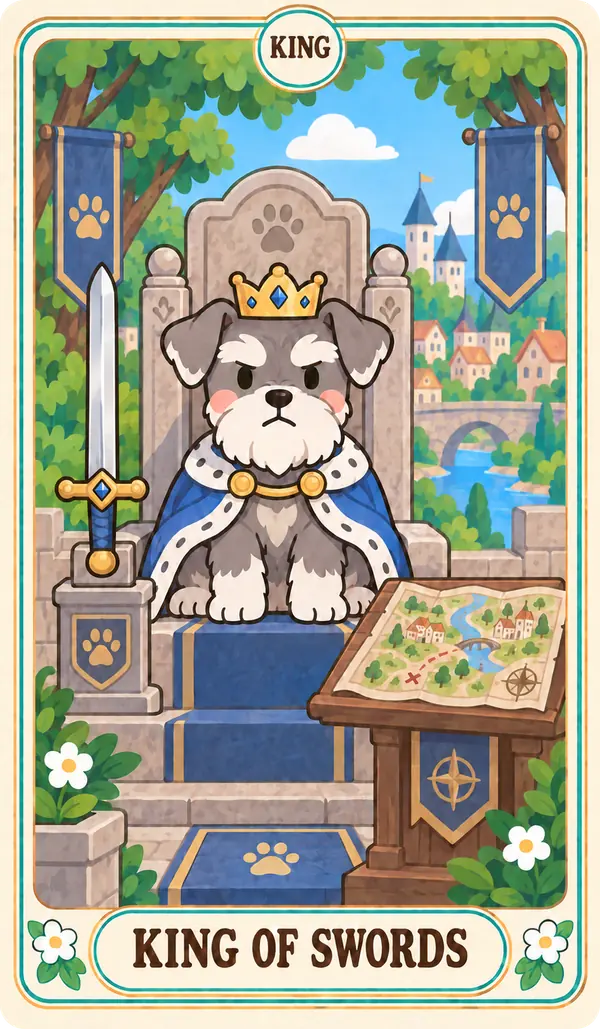 Shiba TownKing of SwordsReason; ethical judgment; clear standards.
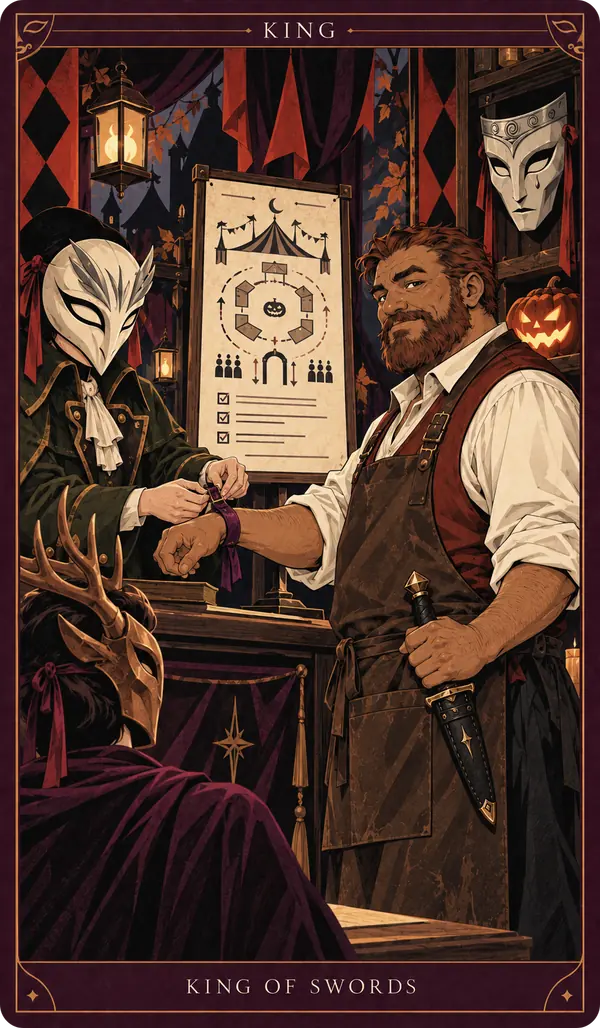 Velvet MasqueradeKing of SwordsA shared standard that includes its keeper.
 Four TrailsKing of SwordsClear judgment, reason, accountability.
 Living ThresholdKing of SwordsA visible rule makes the reach of a protective boundary clear.
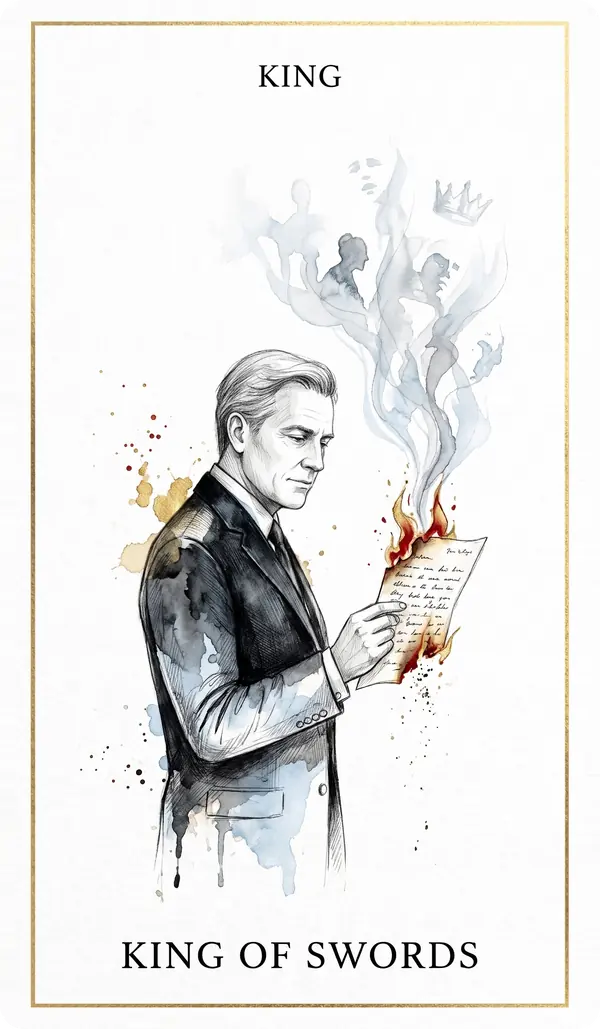 Colour of PowerKing of SwordsYou decide what the world will know and what goes with you.
 BoundKing of SwordsA mind that tells the truth and keeps its own wrist bound.
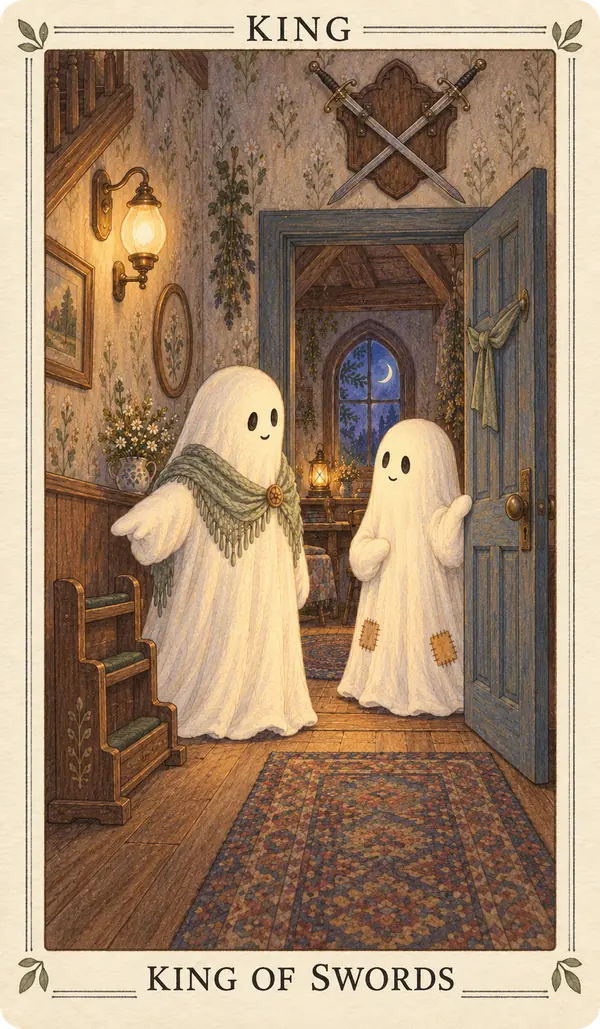 Cozy HauntKing of SwordsApply reason with consent and consistency.
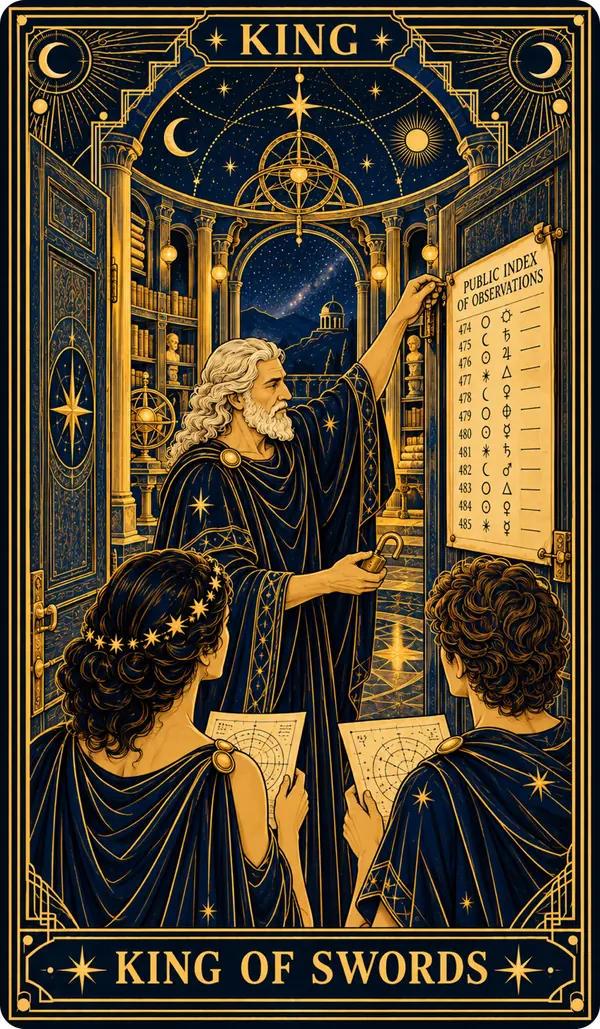 Celestial Night SkyKing of SwordsAn open way to question.
Where it appears
Questions about this card
Is King of Swords a yes or no card in Four Horsemen?
Upright, King of Swords is mixed: you can act well but cannot alter what arrives. Reversed, it leans no, since a choice that assumes exemption from shared limits does not hold. Separate what you can change from what you can only meet, and picture someone without your position giving this answer.
What does King of Swords mean in love?
For a relationship, King of Swords may point to some limits being beyond either of you, with your part still yours. Reversed, a partner may act as though the usual limits do not apply to them. Name together one thing you cannot change and one thing you can each do.
What does King of Swords mean reversed in Four Horsemen?
King of Swords reversed describes confusing authority with exemption from the limits everyone shares. The ferryman keeps his hand on the oar and does not pretend the rider is not there. Name one rule in the relationship that should apply to both of you equally, and ask whether you would accept it from someone else.