Five of Swords
Minor Arcana · Swords
In short
A win here may cost more in relationships or goodwill than it’s worth.
Reversed
You may be ready to repair the damage from a past conflict, letting go of needing to have won.
- Swords
- Five
- Air
- The Contender
- a hollow or costly win
- conflict that damages relationships
- winning at the expense of goodwill
Upright
The Five of Swords favors recognizing when winning a conflict has come at a real cost: damaged trust, resentment, or a relationship that won’t easily recover. It asks whether the victory is worth what it took.
This card doesn’t say to never stand your ground, but it questions conflict pursued purely to dominate rather than resolve something fairly.
It rewards honest reflection on what was gained versus lost.
A question to sit with
“What did a recent win cost you in trust or goodwill?”
One step
Consider one way to repair goodwill after a conflict you technically won.
Reversed
Reversed, the Five of Swords can mean choosing to repair a relationship instead of holding onto a win, releasing the need to be right in favor of something more valuable. It can also mean still carrying resentment from a conflict that technically ended, unable to let the win or loss go.
The card asks whether you’re ready to move past the need to win, or still stuck replaying who came out ahead.
A question to sit with
“Are you ready to move past needing to have won, or still replaying who came out ahead?”
One step
Reach out to repair one relationship strained by a past conflict.
How this deck reads reversed cards
Turned over, the scene keeps its energy and changes how it flows: blocked, turned inward, exaggerated or handled carelessly. A reversed card has its own meaning, never the flat opposite.
In love
Winning an argument in this relationship may be costing more in trust than the point is worth.
- Supports
- Your ability to recognize the cost once you look honestly.
- Watch for
- Don’t prioritize being right over the relationship itself.
- One step
- Choose repair over winning in your next disagreement.
Repairing a relationship strained by a past conflict may mean letting go of who was right.
- Supports
- A gesture of repair still open to make.
- Watch for
- Don’t repair on the surface while still holding resentment underneath.
- One step
- Reach out with a real gesture of repair.
At work
A workplace conflict won on technical grounds may be costing real goodwill with colleagues.
- Supports
- Your capacity to see the bigger professional picture.
- Watch for
- Don’t let a technical win damage a working relationship you’ll need later.
- One step
- Repair goodwill with a colleague after a recent disagreement.
Moving past a workplace conflict and rebuilding the working relationship may be within reach for you now.
- Supports
- Your capacity to let go of needing to have won the point.
- Watch for
- Don’t carry resentment into the repair you’re attempting.
- One step
- Take one concrete step to rebuild the working relationship.
Choosing between being right and preserving an important relationship may be exactly what this decision asks of you.
- Supports
- Your willingness to value the relationship over winning the point.
- Watch for
- Don’t sacrifice an important relationship just to prove a point.
- One step
- Choose the option that preserves the relationship, if the point isn’t essential.
Letting go of a past conflict may finally make this decision easier to see clearly.
- Supports
- Freedom that comes from no longer needing to win the old argument.
- Watch for
- Don’t let old resentment quietly shape this new decision.
- One step
- Decide based on the present situation, separate from the old conflict.
Winning isn’t always worth what it costs in relationships, and learning that is real growth.
- Supports
- Willingness to value connection over always being right.
- Watch for
- Don’t confuse growth with never standing your ground at all.
- One step
- Let go of one need to be right that’s costing you a relationship.
Growth includes releasing the need to have won an old conflict that no longer serves you.
- Supports
- Your readiness to finally let it go.
- Watch for
- Don’t judge yourself for how long you held onto it.
- One step
- Consciously release one old need to have been right.
Winning a family argument may cost more goodwill than it’s worth.
- Supports
- Choosing peace over pride.
- Watch for
- Needing the last word.
- One step
- Let one family disagreement rest without a winner.
Mending after a quarrel may be within the family’s reach, once winning stops mattering.
- Supports
- Apologies and small repairs.
- Watch for
- Keeping score of old fights.
- One step
- Offer a short apology for your part in any family argument that still lingers.
Yes or no
NoMixedThis can be won, and what it would take to win it costs more than the point being argued.
Supports
- The relationship involved is genuinely worth more than winning this specific point.
- Repair is realistically possible if you choose it.
Limits
- Pride may be pushing toward winning at any cost.
- Trust already damaged may take real time to rebuild.
One step
Weigh what winning would cost against what repair could restore.
Choosing repair over being right and quietly replaying who won look similar, and only one is finished.
Supports
- You can name what repair would look like.
- The other party would likely be open to it.
Limits
- Old resentment may still be harder to release than it seems.
- Pride about having been right could resurface.
One step
Reach out with one small gesture of repair and see how it’s received.
What is in the picture
A figure smugly collects swords while two others walk away dejected in the background, under a stormy sky.
The winner’s smug collecting of swords in the foreground against the defeated figures walking away keeps the hollowness of the win visually central.
- figure collecting swords
- two dejected figures walking away
- stormy sky
- smug expression
- scattered swords on the ground
- turbulent water
This card in other decks
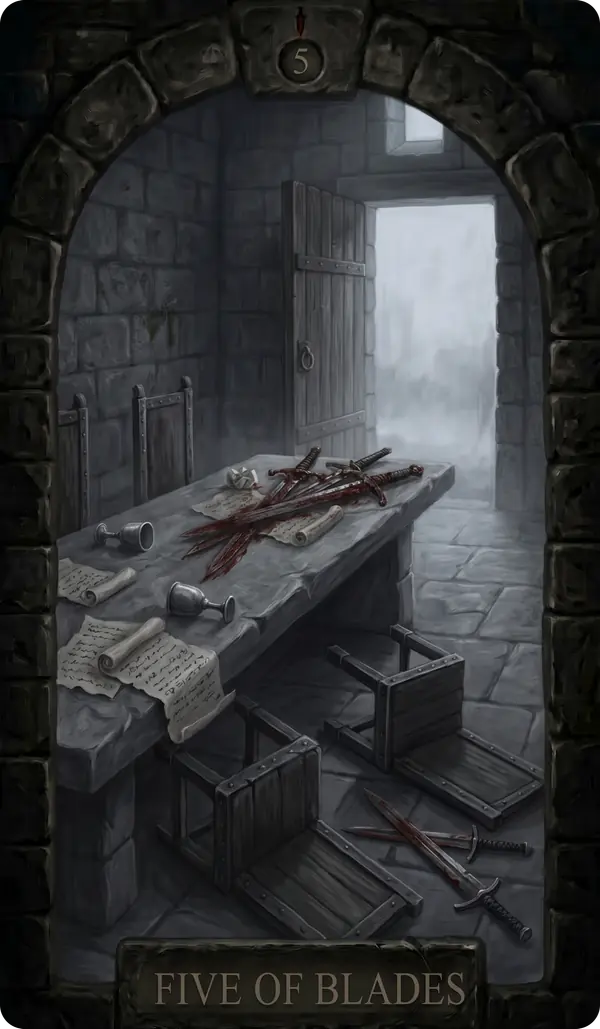 FamiliaFive of BladesThe dispute is won fairly, and the price shows at once: there is no one left to sit at the table.
 City of WindowsFive of SwordsNoticing the price of winning with words, and stepping out of the contest.
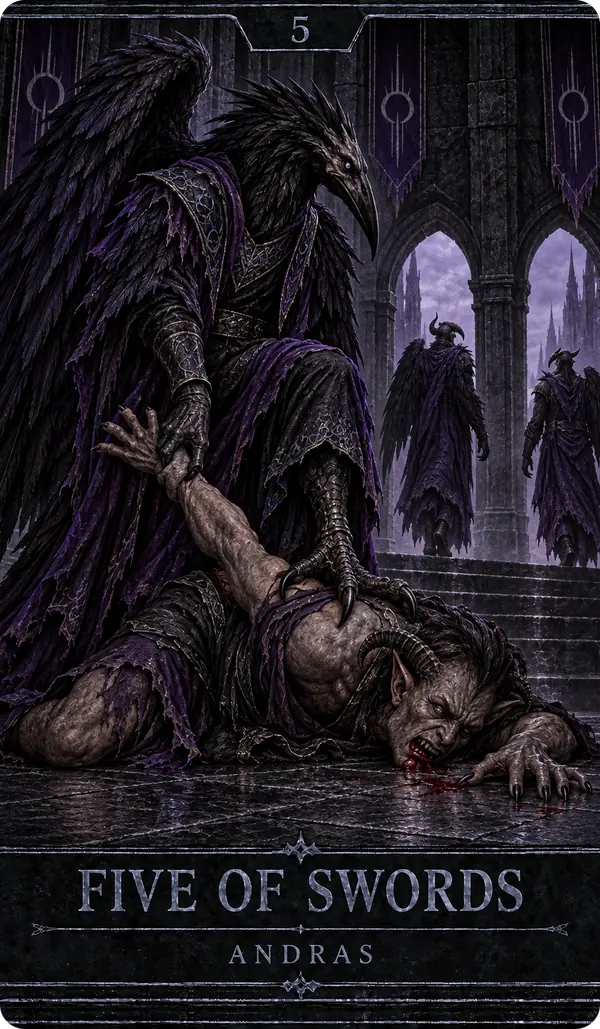
 CarnalFive of SwordsWinning a conflict can leave the shared ground damaged.
 Crimson InfernoFive of SwordsAssess the cost of prevailing.
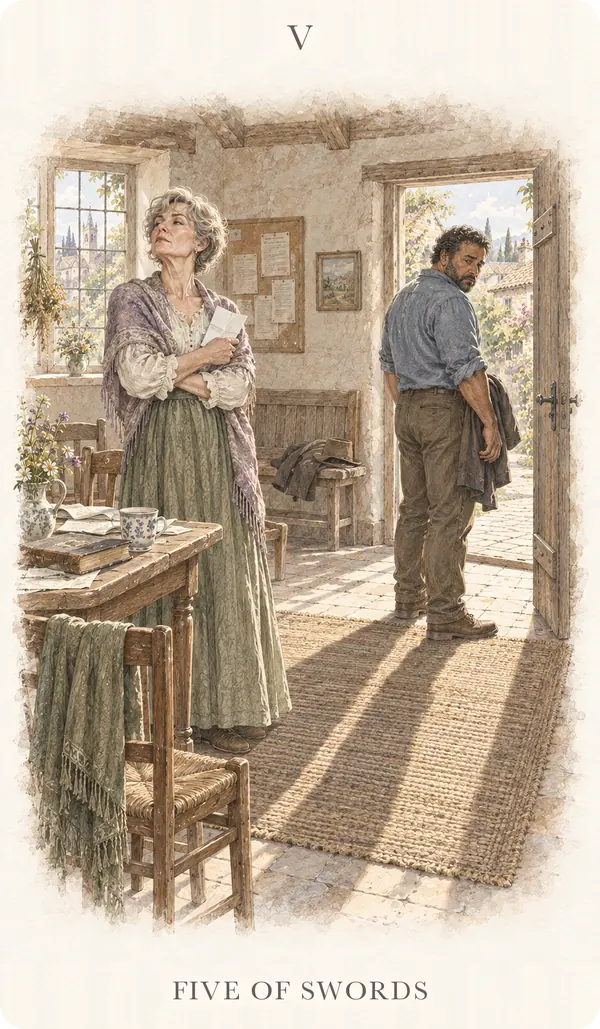 Everyday WondersFive of SwordsWinning the argument at the cost of the relationship.
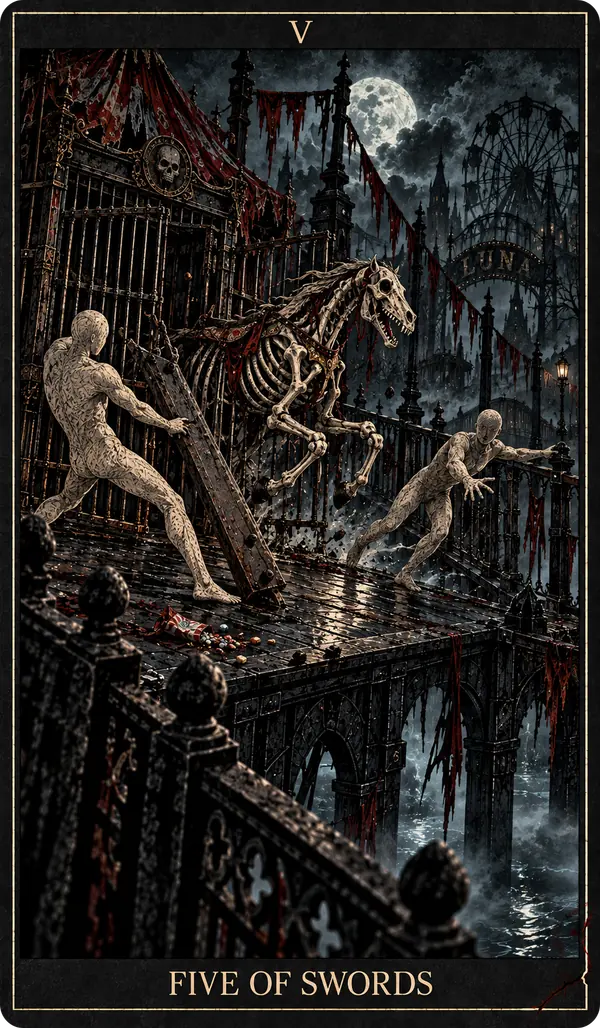 Mirror NightFive of SwordsCount the cost of a narrow victory.
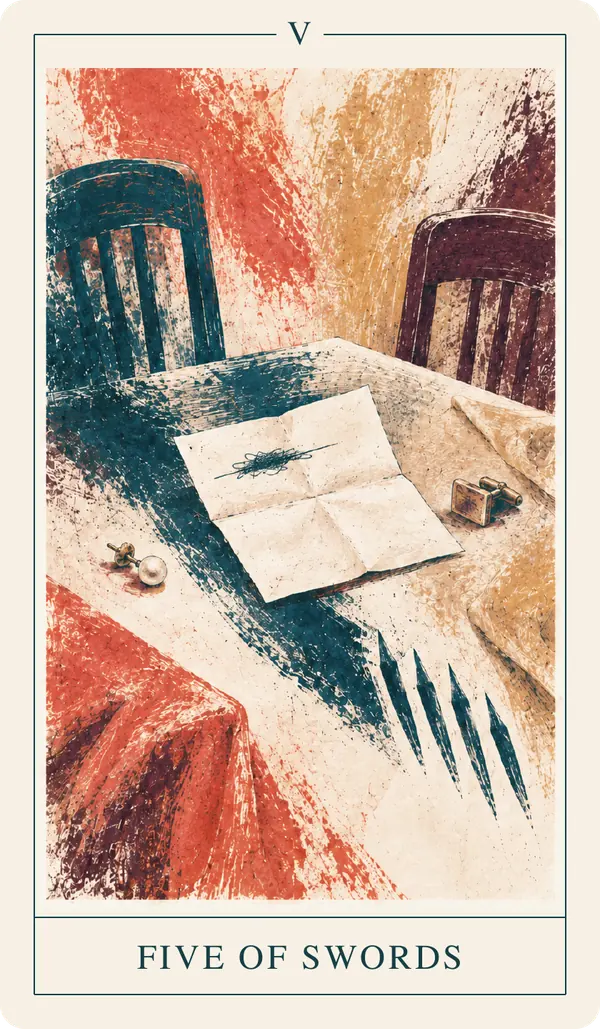 Self ContactFive of SwordsNotice the cost of winning and decide whether to disengage or repair.
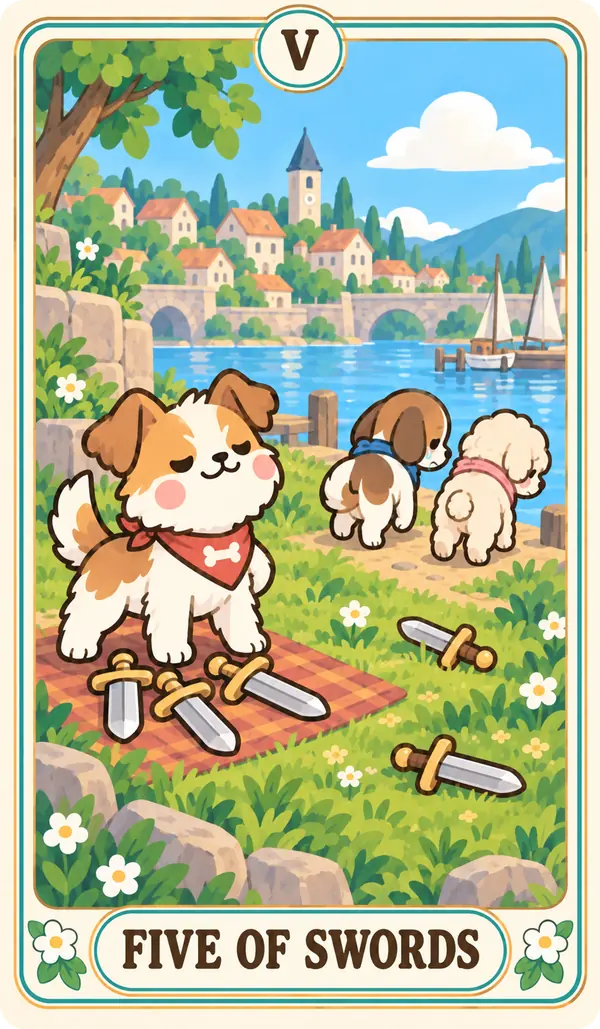 Shiba TownFive of SwordsA hollow victory; conflict; the cost of being right.
 Velvet MasqueradeFive of SwordsA victory that may cost trust.
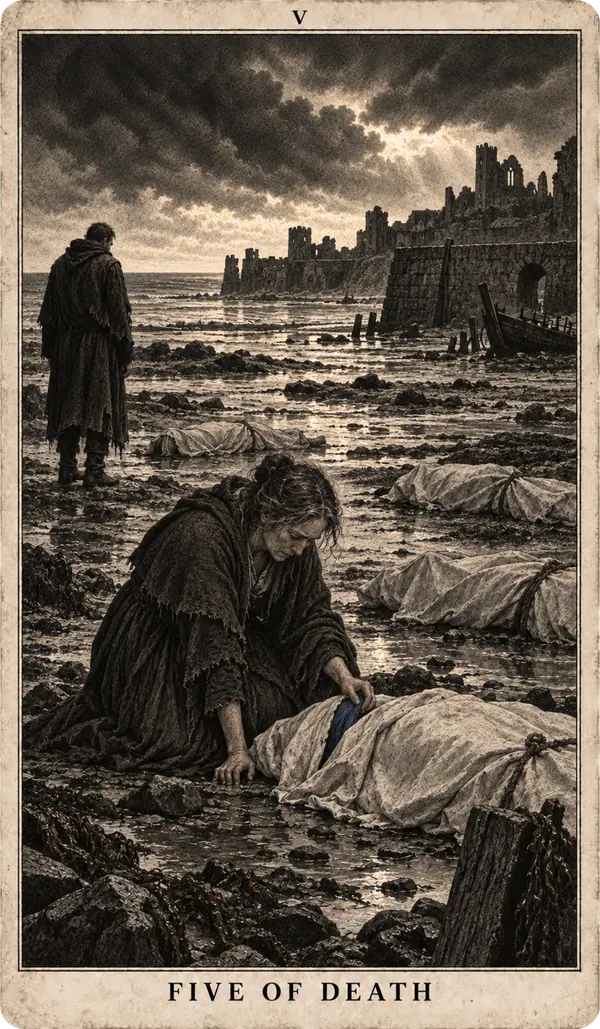 Four HorsemenFive of DeathFace the loss without abandoning the living beside it.
 Four TrailsFive of SwordsHollow victory, conflict, damaged trust.
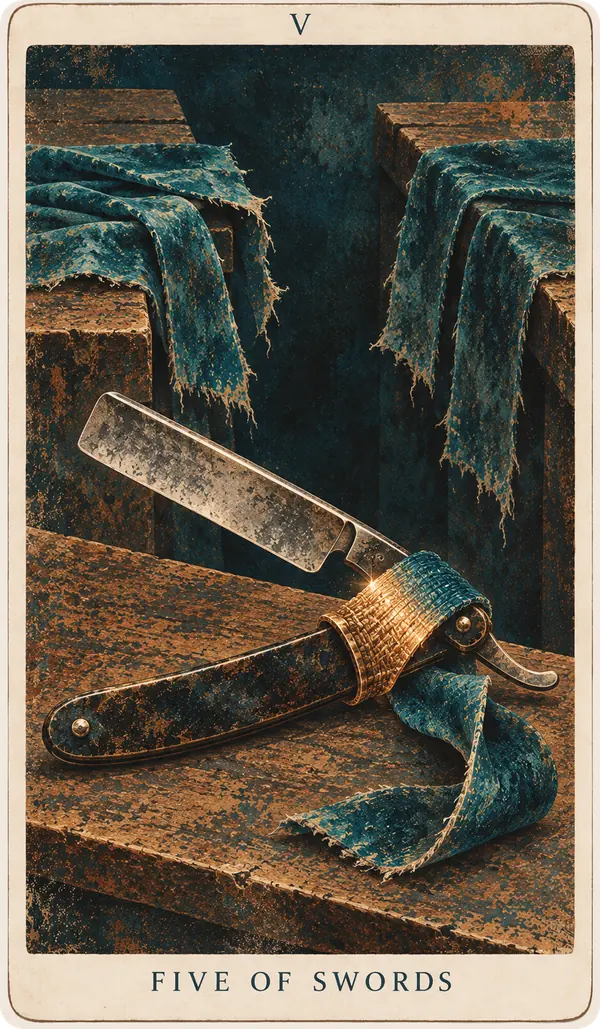 Living ThresholdFive of SwordsThe strip of cloth the razor cut and claimed shines while the shared cloth shelter falls apart.
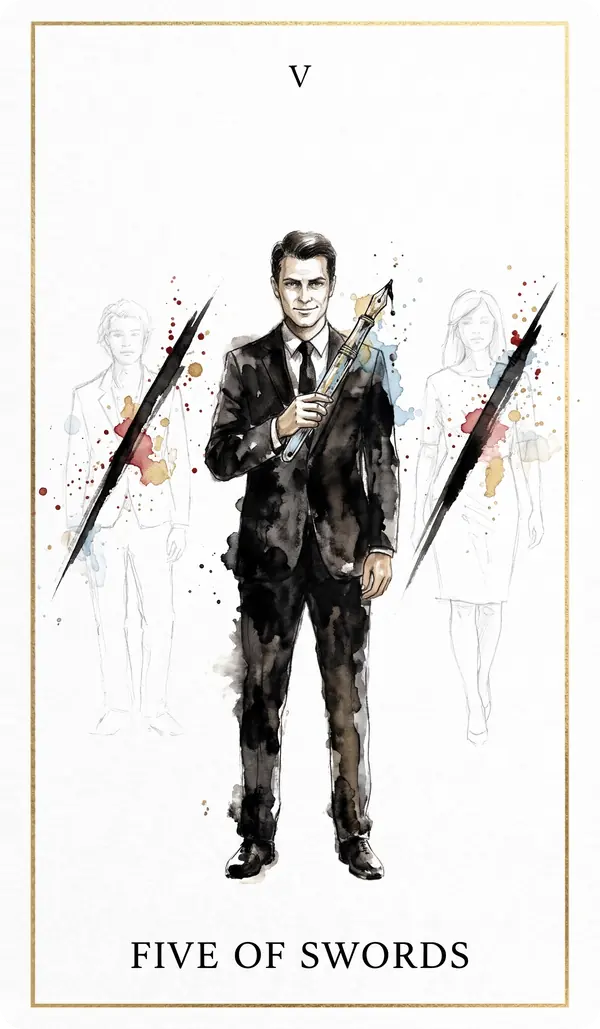 Colour of PowerFive of SwordsYou won by crossing them out; count what the win cost you.
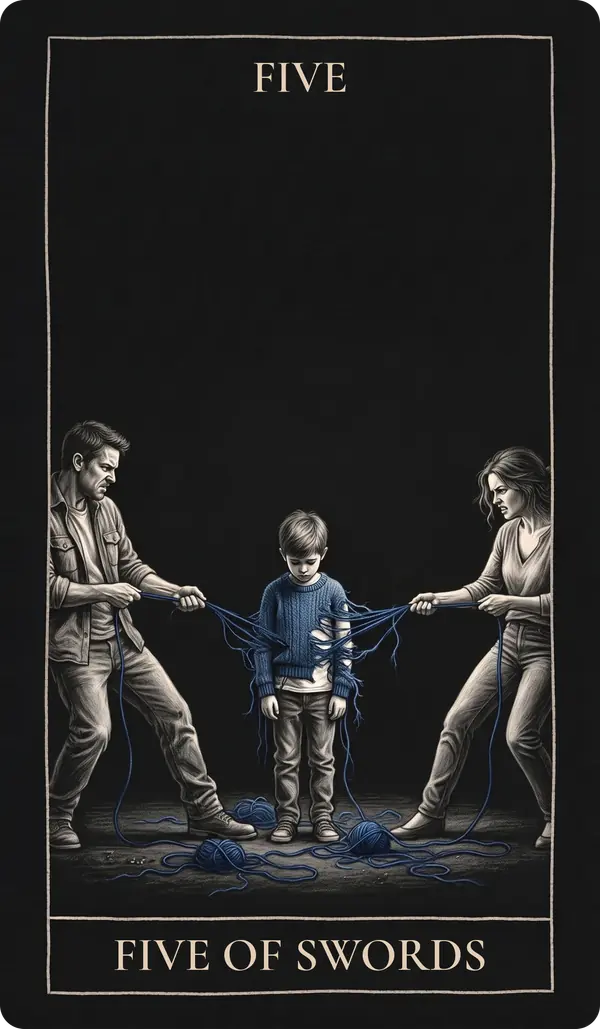 BoundFive of SwordsA quarrel won, while the one in the middle comes apart.
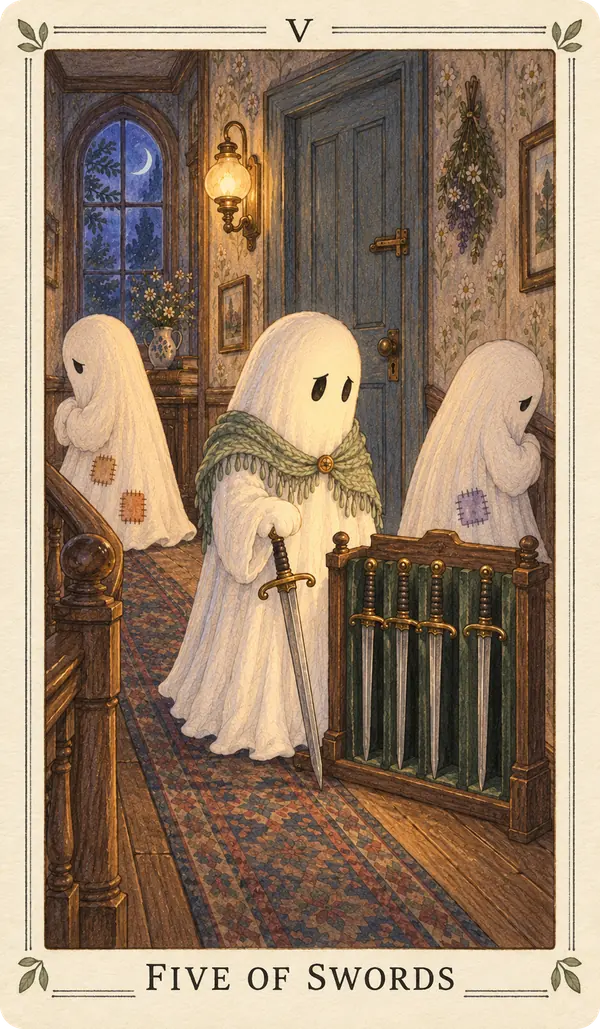 Cozy HauntFive of SwordsCount the human cost of being right.
 Celestial Night SkyFive of SwordsA fact spoken without humiliation.
Where it appears
Questions about this card
Is the Five of Swords a yes or no card?
Upright, the Five of Swords leans no. The point may well be winnable, but what it would take to win costs more than the point itself. Reversed, the lean is mixed: choosing repair over being right looks a lot like quietly replaying who won, and only the first of the two is actually finished.
What does the Five of Swords mean in love?
Upright in a love reading, the Five of Swords asks whether winning an argument is costing more trust than the point is worth. It is a hard card about hollow victories: someone can be right and still leave the relationship worse off. Reversed, it points to repair after a conflict, which usually means letting go of who was right. The card asks you to look at your own part, not to assign blame.
What does the Five of Swords reversed mean?
Reversed, the Five of Swords turns toward the aftermath of a conflict. It can mean being ready to repair the damage and look for a fairer resolution, letting go of the need to have won. It can also describe a fight that is over on paper but still replayed in your head. The card leaves you to judge which of the two is happening, and whether the repair is real.