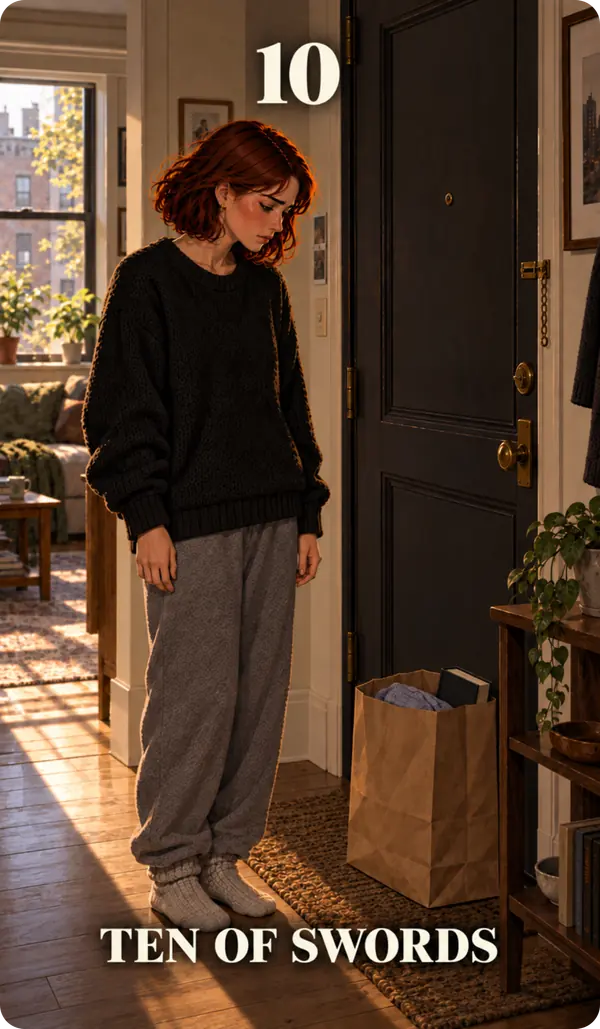
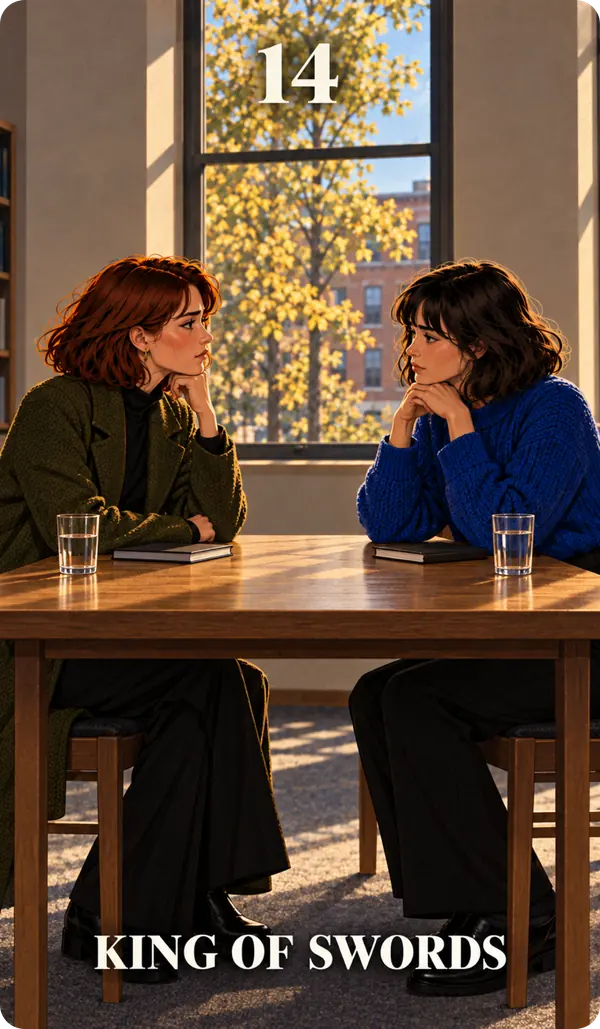
Five of Swords
Five of Swords in City of Windows · Minor Arcana
RelationshipsIn short
Noticing the price of winning with words, and stepping out of the contest.
Reversed
An apology without any change in how you argue, or a readiness to stop landing blows on each other.
- Swords
- Five
- Air
- The Contest Quitter
- argument as a contest
- winning at the cost of trust
Upright
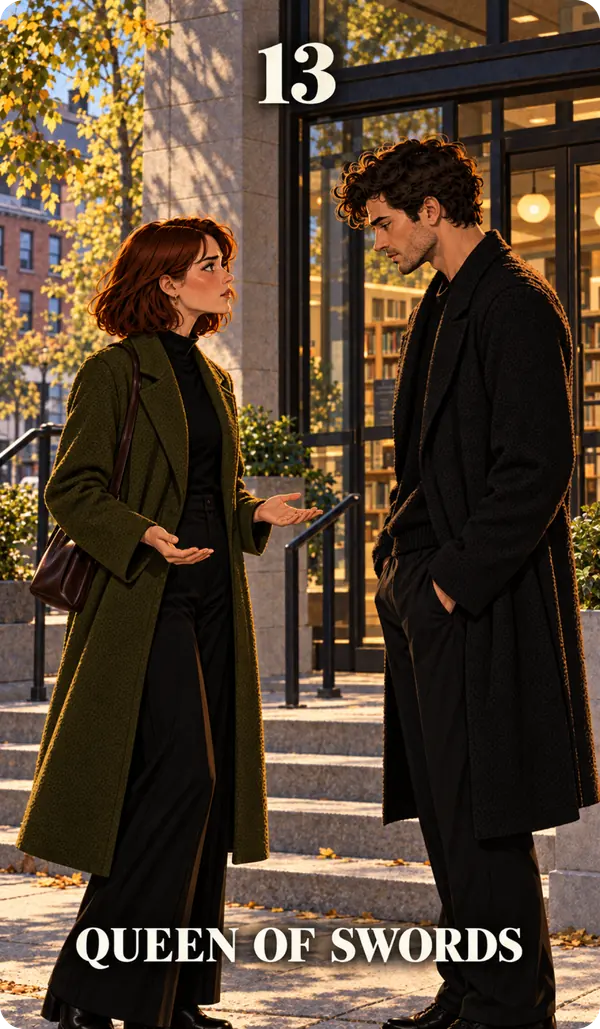
Noticing the price of winning with words, and stepping out of the contest. Bring the conversation back to the question you are both avoiding. A day later Sara and Lev argue at the café door.
Lev seizes on one imprecise phrase of Sara’s; she answers by sharply reminding him of the promise he broke. He gets the last word, but Sara ends the argument and walks away, and the question of his previous relationship still has no clear answer.
His drained face shows what this “victory” has cost.
A question to sit with
“What did I win in the argument, and which answer did I lose along the way?”
One step
Bring the conversation back to the question you are both avoiding.
Reversed
An apology without any change in how you argue, or a readiness to stop landing blows on each other.
A question to sit with
“Which remark is worth owning before you discuss the rest?”
One step
Own one remark you regret before you discuss anything else.
How this deck reads reversed cards
Reversed, a window may show a delay, an imbalance, a defensive reaction or the first step out of one; the neighboring cards help tell which. A reversal does not mean “a bad person”, and one card proves no one’s motive.
In love
An argument may be won with words while the real question stays unanswered, leaving two drained people at the café door.
- Supports
- Stepping out of the contest and back to the question you both avoid.
- Watch for
- Catching on one imprecise phrase to score a point.
- One step
- In your next disagreement, name the question underneath the argument and leave the rest.
An apology may come without any change in how you argue, or both of you may be ready to stop landing blows.
- Supports
- Owning one remark before discussing the rest.
- Watch for
- Saying sorry so the subject can be dropped.
- One step
- Name one thing you said that you regret, and leave the rest of the talk for later.
At work
A debate at work may be won at a cost, and the issue that matters may still be sitting there afterwards.
- Supports
- Seeing the price of being right.
- Watch for
- Getting the last word and losing the colleague.
- One step
- Go back to the real issue behind a recent argument, and ask about it calmly.
Apologies at work may be hollow if nothing in the way of working changes, or a truce may be starting to hold.
- Supports
- Following an apology with one changed habit.
- Watch for
- Repeating the same sharp exchange after saying sorry.
- One step
- Choose one way you argue at work and change it this week.
Winning may tempt you more than choosing well, and walking away from a contest may leave room for the real decision.
- Supports
- Asking what you are trying to win, and what it costs.
- Watch for
- Picking an option to prove someone wrong.
- One step
- Write the decision you would make if nobody had to lose.
Before choosing, owning your part in a quarrel may clear the air, or an empty sorry may be standing in for real change.
- Supports
- Responsibility that comes before negotiation.
- Watch for
- Using an apology to win the next round.
- One step
- Write one sentence owning your part, and use it before you discuss the options.
Noticing the drained face of a so-called victory may help you grow, choosing to end a fight rather than to finish it.
- Supports
- Letting go of the habit of needing the last word.
- Watch for
- Measuring a conversation by who came out ahead.
- One step
- Next time an argument heats up, say you want to stop and come back to the real question later.
Stopping the blows may be its own step forward, if your apology is followed by a different way of speaking.
- Supports
- Changing how you fight, not just saying sorry.
- Watch for
- Expecting an apology to erase what happened.
- One step
- Pick one phrase you use in arguments that hurts, and replace it with a calmer one.
Family arguments may be scored like matches, and the question beneath them may stay untouched however often someone wins.
- Supports
- Steering family talk back to what matters.
- Watch for
- Bringing up an old broken promise to win a new argument.
- One step
- Name, with the family, the question that keeps getting lost in arguments, and write it down.
A family may apologise and then fight the same way again, or may be ready at last to argue more fairly.
- Supports
- Agreeing on one fairer way to disagree at home.
- Watch for
- Demanding apologies while keeping your own tone unchanged.
- One step
- Suggest one family rule for arguments, such as no bringing up old promises, and try it.
Yes or no
NoMixedA win in the argument may have left the main question unanswered, so the answer leans no for now.
Supports
- Seeing what a win with words costs can end the contest.
- Going back to the avoided question is still possible.
Limits
- Trust may have paid for the last word.
- The real question could still be unanswered under the argument.
One step
Set aside who was right and write down the question that is still open between you.
A readiness to stop fighting may be there, alongside apologies that change nothing, so the answer is mixed.
Supports
- Owning one sharp remark can change how you argue.
- Both of you may be ready to stop landing blows.
Limits
- An apology may come without any change in how you argue.
- Old habits of scoring points could return at the next disagreement.
One step
Own one remark of yours before you discuss anything else.
What is in the picture
Sara in her olive coat walks away from the café, holding the strap of her bag, upset and irritated. Lev stays by the door, his face drained; open distance lies between them.
His drained face shows what this “victory” has cost.
- café door
- hand gripping a bag strap
- open distance between two people
- lit café windows
- street lamps
- wet pavement
This card in other decks
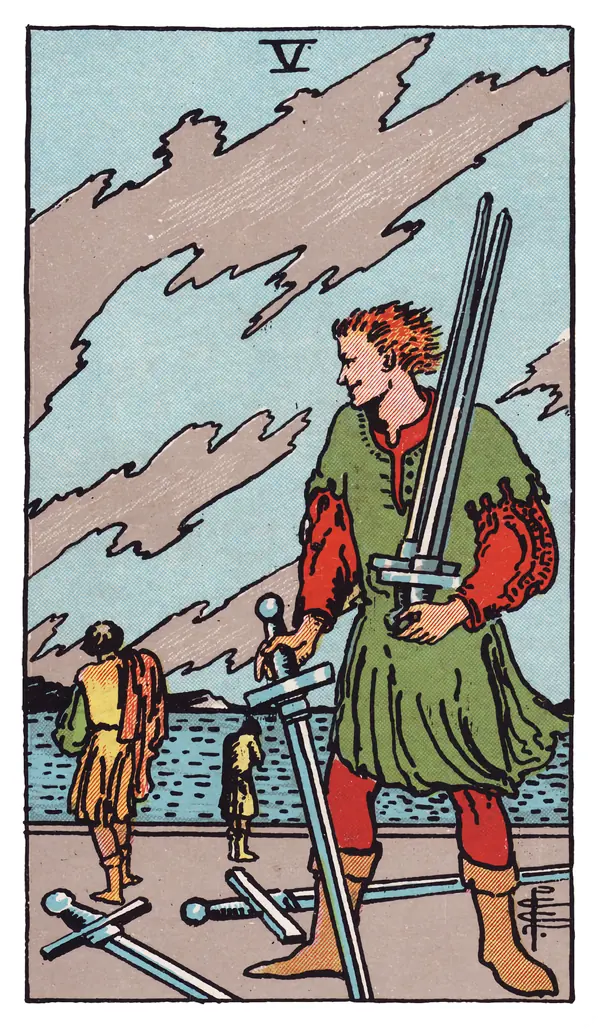 Rider–Waite–SmithFive of SwordsA win here may cost more in relationships or goodwill than it’s worth.
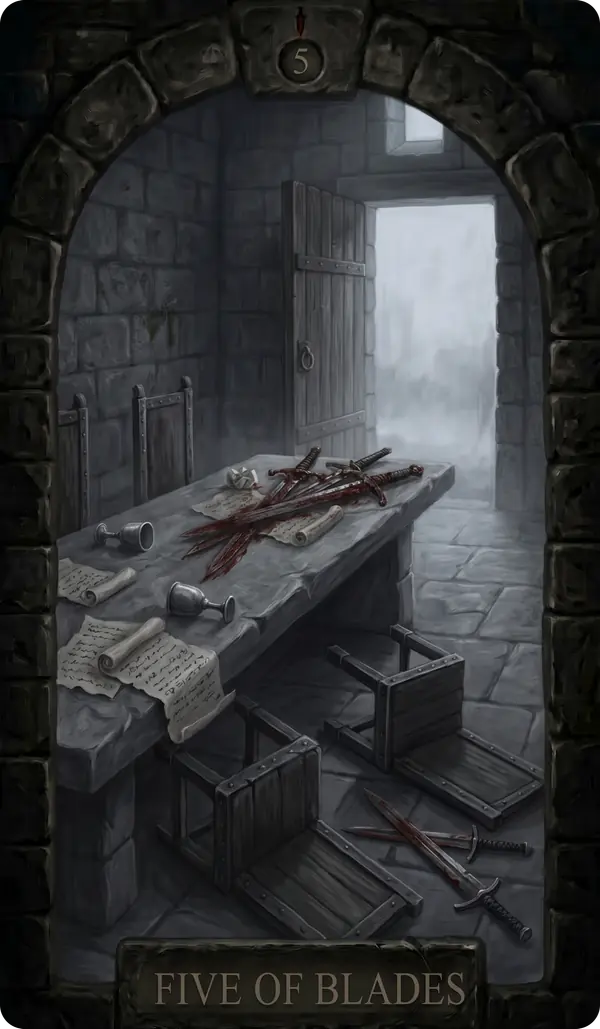 FamiliaFive of BladesThe dispute is won fairly, and the price shows at once: there is no one left to sit at the table.
 CarnalFive of SwordsWinning a conflict can leave the shared ground damaged.
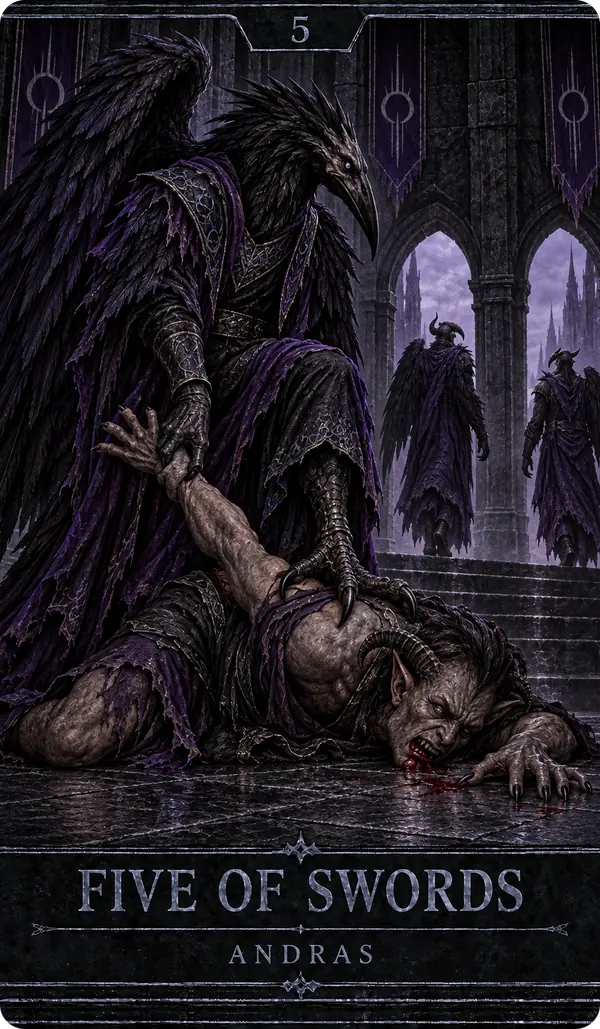 Crimson InfernoFive of SwordsAssess the cost of prevailing.
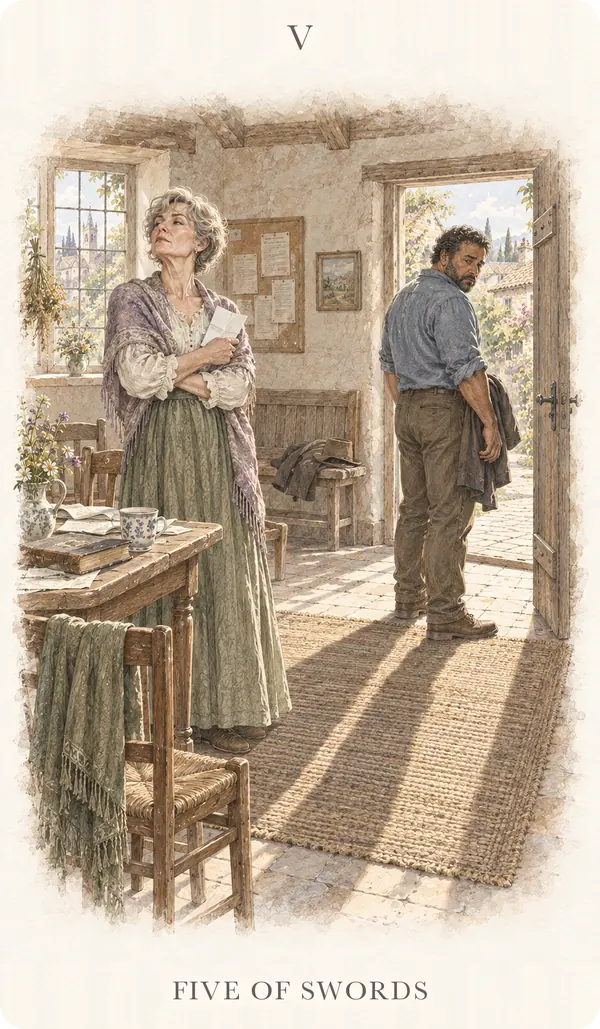 Everyday WondersFive of SwordsWinning the argument at the cost of the relationship.
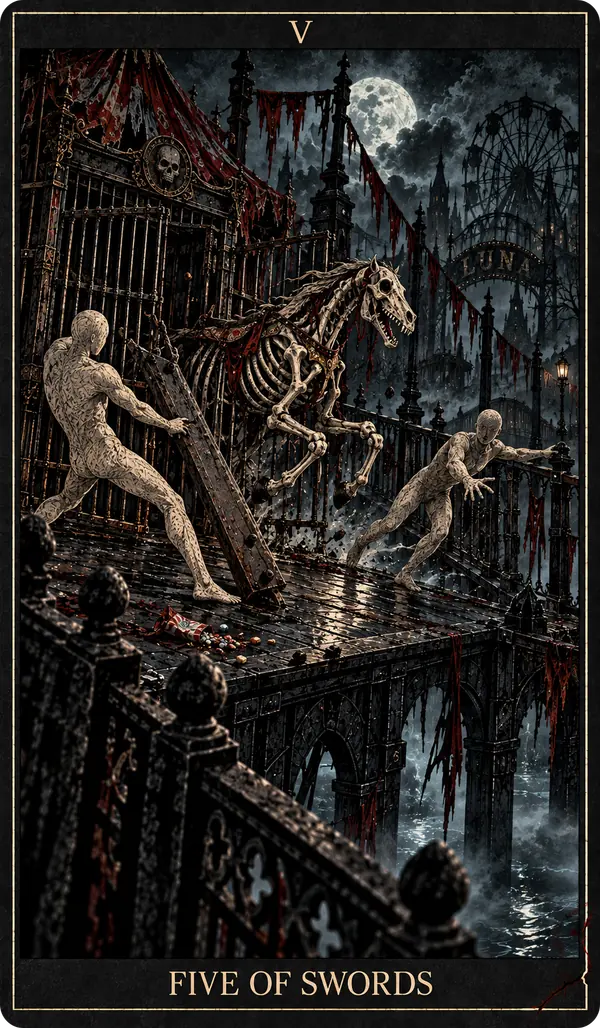 Mirror NightFive of SwordsCount the cost of a narrow victory.
 Self ContactFive of SwordsNotice the cost of winning and decide whether to disengage or repair.
 Shiba TownFive of SwordsA hollow victory; conflict; the cost of being right.
 Velvet MasqueradeFive of SwordsA victory that may cost trust.
 Four HorsemenFive of DeathFace the loss without abandoning the living beside it.
 Four TrailsFive of SwordsHollow victory, conflict, damaged trust.
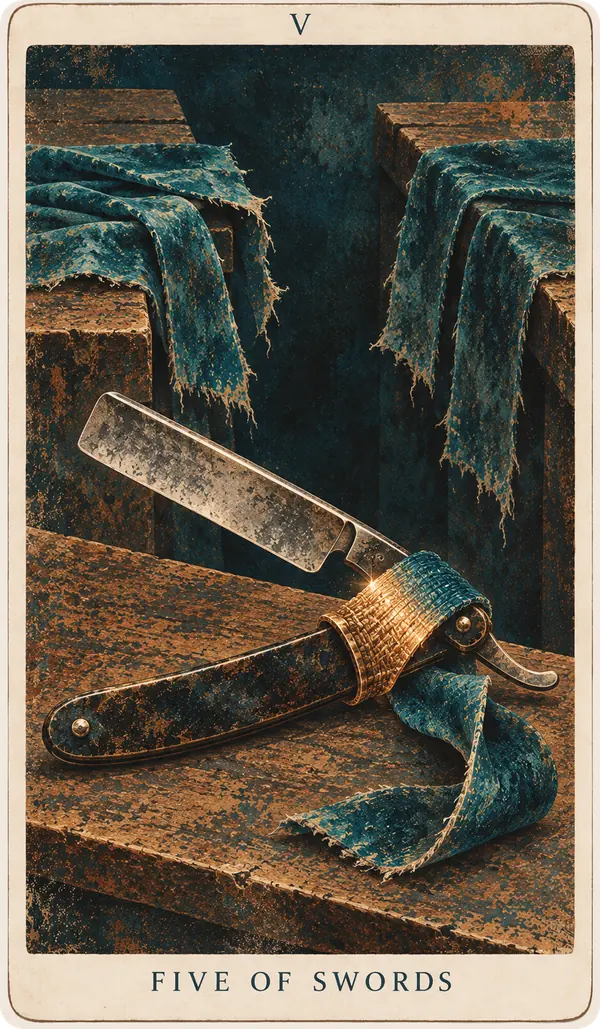 Living ThresholdFive of SwordsThe strip of cloth the razor cut and claimed shines while the shared cloth shelter falls apart.
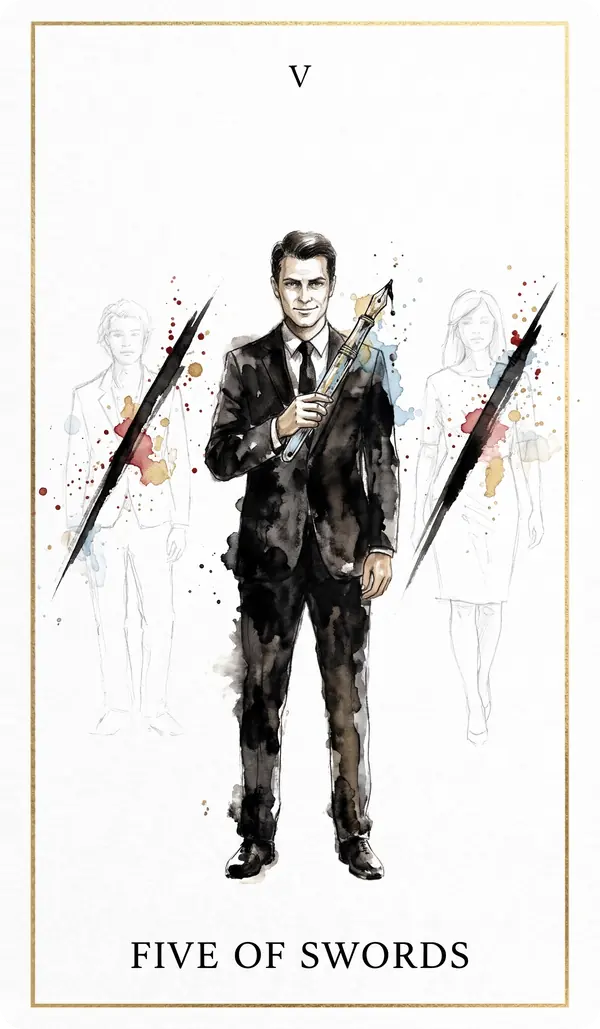 Colour of PowerFive of SwordsYou won by crossing them out; count what the win cost you.
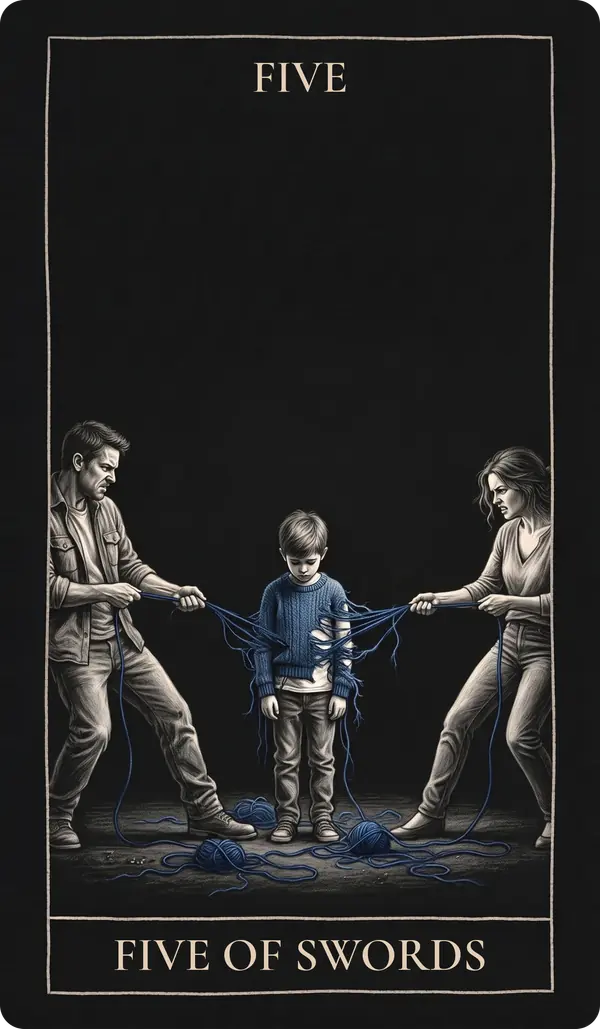 BoundFive of SwordsA quarrel won, while the one in the middle comes apart.
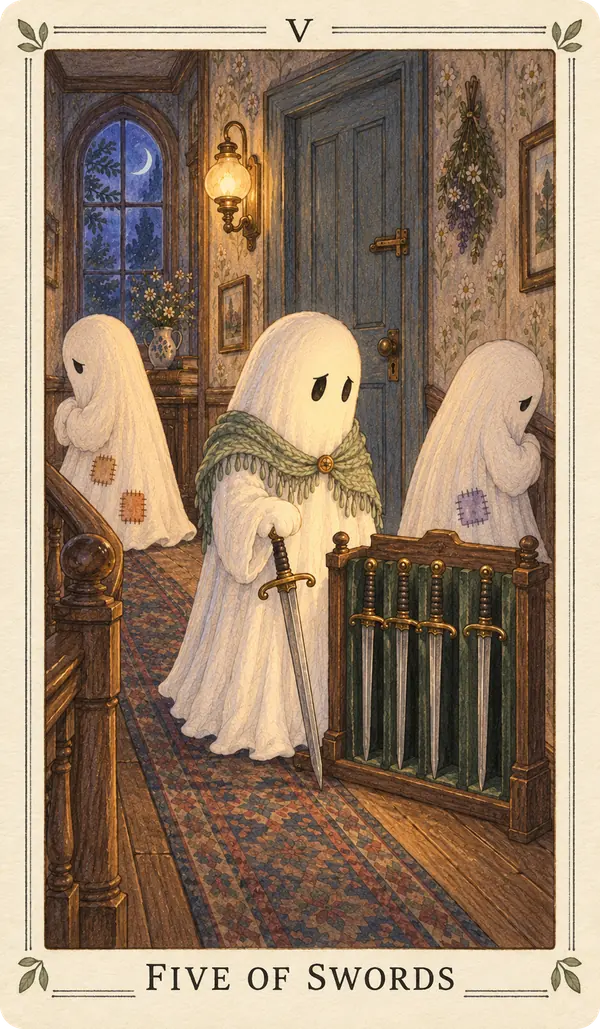 Cozy HauntFive of SwordsCount the human cost of being right.
 Celestial Night SkyFive of SwordsA fact spoken without humiliation.
Where it appears
Questions about this card
Is the Five of Swords a yes or no card in City of Windows?
Upright, the Five of Swords leans no. Someone may have won the argument while the main question stayed unanswered, and a win like that settles nothing. Reversed, the answer is mixed. A readiness to stop fighting may be there, alongside apologies that change nothing about how you argue, and it is hard yet to tell which carries more weight.
What does the Five of Swords mean in a relationship?
In a relationship, the Five of Swords points to an argument that has become a fight for the last word. In City of Windows, Lev seizes on one careless phrase of Sara’s, and she answers by reminding him of the promise he broke. He gets the last word. The question about his previous relationship stays unanswered. The card asks what that win cost, and brings you back to the question you both avoid.
What does the Five of Swords mean reversed?
Reversed, the Five of Swords shows two possible turns after a fight. One is an apology that changes nothing, sorry said while the same blows keep landing. The other is a real readiness on both sides to stop. The test is simple. Own one thing you said before discussing the rest, and watch whether the way you argue actually shifts.