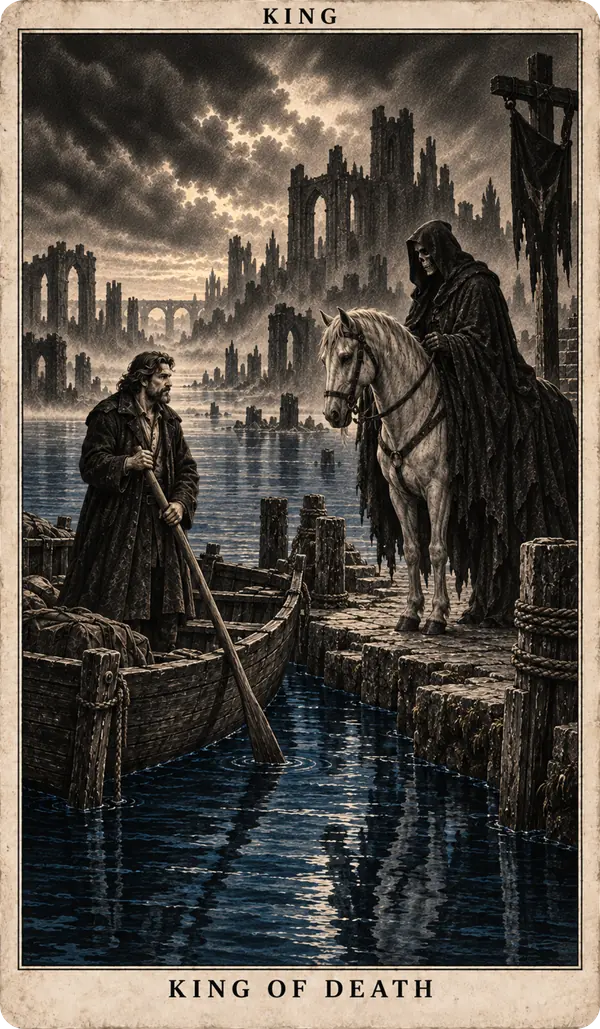
Seven of Death
Seven of Swords in Four Horsemen · Minor Arcana
LossIn short
Examine what your escape or advantage takes from others.
Reversed
Excusing betrayal as a necessary act of survival.
- Death
- Seven
- Air
- The Grave Robber
- seeing what an advantage costs
- bringing a hidden gain into the light
- respecting what belongs to the absent
Upright
Examine what your escape or advantage takes from others. The tomb stands open and the robber is knotting jewellery into a violet cloth.
A mourner is coming up the path with a lantern, and he turns toward the light, tightening his grip. The one in the grave cannot defend what was left with them.
Whatever he carries off is taken from someone who cannot object, and from the people who came to mourn.
A question to sit with
“Whose loss is paying for my advantage?”
One step
Think of one advantage you hold and write down who bore the cost of it. Nothing has to change today; the point is to see it.
Reversed
Excusing betrayal as a necessary act of survival. Hard times make it easy to say that the living need things more than a grave does.
The robber may be telling himself exactly that as the lantern comes closer. The story makes the theft sound like good sense and keeps the mourner out of the picture.
Survival can be real and still be paid for by someone else.
A question to sit with
“What story makes my advantage sound like survival, and who is left out of it?”
One step
Notice one reason you give yourself for something you would not want seen by lantern light, and say it aloud to hear how it sounds.
How this deck reads reversed cards
Reversed, the act on the card turns inward, meets an obstacle, grows harsher or shows its price. On this road a reversal is not automatically the opposite, and not automatically something worse.
In love
One person in a relationship may be gaining something at the other’s expense, or at the expense of someone absent.
- Supports
- Holding a lantern up to what is being kept quiet.
- Watch for
- Keeping a secret advantage in the name of the relationship.
- One step
- Ask yourself what you would change if your partner could see everything you gain.
A partner may be excusing something hurtful as necessary for getting through.
- Supports
- Naming the excuse for what it is.
- Watch for
- Accepting survival as a reason for anything.
- One step
- Say plainly, to yourself first, what the excuse is covering.
At work
An advantage may be open to you at work that takes from someone who cannot object.
- Supports
- Checking who else pays for the gain.
- Watch for
- Taking credit or resources from someone who has left.
- One step
- Before taking an opening at work, find out whose loss created it.
Hard times may be used at work to justify taking what belongs to others.
- Supports
- A written account of who took and who carried.
- Watch for
- Treating what everyone does as an excuse.
- One step
- Check one decision against how it would look to the person it cost.
One option may bring you something by taking it from someone absent.
- Supports
- Weighing the cost to those who cannot speak for themselves.
- Watch for
- Choosing what only works while it stays hidden.
- One step
- Write down who loses if you choose the easier gain.
The choice may be dressed up as necessity when it may simply be advantage.
- Supports
- Asking whether you truly have no other way.
- Watch for
- Calling any choice survival.
- One step
- List at least one other way through that costs no one else.
Seeing what your escape costs other people may be the lesson.
- Supports
- Letting the lantern find you.
- Watch for
- Justifying a gain because no one is watching.
- One step
- Think of one advantage you have kept quiet, and consider who bore its cost.
Giving up a story that makes taking sound like surviving may be the growth here.
- Supports
- Honesty about what you needed and what you only wanted.
- Watch for
- Resentment toward whoever brings the lantern.
- One step
- Tell one trusted person the story from the other side, and listen.
In a family, belongings or keepsakes of someone gone may be taken quietly by one person.
- Supports
- Open conversation about what was left and for whom.
- Watch for
- Dividing things in private before others have had time to mourn.
- One step
- Suggest that belongings be talked about openly, with everyone present.
In a family, one member may explain away a hidden taking as what anyone would do in hard times.
- Supports
- A relative who asks gently what happened.
- Watch for
- Letting silence protect the one who took.
- One step
- Ask one plain question about what happened, and listen to the whole answer.
Yes or no
MixedNoAn advantage is within reach, but at another’s expense, so the answer is mixed until that cost is looked at.
Supports
- A lantern is coming up the path.
- What has been taken can still be looked at plainly.
Limits
- Someone else may be paying for the advantage.
- The gain has to be hidden to be kept.
One step
Ask who bears the cost of what you would gain.
An advantage that needs a cover story holds only while nobody looks closely, so the answer leans no.
Supports
- The story can still be questioned.
- The mourner’s light shows the ground as it is.
Limits
- Survival may be serving as an excuse.
- A hidden gain tends to come to light.
One step
Ask whether you would give the same reason with the mourner standing beside you.
What is in the picture
A grave robber crouches beside an opened tomb, gathering jewellery into a violet cloth. A mourner approaches with a lantern. The robber turns toward the light and tightens his grip on the bundle. Another person’s absence has become an opportunity he must conceal.
Concealment protects the robber’s advantage at the expense of the dead and the living.
- opened stone tomb
- grave robber crouching
- jewellery in a violet cloth
- mourner with a lantern
- weathered stone cross
- cemetery gate
- broken chapel on the cliff
This card in other decks
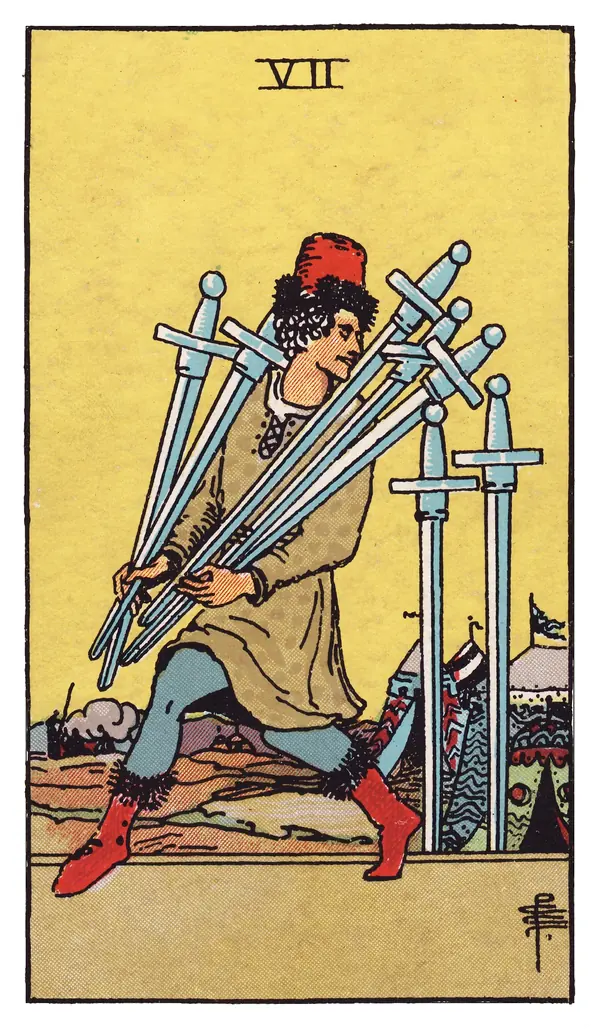 Rider–Waite–SmithSeven of SwordsA strategic, solo approach may be tempting here, but it’s worth being honest about what it avoids.
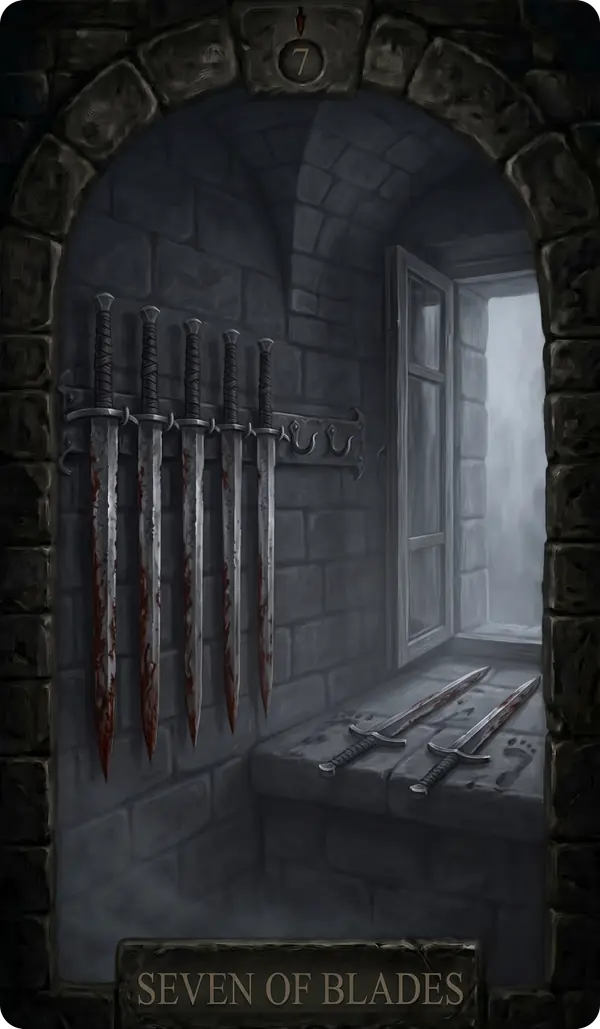 FamiliaSeven of BladesSomething taken quietly and precisely, by a route around the rules, which works until someone counts the hooks.
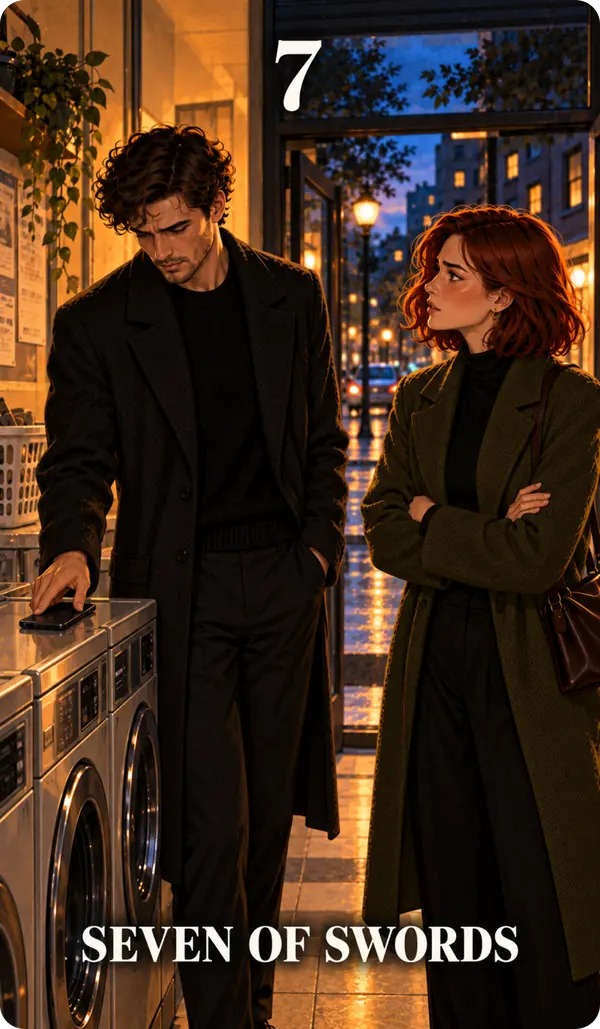 City of WindowsSeven of SwordsNoticing a specific evasion and naming it.
 CarnalSeven of SwordsConcealment alters who can make an informed choice.
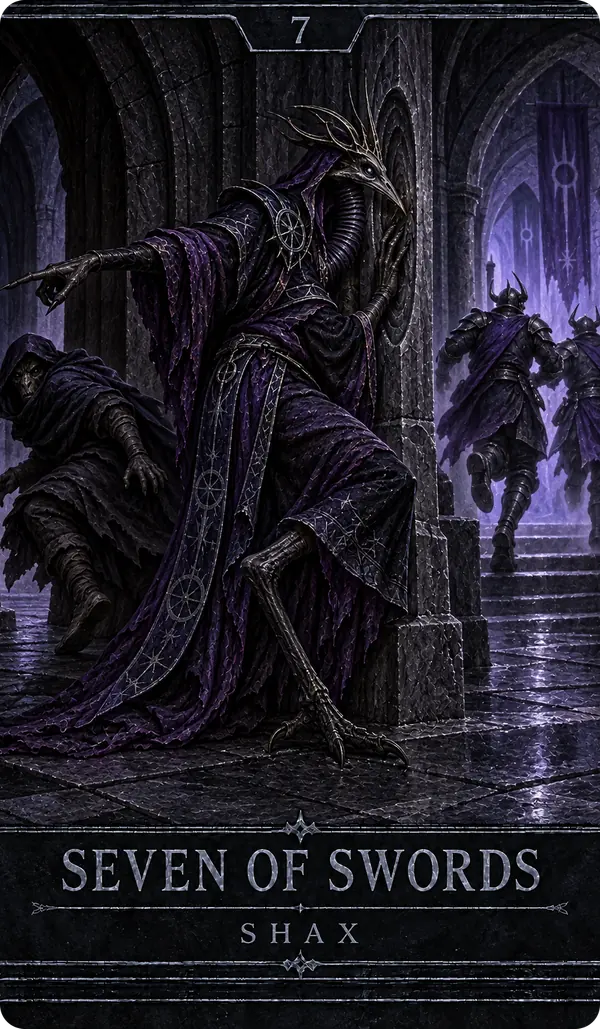 Crimson InfernoSeven of SwordsUse discretion when openness would expose someone to harm.
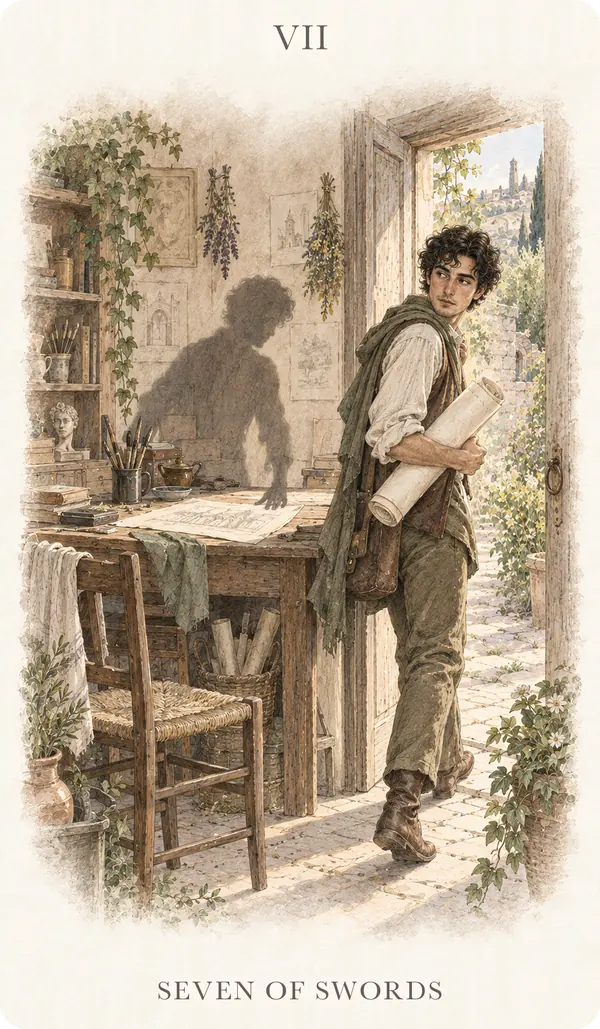 Everyday WondersSeven of SwordsStrategy and holding things back, and who carries the cost.
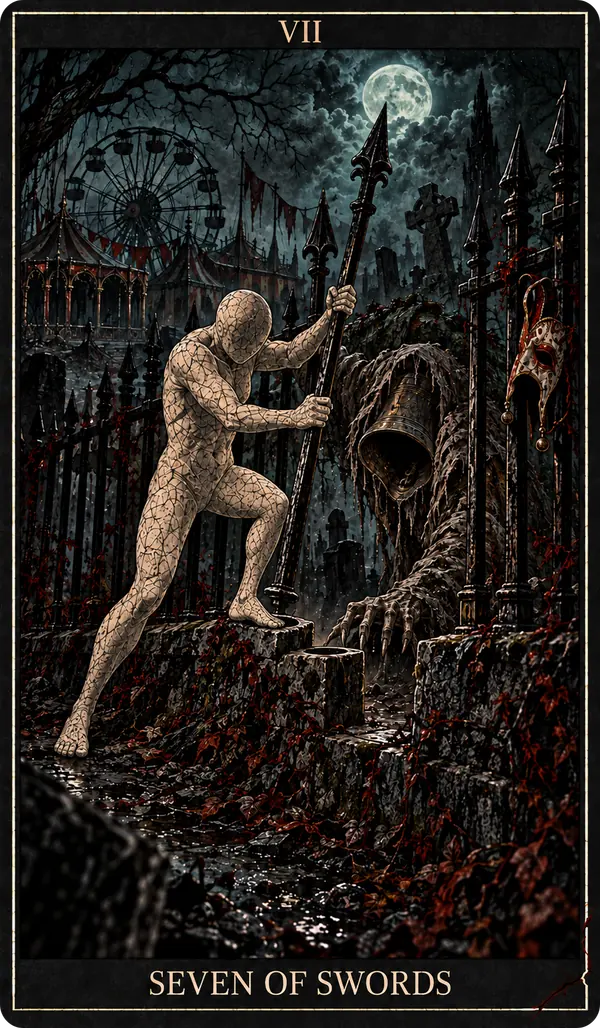 Mirror NightSeven of SwordsRecognise concealment and the cost of access.
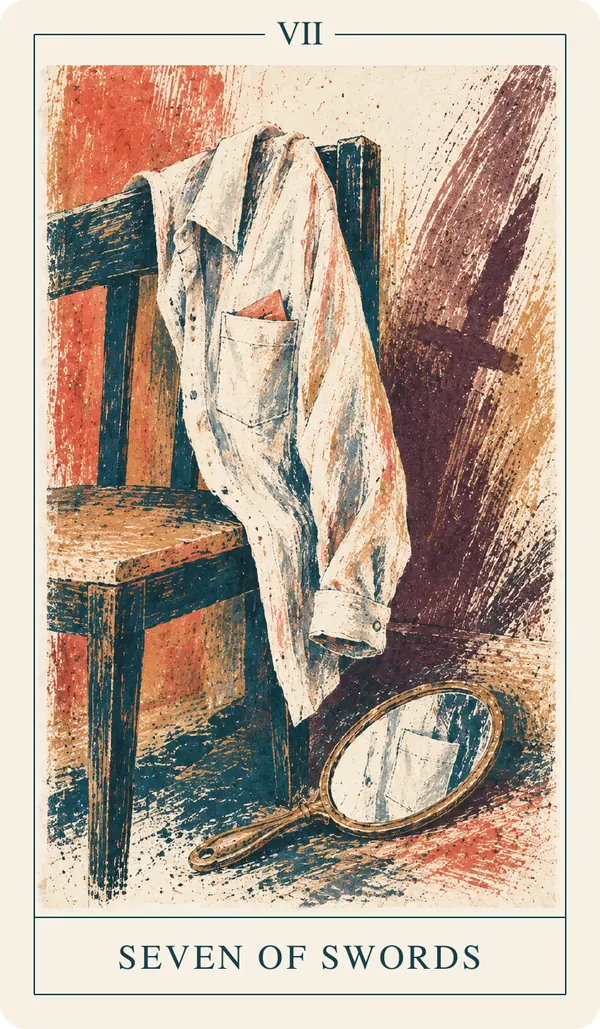 Self ContactSeven of SwordsUse discretion and strategy while examining the cost of concealment.
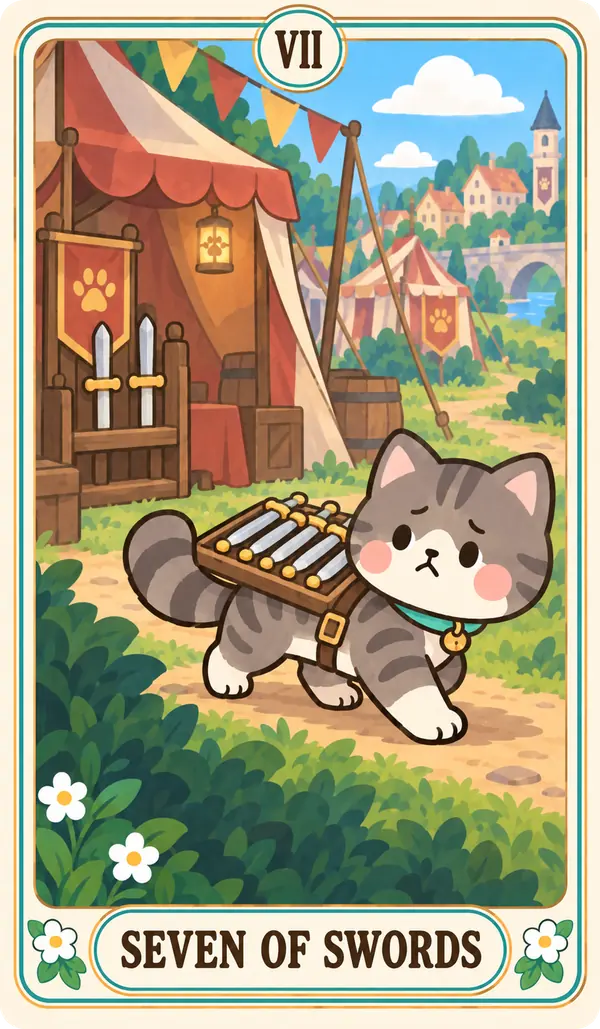 Shiba TownSeven of SwordsStrategy; secrecy; taking a shortcut at a cost.
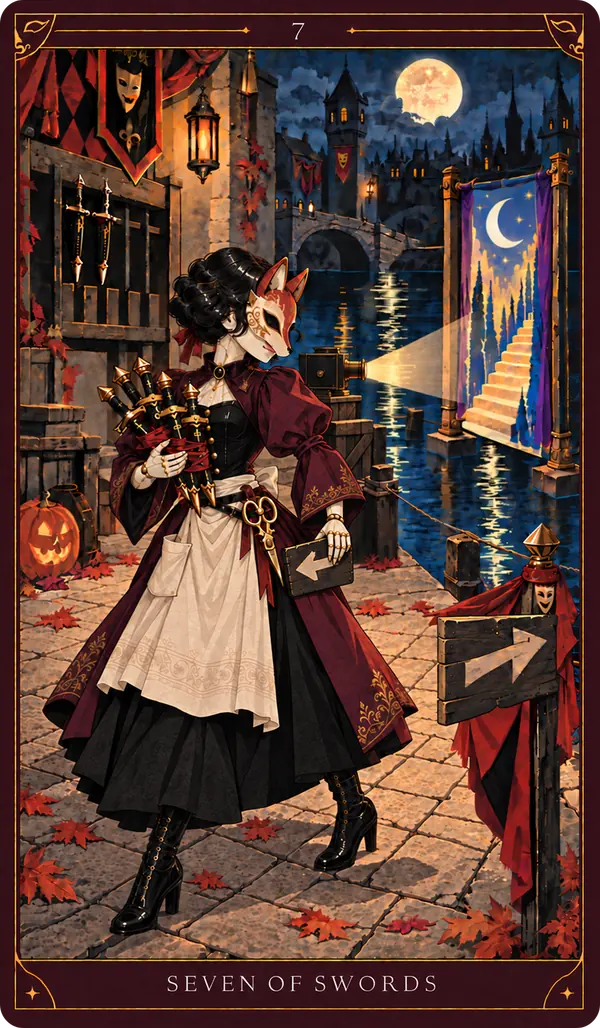 Velvet MasqueradeSeven of SwordsA concealed plan outside shared agreement.
 Four TrailsSeven of SwordsSecrecy, strategy, evasion.
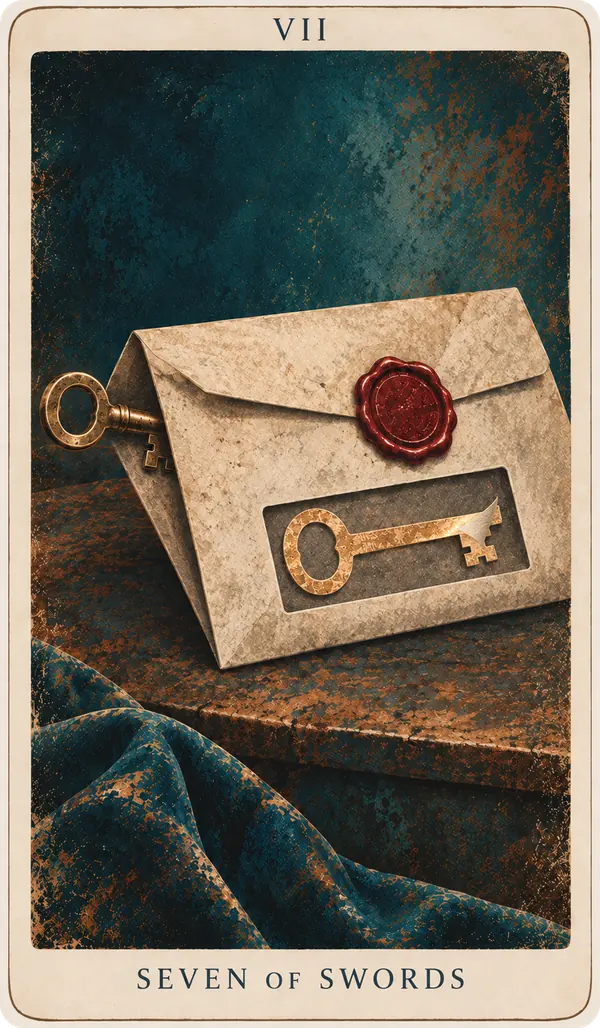 Living ThresholdSeven of SwordsThe real key slips out the back while a paper copy shines at the front.
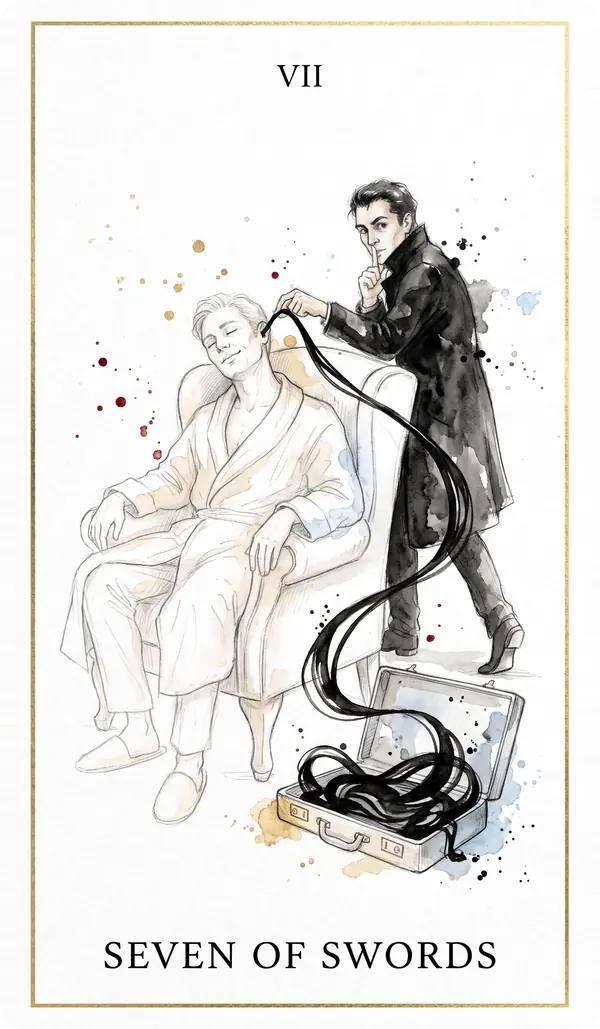 Colour of PowerSeven of SwordsSomeone is taking what is in your head while you sleep.
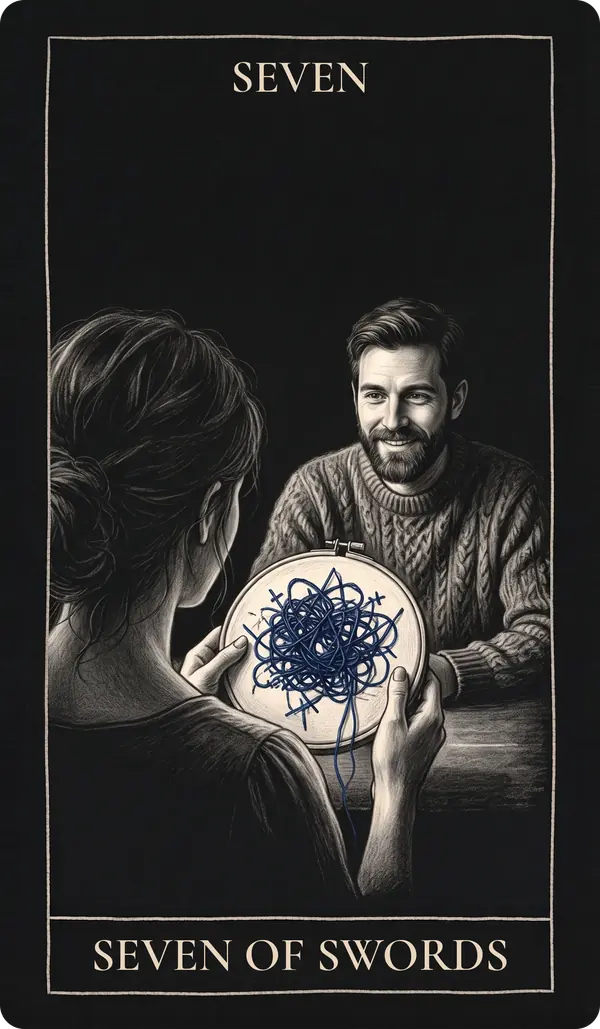 BoundSeven of SwordsWhat is shown is not what is; the knots stay behind.
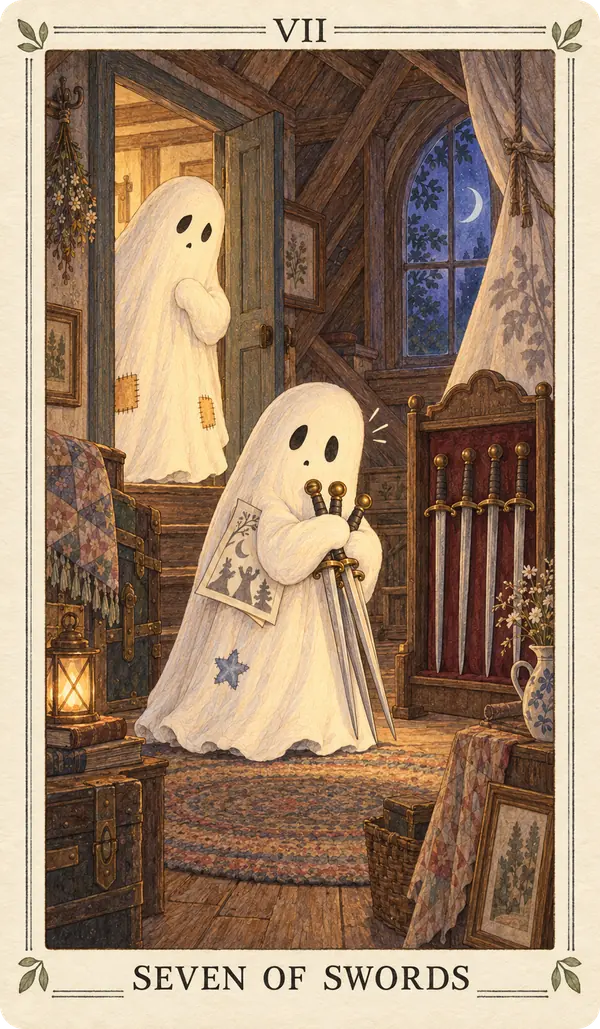 Cozy HauntSeven of SwordsExamine what secrecy protects and costs.
 Celestial Night SkySeven of SwordsAn opened source and an honest path.
Where it appears
Questions about this card
Is Seven of Swords a yes or no card in Four Horsemen?
Seven of Swords is mixed upright: an advantage is within reach, but at another’s expense, so the answer waits until that cost is looked at. Reversed, it leans no, because an advantage that needs a cover story holds only while nobody looks closely. Ask who bears the cost of what you would gain.
What does Seven of Swords mean in love?
Where love is concerned, Seven of Swords may point to one person gaining something at the other’s expense, or at the expense of someone absent. Reversed, a partner may excuse something hurtful as necessary for getting through. Ask yourself what you would change if your partner could see everything you gain.
What does Seven of Swords mean reversed in Four Horsemen?
Upside down, Seven of Swords describes excusing a broken trust as a necessary act of survival. Ask whether you would give the same reason with the mourner standing beside you. Say plainly, to yourself first, what the excuse is covering, then decide whether it can be said aloud.