Six of Swords
Six of Swords in Crimson Inferno · Minor Arcana
ConflictIn short
Accept a necessary transition and the help it requires.
Reversed
Returning to familiar harm, or resisting support.
- Swords
- Six
- Air
- The Floodwater Carrier
- transition
- recovery in motion
- leaving harm
Upright
Valac hauls a barely conscious survivor through waist-deep floodwater, while one companion braces him from behind and another reaches down from the ledge. Accept a needed crossing and the help it takes.
Movement toward safety can begin before relief does, and the wounds come along instead of vanishing.
A question to sit with
“What must come with me, and what need not?”
One step
Name one person who could help carry you through this change, and ask them for one specific thing.
Reversed
Valac gets the survivor through waist-deep floodwater only because one companion braces Valac from behind and another kneels on the ledge, hands out to take the weight.
The crossing can still fail: a pull toward the harm you know, help pushed away, or a departure that pretends the wounds stayed behind in the dark passage.
A question to sit with
“Why does the familiar harm pull me back harder than the hands trying to carry me across?”
One step
Write down one familiar harm you keep drifting back toward, and one person you could let help.
How this deck reads reversed cards
Reversed, a card may show excess, blockage, a hidden price or a hard release, and it is rarely a simple opposite. In the basalt city an upright card can already show a power through its misuse, and turning it over softens nothing in the picture. A mark may loosen or bite deeper, and the city does not promise which.
In love
The survivor’s head rests on Valac’s shoulder as he wades. In love, a move toward a safer place may happen with someone else taking part of your weight.
- Supports
- Leaning on a partner or friend without apology.
- Watch for
- Pretending the old hurts stayed behind.
- One step
- Ask the person closest to you to help with one specific part of the change.
In love, you may be drawn back toward a familiar harm, or refusing the support that would carry you.
- Supports
- Honesty about what keeps pulling you back.
- Watch for
- Calling it loyalty when it is fear of the unfamiliar.
- One step
- Tell someone you trust what the pull back feels like.
At work
At work, a transition may be needed, and it may go better with help from both sides.
- Supports
- Colleagues who push and colleagues who receive.
- Watch for
- Expecting the change to feel better at once.
- One step
- Ask one person already on the other side what the first weeks were like.
The familiar at work may be pulling you back toward what hurts, or you may be trying to move alone.
- Supports
- Accepting a referral, a mentor or an introduction.
- Watch for
- Returning to the known because the unknown is cold.
- One step
- Reach out to one person who could help with the move.
What may be at stake is moving toward safety before relief arrives.
- Supports
- Help that may already be reaching toward you.
- Watch for
- Waiting to feel better before moving.
- One step
- Write on one line what comes with you, and on another what need not.
Valac drags the survivor away, yet the interrogation passage still opens into the dark behind them. The pull of the familiar, even where it hurt, may be tilting the choice.
- Supports
- Remembering why the crossing started.
- Watch for
- Choosing what you know over what would heal.
- One step
- Write what you are carrying and what you need not.
Valac keeps both arms hooked under the survivor’s shoulders through every step of the flood. Growth may happen in motion, one hard step at a time, with a hold that does not slip.
- Supports
- Accepting that the wounds come too, and moving anyway.
- Watch for
- Believing you must carry yourself.
- One step
- Accept one offer of help this week that you would normally refuse.
Growth may be stalled by returning to old harm or by refusing to name what needs healing.
- Supports
- Naming one wound honestly.
- Watch for
- Moving on without looking at what you bring with you.
- One step
- Name one hurt you are carrying and one person who could help with it.
In the family, someone may need to be carried out of danger, with others bracing and receiving.
- Supports
- Each relative taking a clear part: one hauls, one braces, one receives.
- Watch for
- Pretending the move has healed everything.
- One step
- Offer the most worn out family member one specific kind of help.
The family may be drawn back into an old harm, or someone may be refusing help they need.
- Supports
- Patience with the one who resists support.
- Watch for
- Returning to the old arrangement because it is familiar.
- One step
- Ask one relative what help they would actually accept.
Yes or no
YesNoA necessary transition with help at hand points toward yes, as long as you let the help take some of the weight.
Supports
- Movement toward safety can begin now.
- Help may be there to carry you and to receive you.
Limits
- The wounds may still be there after the crossing.
- Relief may come later than the move.
One step
Ask who is bracing you from behind and who is waiting on the higher ledge.
Returning to what hurt, or refusing support, points toward no, until you let someone take part of the weight.
Supports
- Knowing what pulls you back is a start.
- Support may still be offered.
Limits
- Familiar harm may be drawing you back.
- Help may be refused out of pride or fear.
One step
Think about what you would have to admit needs healing before you could move on from it.
What is in the picture
Valac hauls a barely conscious adult through waist-deep floodwater, both arms securely hooked beneath the survivor’s armpits. The survivor’s head sags against Valac’s shoulder and bruised bare feet trail in the water. One companion braces Valac from behind against a stone pier; another kneels on the higher ledge with both hands extended to receive the survivor. Behind them, the interrogation passage recedes into darkness.
Every body strains toward the same safer side. The evacuation moves people out of immediate danger without pretending the wounds have disappeared.
- small angular face with ridged fins
- waist-deep floodwater
- arms hooked under the survivor’s arms
- head sagging on a shoulder
- bruised bare feet in the water
- companion bracing from behind
- hands reaching down from the ledge
- dark interrogation passage
This card in other decks
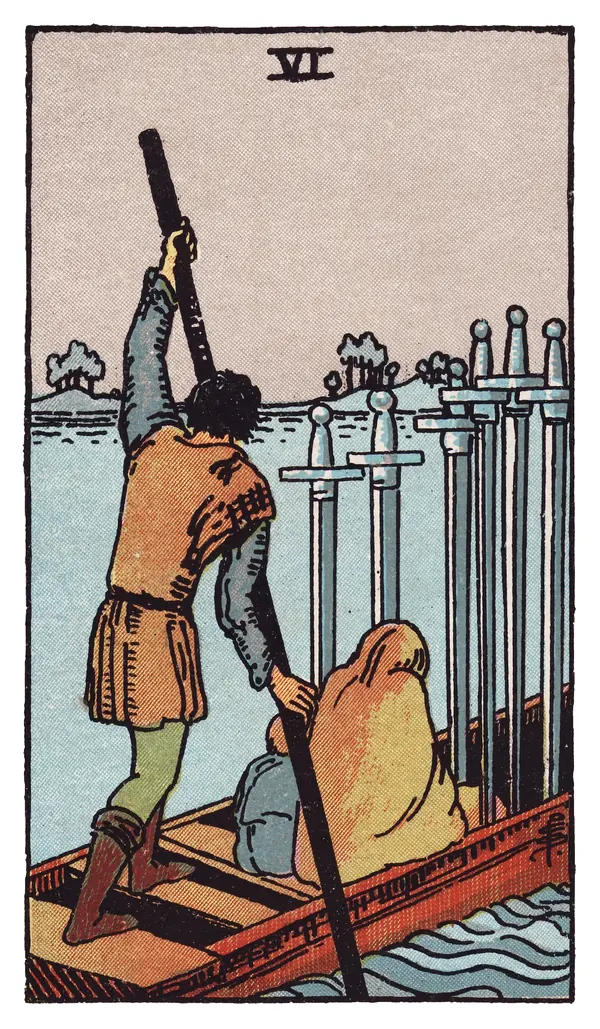 Rider–Waite–SmithSix of SwordsYou’re moving, even if slowly, toward calmer circumstances after a genuinely difficult stretch.
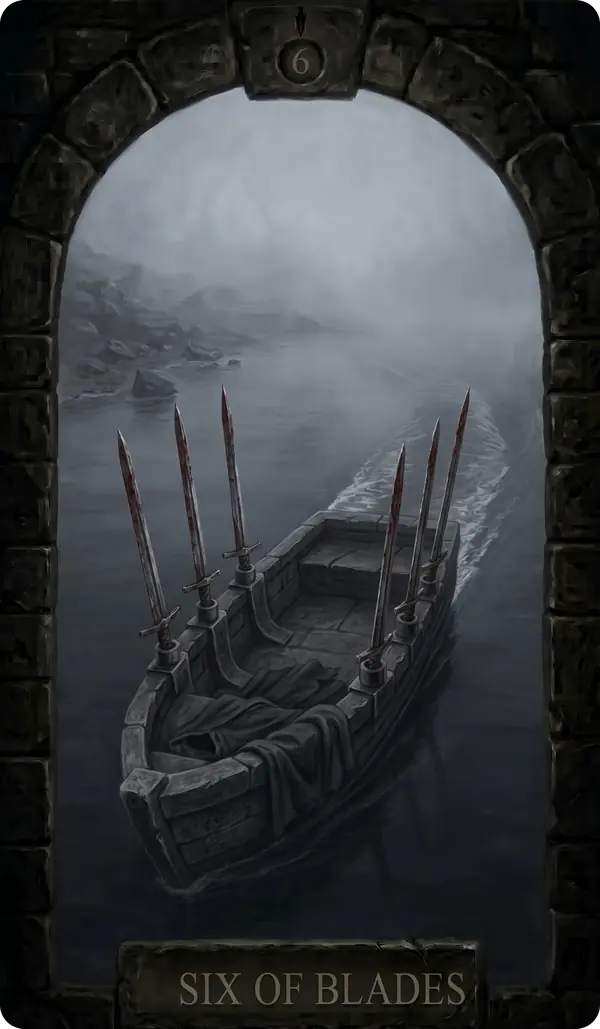 FamiliaSix of BladesA departure from a place where things were settled badly, taking the memory along and no longer fighting.
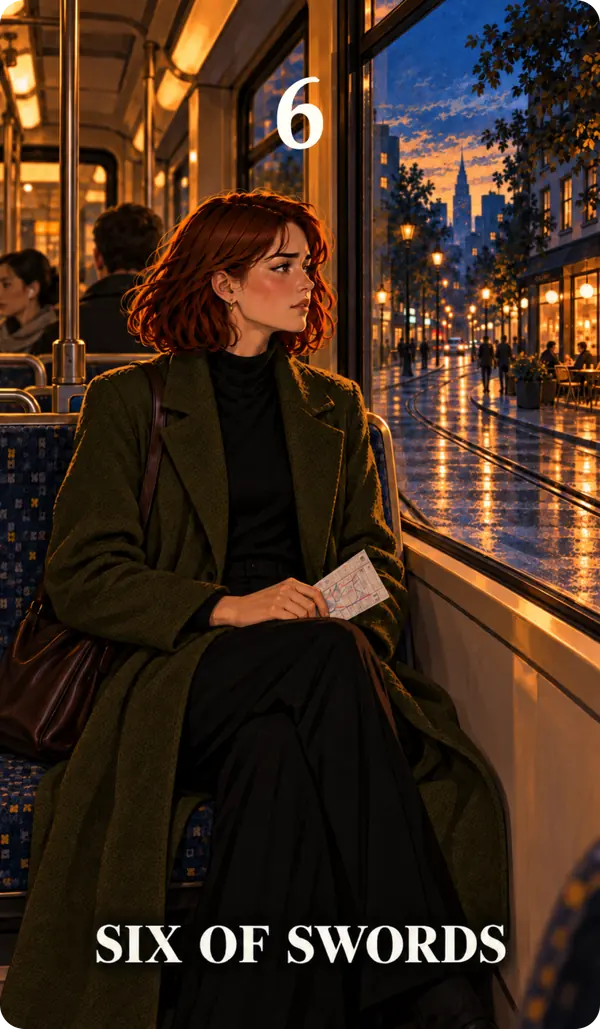 City of WindowsSix of SwordsPhysically leaving the argument and getting to support.
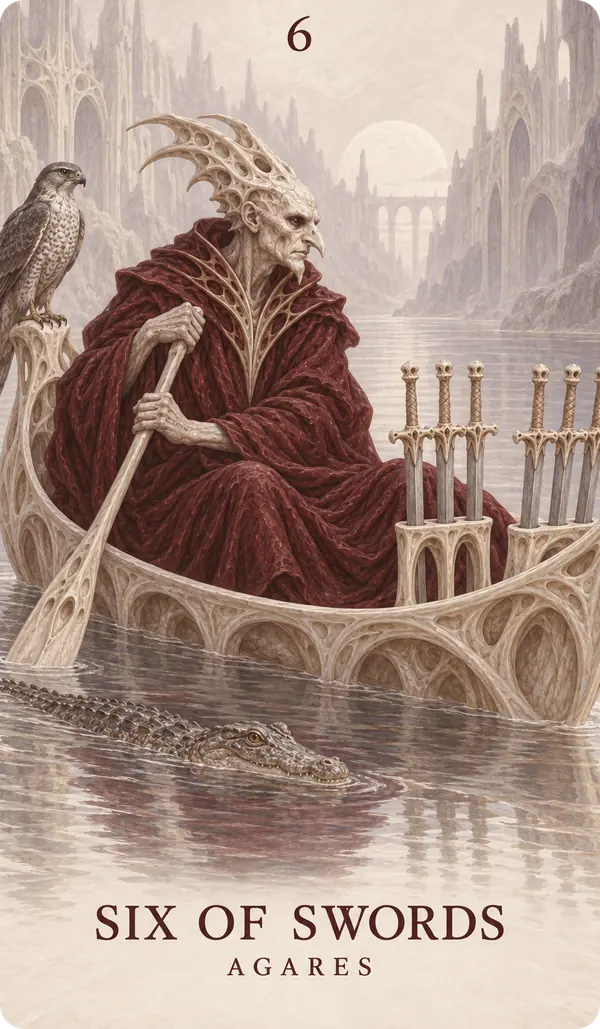 CarnalSix of SwordsA difficult transition carries unresolved knowledge with it.
 Everyday WondersSix of SwordsMoving toward calmer times, with help along the way.
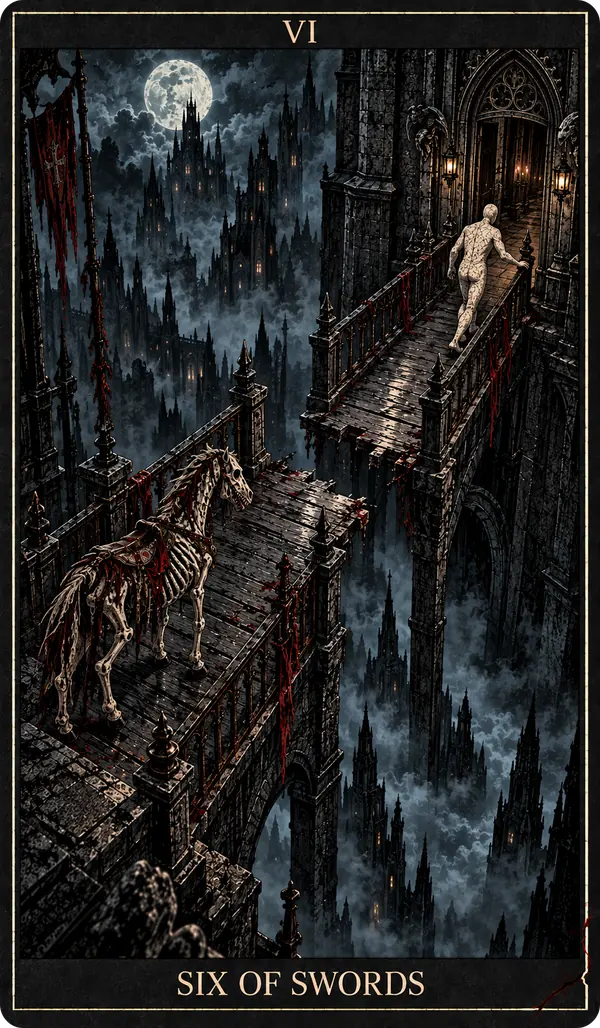 Mirror NightSix of SwordsMove through a difficult transition.
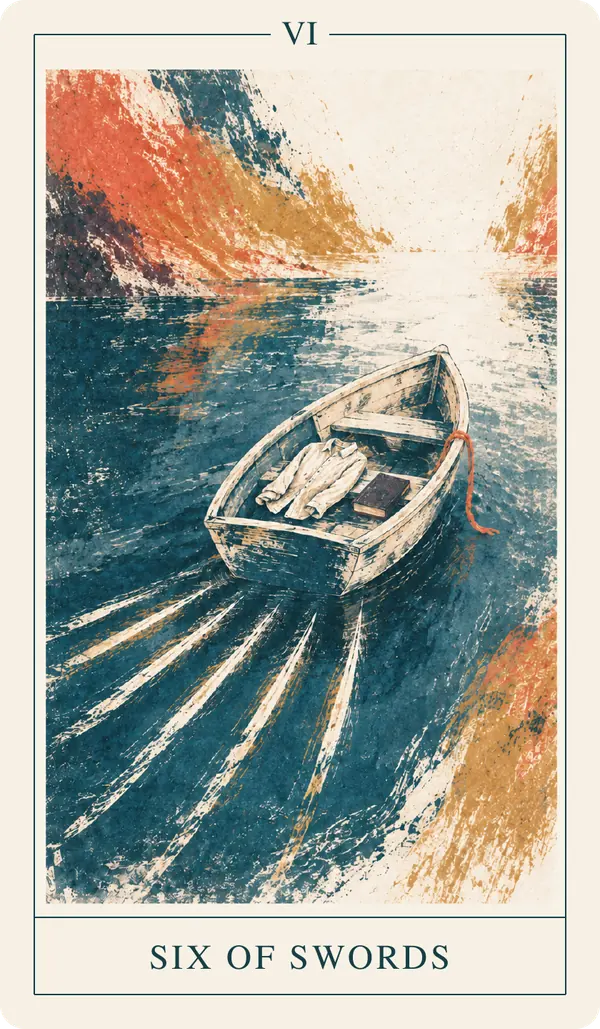 Self ContactSix of SwordsA careful transition can carry experience into calmer conditions.
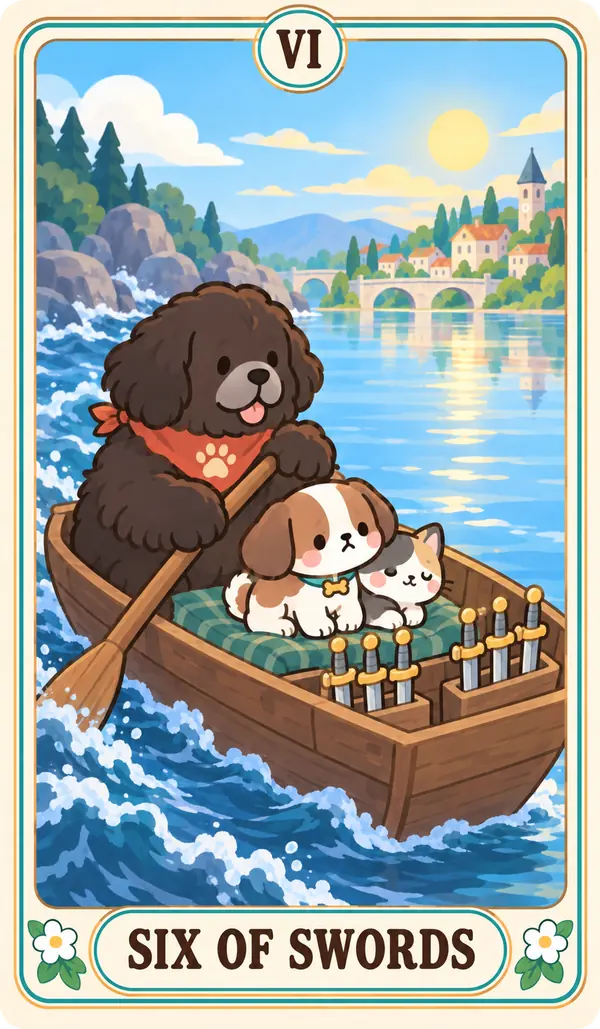 Shiba TownSix of SwordsTransition; leaving trouble; accepting help on the way.
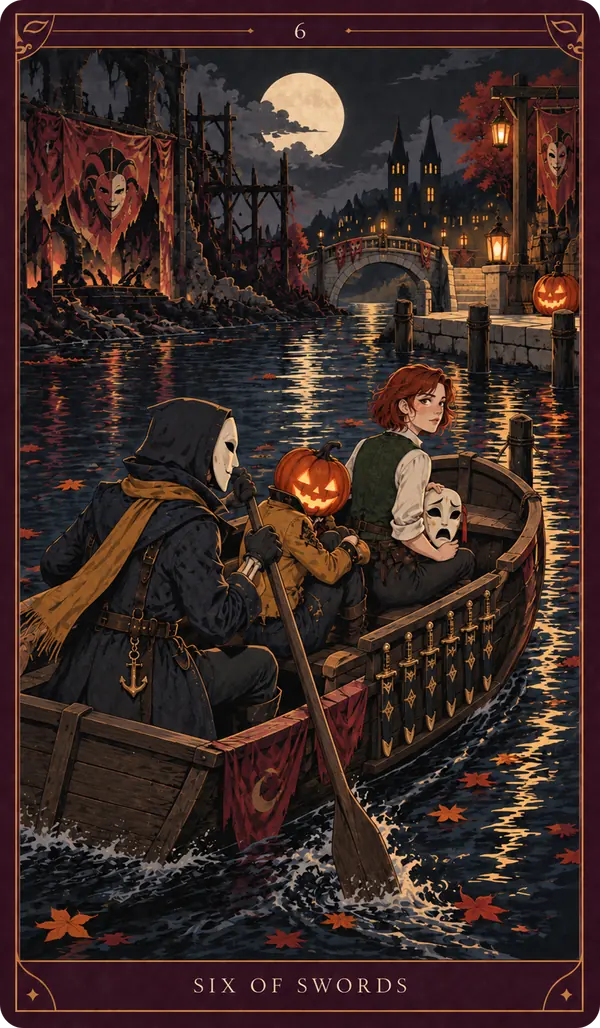 Velvet MasqueradeSix of SwordsA supported crossing toward a real landing.
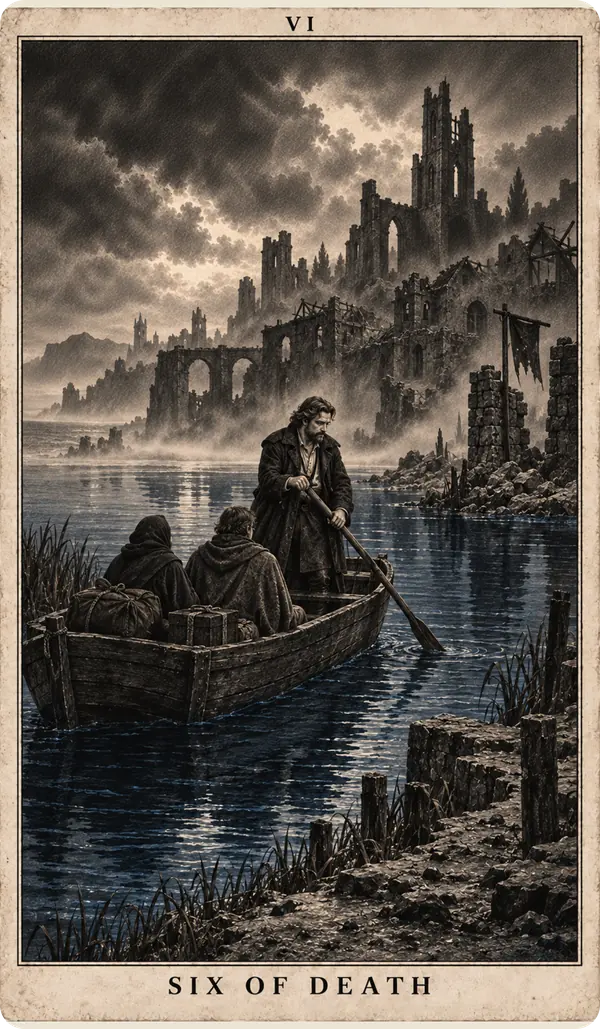 Four HorsemenSix of DeathMove toward safer ground with what you cannot yet resolve.
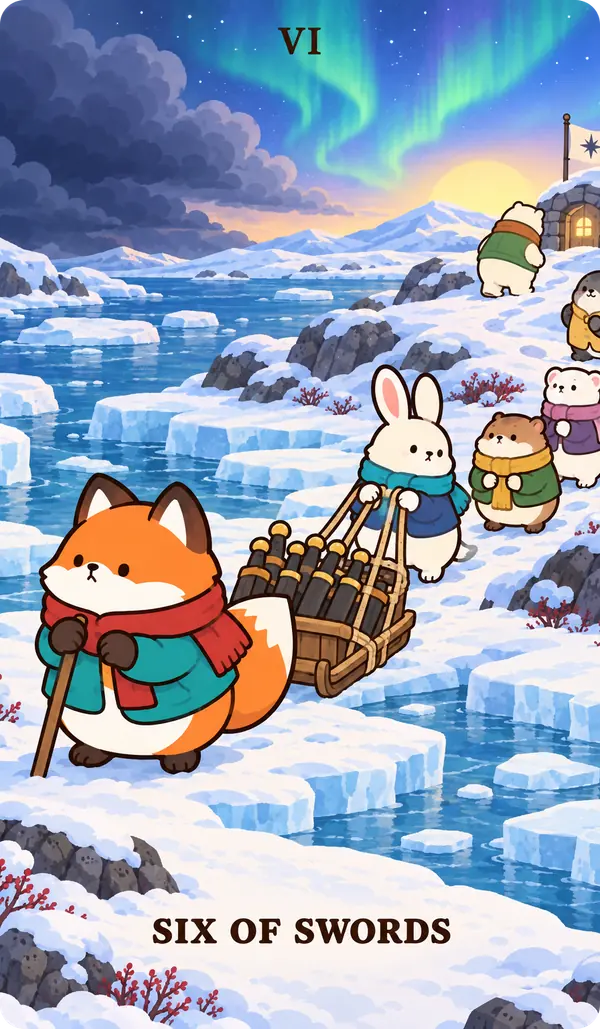 Four TrailsSix of SwordsTransition, leaving trouble, cautious hope.
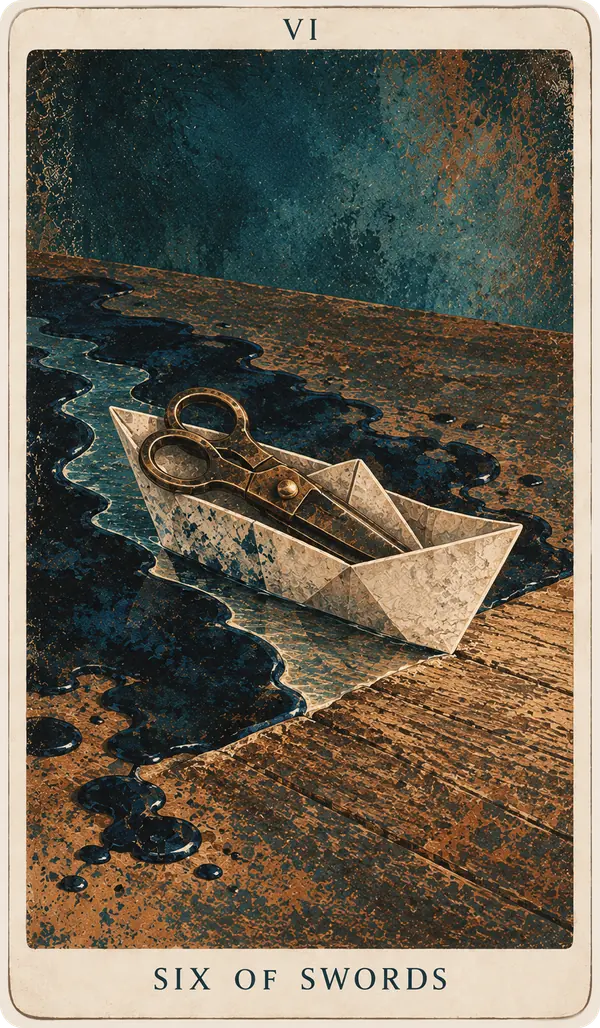 Living ThresholdSix of SwordsA paper boat carries useful shears through ink toward dry support.
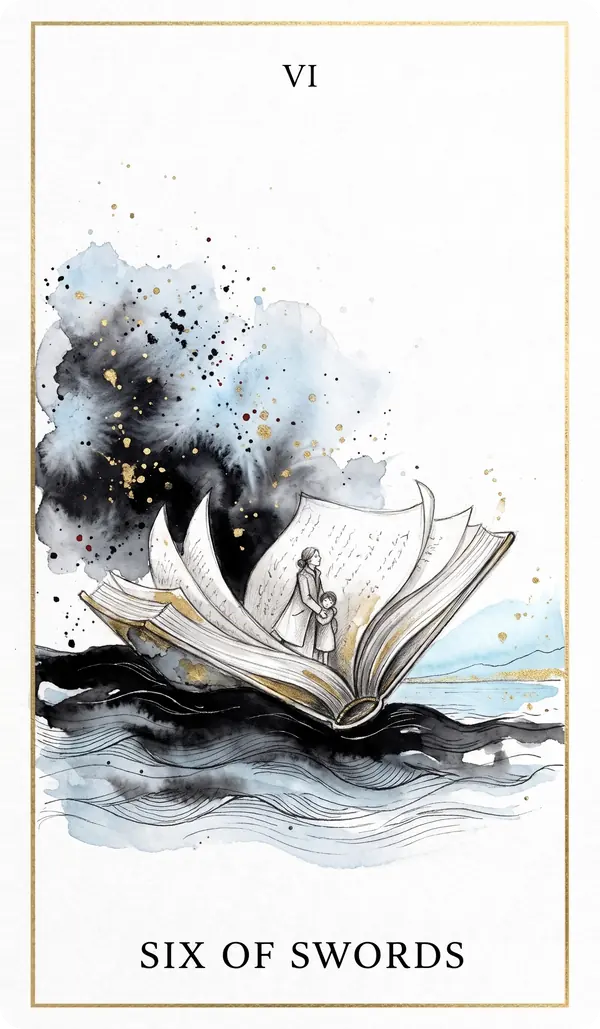 Colour of PowerSix of SwordsWhat you know carries you across; sail, do not look back.
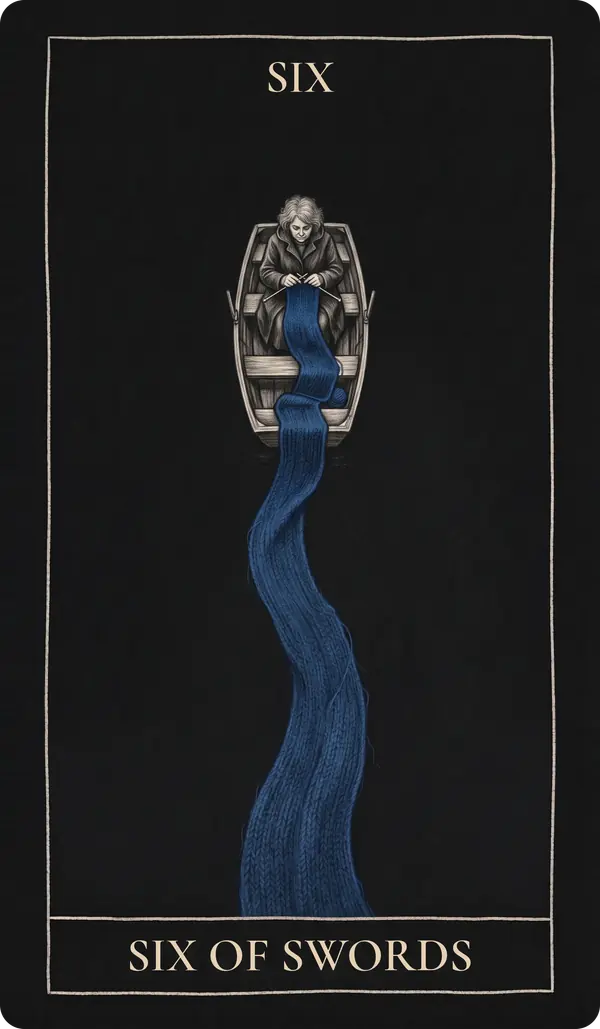 BoundSix of SwordsThe boat moves because she knits: the old shore becomes road.
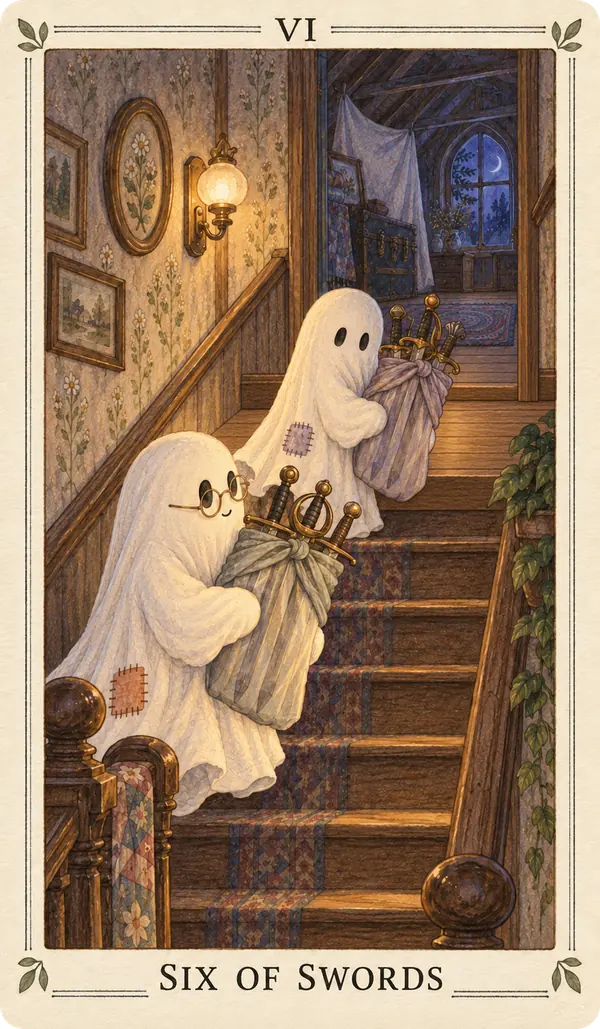 Cozy HauntSix of SwordsMove toward a safer arrangement.
 Celestial Night SkySix of SwordsA new view with the past acknowledged.
Where it appears
Questions about this card
Is Six of Swords a yes or no card in Crimson Inferno?
Six of Swords leans yes upright: a necessary transition with help at hand points that way, as long as you let the help take some of the weight. Reversed, it leans no, since returning to what hurt or refusing support points away. Ask who is bracing you from behind.
What does Six of Swords mean in love?
A move toward a safer place may be under way when Six of Swords appears upright in love, with someone else taking part of your weight. Reversed, you may be drawn back toward a familiar harm, or refusing the support that would carry you. Ask the person closest to you to help with one specific part of the change.
What does Six of Swords mean reversed in Crimson Inferno?
Reversed, Six of Swords means returning to familiar harm, or resisting support. Calling it loyalty when it is fear of the unfamiliar is the common disguise. Tell someone you trust what the pull back feels like. In Crimson Inferno the way out is a crossing made with help, so the reversal asks what is pulling you back toward the old shore.