King of Swords
Minor Arcana · Swords
In short
Clear, rational judgment and fair authority are available right now, worth applying with real discipline.
Reversed
Rational judgment here may be tipping into coldness, dismissing feeling that matters.
- Swords
- King
- Air
- The Judge
- clear, rational judgment
- fair and structured authority
- truth applied with discipline
Upright
The King of Swords favors clear, rational judgment: deciding based on facts and fairness rather than emotion or favoritism. It rewards structured, disciplined thinking applied to a real problem, and holding a firm, well-reasoned position.
This card often appears when a situation needs someone to think clearly and decide fairly, without being swayed by pressure.
It asks that authority serve fairness, not control.
A question to sit with
“What decision needs your clear, rational judgment instead of emotional reaction right now?”
One step
Make one decision based on clear reasoning rather than emotional reaction.
Reversed
Reversed, the King of Swords can mean judgment that’s become cold or rigid, using logic to dismiss legitimate feelings rather than to genuinely understand a situation. It can also mean authority applied unfairly, favoring rules over actual justice, or manipulating facts to win an argument rather than to find the truth.
The card asks whether the current use of reason is serving fairness, or just serving control.
A question to sit with
“Is your current use of reason serving fairness, or just serving control?”
One step
Check honestly whether a rational-sounding decision is being fair to everyone involved.
How this deck reads reversed cards
Turned over, the scene keeps its energy and changes how it flows: blocked, turned inward, exaggerated or handled carelessly. A reversed card has its own meaning, never the flat opposite.
In love
A clear, fair-minded approach to a relationship decision will serve better than an emotional reaction.
- Supports
- Your capacity for calm, structured thinking even in an emotional situation.
- Watch for
- Don’t let rational distance replace genuine warmth entirely.
- One step
- Think one relationship question through on paper today, clearly and fairly.
Rational distance may be crowding out warmth that this relationship needs right now.
- Supports
- Your capacity to notice the imbalance and adjust.
- Watch for
- Don’t use logic to avoid a needed emotional conversation.
- One step
- Balance clear thinking with genuine warmth in your next conversation.
At work
Clear, rational, and fair judgment is a real asset for a work decision right now.
- Supports
- A track record of disciplined, fair thinking.
- Watch for
- Don’t let rational distance come across as cold to your team.
- One step
- Apply clear, fair reasoning to your next work decision.
A rational-sounding work decision may not be fair to everyone it affects.
- Supports
- Your willingness to check the decision’s real fairness.
- Watch for
- Don’t prioritize the rule over actual justice here.
- One step
- List everyone this work decision affects, and ask if each of them would call it fair.
Clear, disciplined reasoning carries this decision further than an emotional reaction would.
- Supports
- Your ability to weigh facts fairly.
- Watch for
- Don’t dismiss a legitimate feeling just because it isn’t logical.
- One step
- List the facts fairly, then decide with genuine care too.
Logic may be overriding a legitimate feeling that matters to this decision.
- Supports
- Your ability to bring the feeling back into the equation.
- Watch for
- Don’t dismiss the feeling as simply irrational.
- One step
- Weigh the legitimate feeling alongside the facts before deciding.
You’re growing by applying clear, disciplined judgment to your own patterns and decisions.
- Supports
- Willingness to be fair and honest with yourself.
- Watch for
- Don’t let self-discipline turn into harsh self-judgment.
- One step
- Apply one piece of clear, fair reasoning to your own growth today.
Growth requires balancing fair, disciplined self-assessment with genuine self-compassion.
- Supports
- Your willingness to find that balance.
- Watch for
- Don’t let rational self-critique become unnecessarily harsh.
- One step
- Apply one piece of fair reasoning to yourself, with real compassion too.
Fair, rational leadership may help settle a family dispute.
- Supports
- Clear rules applied evenly.
- Watch for
- Treating the family like a courtroom.
- One step
- Set out the facts of a family dispute calmly and let each person respond.
Rational authority at home may be brushing aside feelings that matter.
- Supports
- Room for emotion in family decisions.
- Watch for
- Dismissing a relative’s feelings as irrational.
- One step
- Ask how a family decision feels to others, not only whether it makes sense.
Yes or no
YesNoThe facts line up well enough to decide on, and pressure from any side does not change them.
Supports
- The facts here support a clear, fair decision.
- Rational judgment is well suited to this situation.
Limits
- Emotional factors may need acknowledgment alongside the logic.
- Firmness could come across as rigid if not balanced with care.
One step
Decide based on the clear facts, but check in on how it affects the people involved.
The reasoning here may be airtight while still ruling out something legitimate, which is a different kind of problem.
Supports
- You can identify where fairness may have been overlooked.
- Adjusting the decision to be more fair is realistically possible.
Limits
- Logic may currently be overriding a legitimate feeling or concern.
- Rigid application of a rule could be causing unnecessary harm.
One step
Check the decision against how it affects everyone, not just the rule involved.
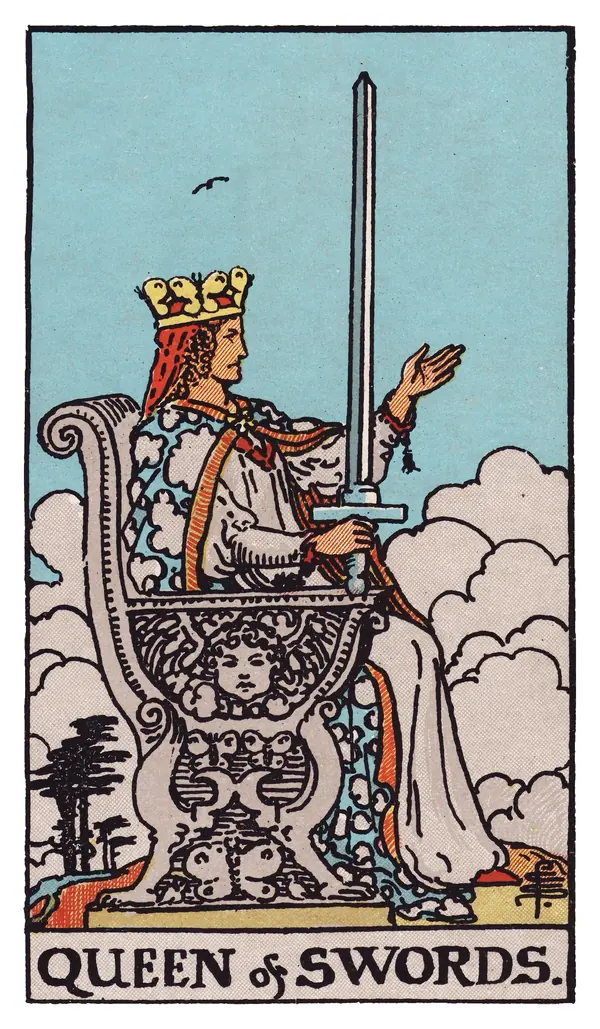
What is in the picture
A crowned figure sits upright on a throne, holding an upright sword, two crescent moons carved into the throne, birds in the sky.
The upright, formal seated posture and raised sword keep structured, rational authority at the center of the image.
- upright sword
- crowned figure
- two crescent moons on the throne
- birds in the sky
- stern, direct expression
- butterfly carvings
This card in other decks
 FamiliaKing of BladesThe scales are tipped by someone ready to answer for the tipping, and that is why the judgment finally ends.
 City of WindowsKing of SwordsApplying one measure to yourself and to others, telling testimony apart from guesswork, and answering for your words.
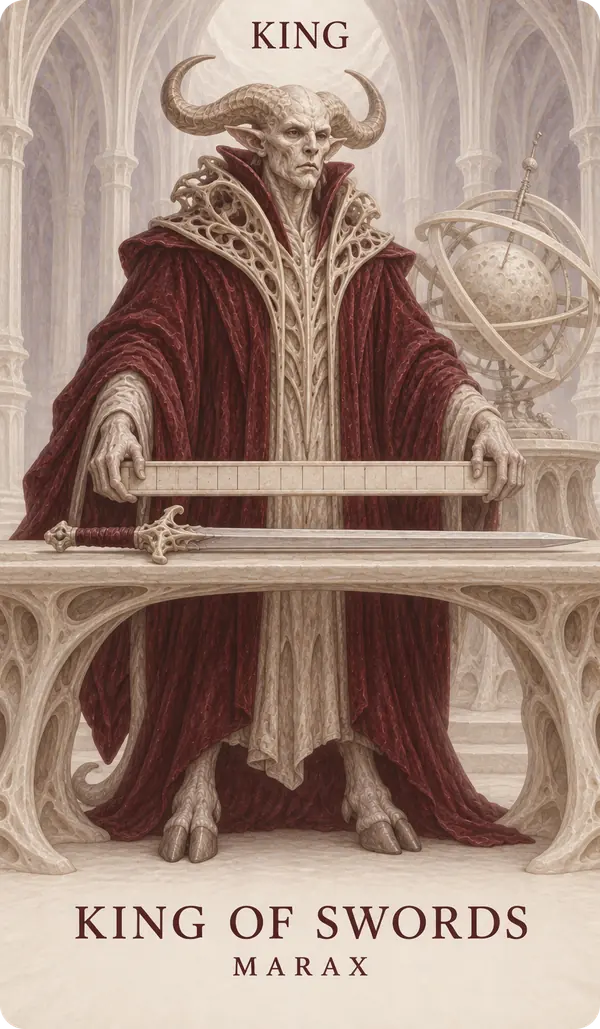 CarnalKing of SwordsJudgment organized into a consistent standard.
 Crimson InfernoKing of SwordsUse reason with accountability.
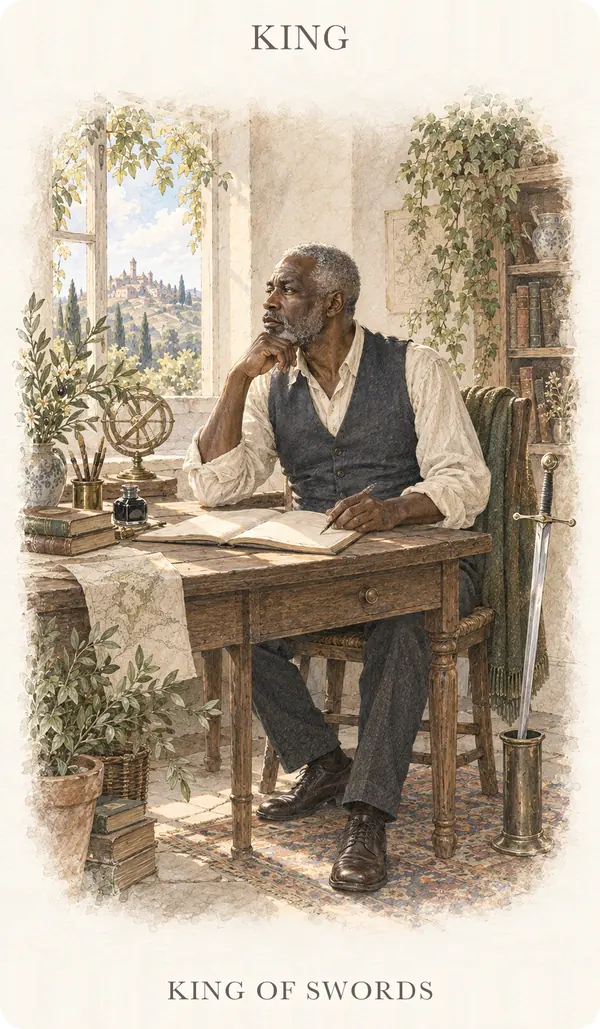 Everyday WondersKing of SwordsTaking responsibility for your judgments and welcoming questions.
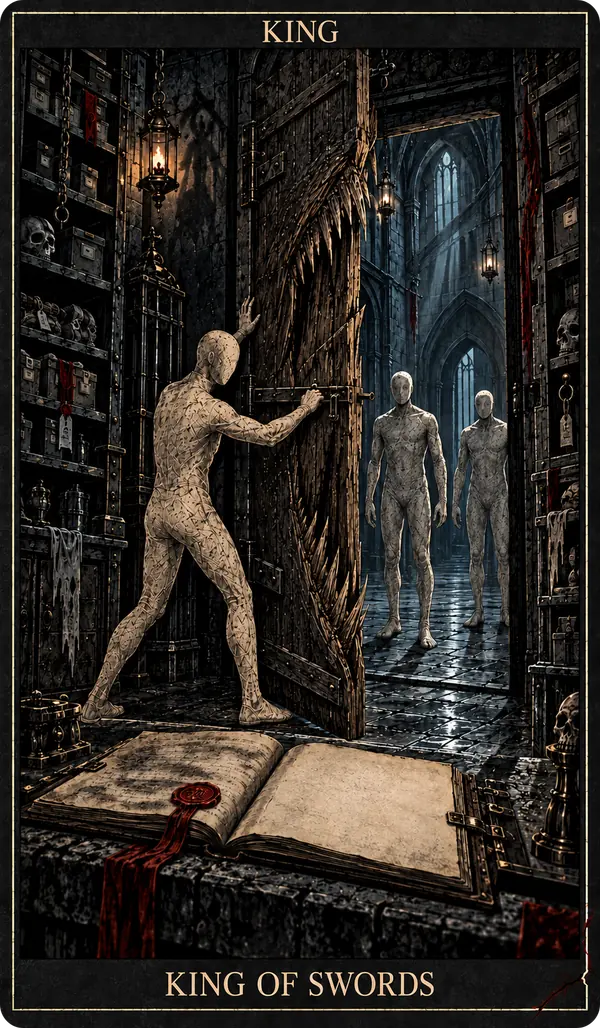 Mirror NightKing of SwordsLet others examine what is known and what remains uncertain.
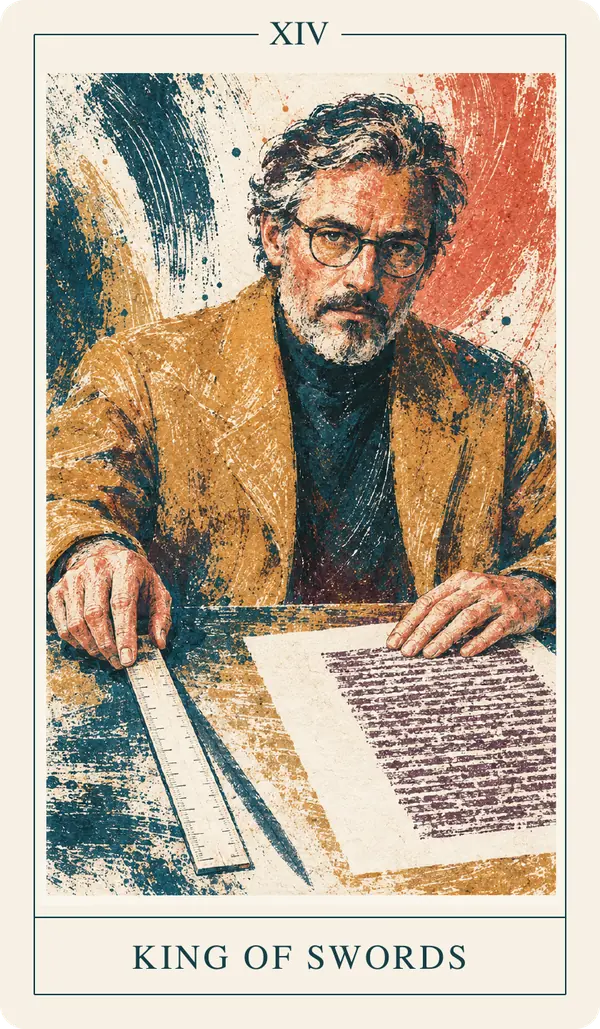 Self ContactKing of SwordsApply reason consistently, including to your own preferred explanation.
 Shiba TownKing of SwordsReason; ethical judgment; clear standards.
 Velvet MasqueradeKing of SwordsA shared standard that includes its keeper.
 Four HorsemenKing of DeathMeet an unavoidable truth without abandoning your duty.
 Four TrailsKing of SwordsClear judgment, reason, accountability.
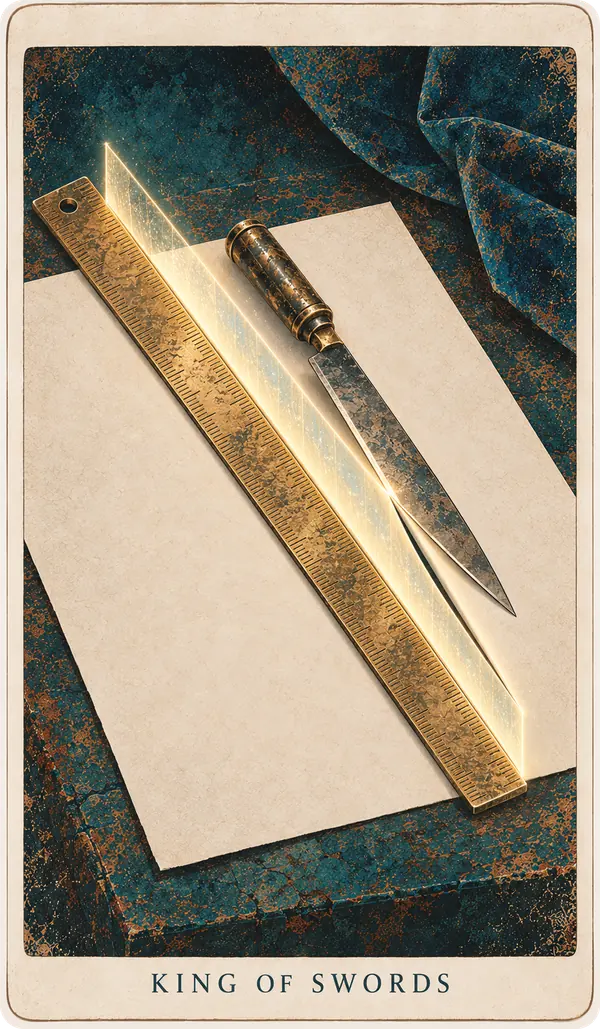 Living ThresholdKing of SwordsA visible rule makes the reach of a protective boundary clear.
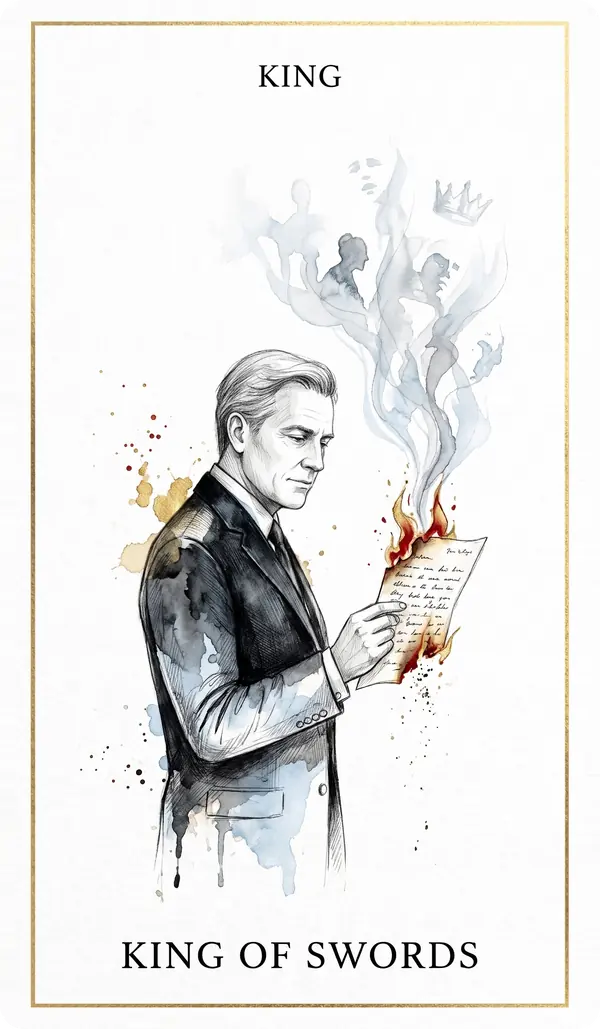 Colour of PowerKing of SwordsYou decide what the world will know and what goes with you.
 BoundKing of SwordsA mind that tells the truth and keeps its own wrist bound.
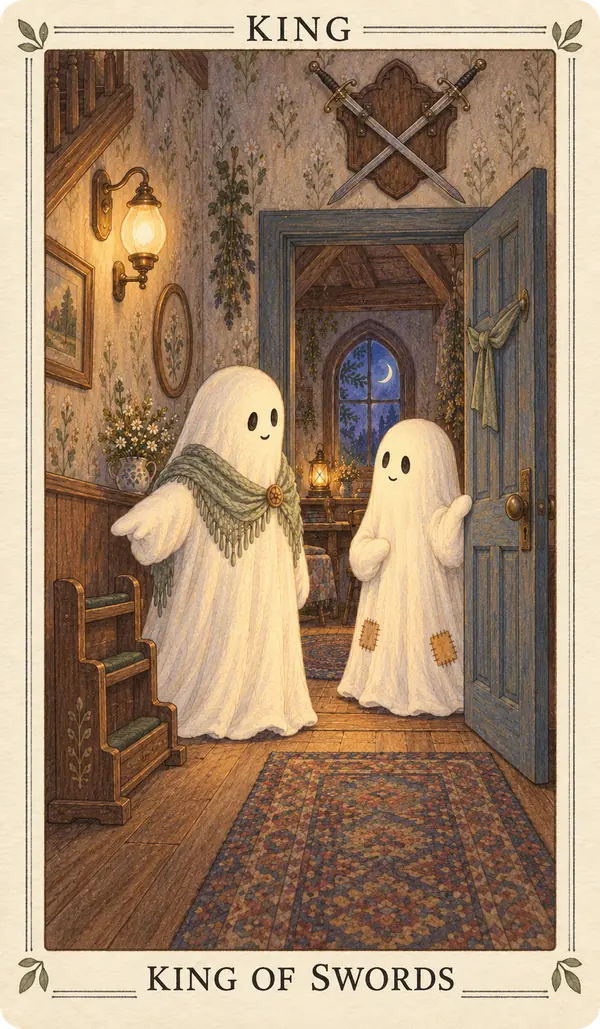 Cozy HauntKing of SwordsApply reason with consent and consistency.
 Celestial Night SkyKing of SwordsAn open way to question.
Where it appears
Questions about this card
Is the King of Swords a yes or no card?
Read upright, the King of Swords leans yes. The facts line up well enough to decide on, and pressure from any side does not change them. Reversed, it leans no: the reasoning may be airtight and still leave out something legitimate, often the feelings of the people a decision affects.
What does the King of Swords mean in love?
When the question is love, the King of Swords upright favors a clear, fair approach to a relationship decision over an emotional reaction in the moment. Reversed, rational distance may be crowding out the warmth the relationship needs. The card values reason, and it is plain that logic can be used to dismiss feelings. It asks whether your thinking is fair to both people, not only whether it is correct.
What does the King of Swords reversed mean?
In its reversed position, the King of Swords shows judgment turning cold or rigid. Logic may be used to dismiss feelings that matter, or authority may be exercised without fairness. The argument can sound perfectly reasonable and still shut out something legitimate. The card asks who a decision affects and whether each of them has actually been heard, rather than whether the reasoning holds up on paper.