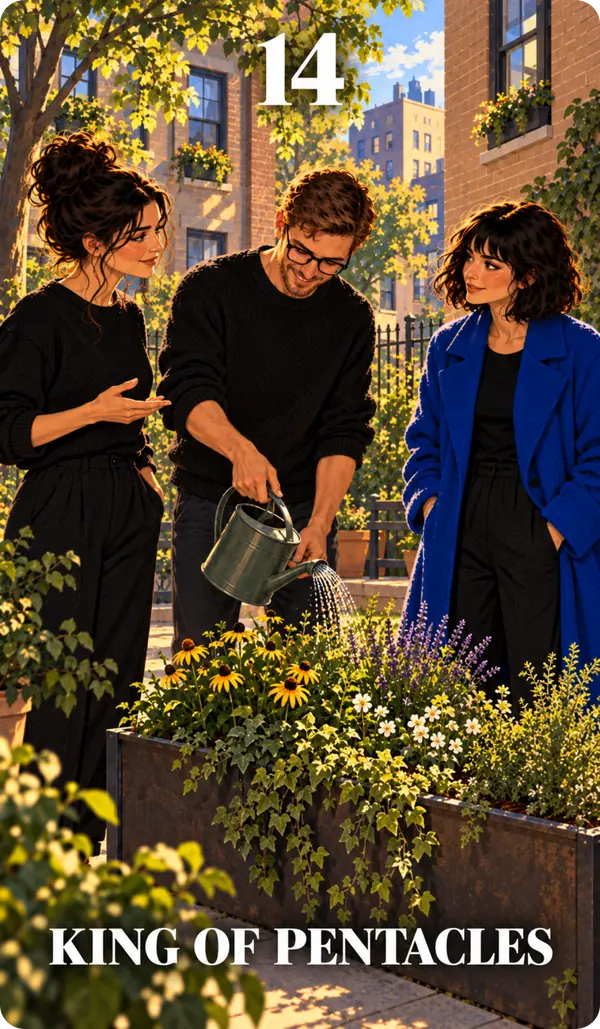
Ten of Pentacles
Ten of Pentacles in City of Windows · Minor Arcana
RelationshipsIn short
Building a reliable home life and keeping relationships going through repeated involvement.
Reversed
Treating property as the measure of love, demanding access to a home “because we’re close”, or keeping up a familiar arrangement in which one person feels cramped.
- Pentacles
- Ten
- Earth
- The Household Circle
- long-term support
- familiar ties
- a stability many people create together
Upright
Building a reliable home life and keeping relationships going through repeated involvement. Which people and actions make life steadier without giving up personal boundaries? Some time later, Mira invites Dana and Sam for a simple lunch at her place.
Everyone joins in without being given a hidden role: Mira lays the table, Dana puts out the salad she brought, Sam pours the water. After the meal, her friends will go back to their own homes; Mira will remain the host of her own space and keep her bond with them.
The card shows the possibility of a stable circle; it does not promise prosperity, marriage or everlasting agreement.
A question to sit with
“What would stability look like if it held both togetherness and a door of your own?”
One step
Name the people and actions that make life steadier while your own boundaries stay in place.
Reversed
Treating property as the measure of love, demanding access to a home “because we’re close”, or keeping up a familiar arrangement in which one person feels cramped.
A question to sit with
“Who has the right to decide about their own space?”
One step
Name who has the right to decide about each space involved, starting with your own.
How this deck reads reversed cards
Reversed, a window may show a delay, an imbalance, a defensive reaction or the first step out of one; the neighboring cards help tell which. A reversal does not mean “a bad person”, and one card proves no one’s motive.
In love
A steady circle may form through repeated care, a simple lunch where each person brings something and then goes home to their own door.
- Supports
- Shared rituals that leave each person their own space.
- Watch for
- Expecting closeness to erase personal boundaries.
- One step
- Invite someone close to a simple meal, and let each person bring one thing.
Property may be getting treated as love’s measure, or access to a home may be claimed on the grounds of being close.
- Supports
- Each person’s right to decide about their own space.
- Watch for
- Demanding a key because you are together.
- One step
- Ask them how they feel about the current arrangement for each of your spaces, and listen.
At work
A reliable working circle may grow from repeated small involvements, each person with a part and none with a hidden role.
- Supports
- Regular, visible shared contributions at work.
- Watch for
- Taking a stable team as permanent without tending it.
- One step
- Suggest one small regular team ritual, like a shared lunch once a month.
A familiar arrangement at work may be cramping someone, or access to shared resources may be claimed by seniority.
- Supports
- Reviewing arrangements that one person finds tight.
- Watch for
- Treating long tenure as a right to someone else’s space.
- One step
- Ask a colleague whether a shared arrangement still works for them.
Keeping your circle of people steady, without asking anyone to give up their own space, may be what tips the choice.
- Supports
- Considering who would be around you under each option.
- Watch for
- Choosing stability that would cramp someone.
- One step
- For each option, write which people would remain close and how often you would see them.
A decision may be tied to property or status more than to what suits the people in it.
- Supports
- Asking who has the right to decide about which space.
- Watch for
- Choosing by what it would show about your position.
- One step
- Write who would have a say over each space under every option.
Becoming part of a reliable circle, laying the table, pouring the water, may be the growth, while still being host of your own life.
- Supports
- Belonging without losing yourself.
- Watch for
- Thinking a stable life must look like a postcard.
- One step
- Take one regular role in a group you belong to, such as bringing the bread.
Growth may mean seeing where a comfortable arrangement leaves someone cramped, or where closeness has become a claim.
- Supports
- Respect for others’ doors.
- Watch for
- Assuming love gives you access.
- One step
- Notice one place where you enter someone’s space without asking, and ask next time.
Family life may feel solid through repeated shared meals and visits, with each person keeping their own door and their own key.
- Supports
- Regular family gatherings with clear boundaries.
- Watch for
- Measuring family love by property or inheritance.
- One step
- Set a date for a simple family lunch, and ask each relative to bring one dish.
In the family, a relative may demand access to a home because they are family, or someone may feel cramped in an old arrangement.
- Supports
- Family respect for each person’s own home.
- Watch for
- Using family ties to claim space or property.
- One step
- Ask before visiting a relative’s home this week, even if you usually just come.
Yes or no
YesNoRepeated involvement that respects each person’s space leans toward yes.
Supports
- People who keep showing up may be making daily life steadier.
- Shared life and a door of your own can exist side by side.
Limits
- Closeness could be taken as a reason to drop personal boundaries.
- A steady circle is built over time and cannot be rushed.
One step
Think of who keeps turning up in ordinary ways, and check that your own boundaries still hold with them.
While access or property stands in for closeness, or one person feels cramped, the answer leans toward no.
Supports
- You have the right to decide about your own space.
- Noticing where you feel cramped shows you where to begin.
Limits
- Someone may be treating closeness as a key to your home.
- Owning things together could be mistaken for proof of love.
One step
Ask yourself who decides about each space you share, and whether that still feels right.
What is in the picture
A small dining area in Mira’s flat; Mira, Dana and Sam around one table with simple food, a window and an ordinary front door in view. On a hook by the door hangs her key on its red cord; a plant stands by the window.
The card shows the possibility of a stable circle; it does not promise prosperity, marriage or everlasting agreement.
- round dining table
- salad bowl
- water jug
- bread board
- front door
- key on a red cord
- plant by the window
This card in other decks
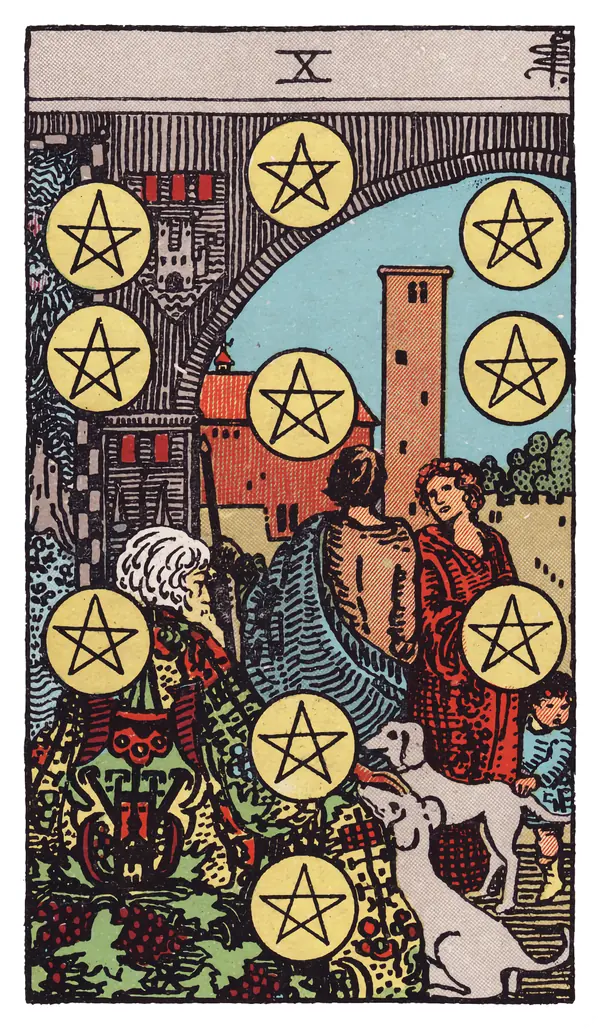 Rider–Waite–SmithTen of PentaclesSomething genuinely lasting is being built here, worth valuing beyond just its immediate, individual benefit.
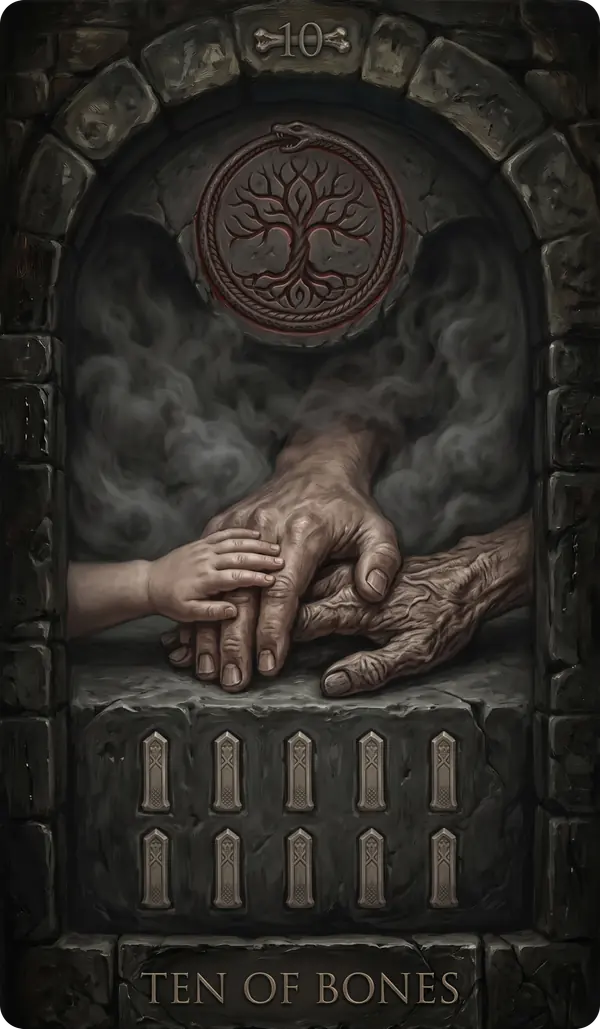 FamiliaTen of BonesA legacy that no longer needs defending: a house, land or business passing peacefully and lawfully between generations.
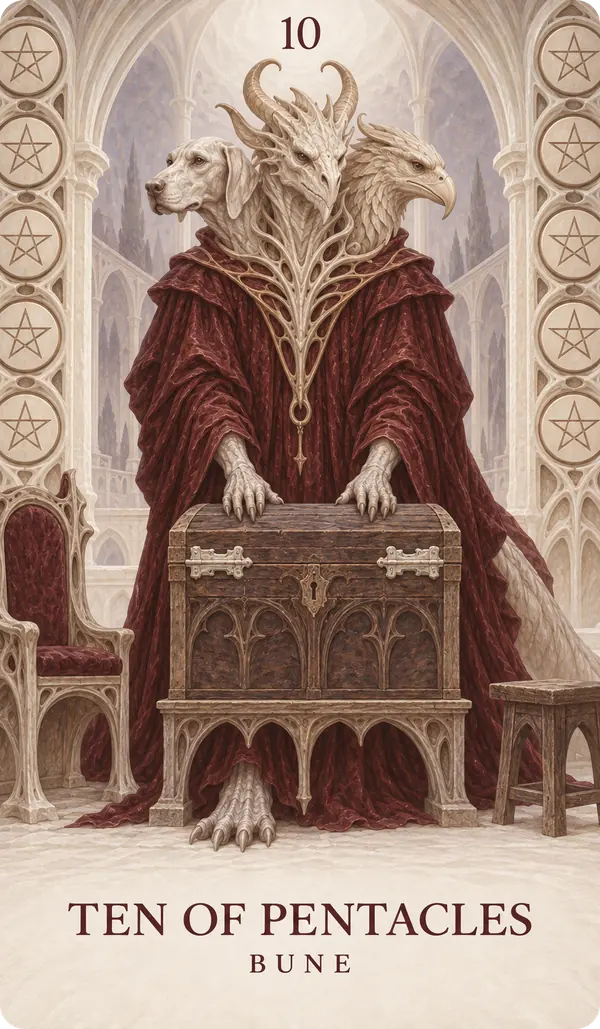 CarnalTen of PentaclesAn achievement becomes an inheritance and a system.
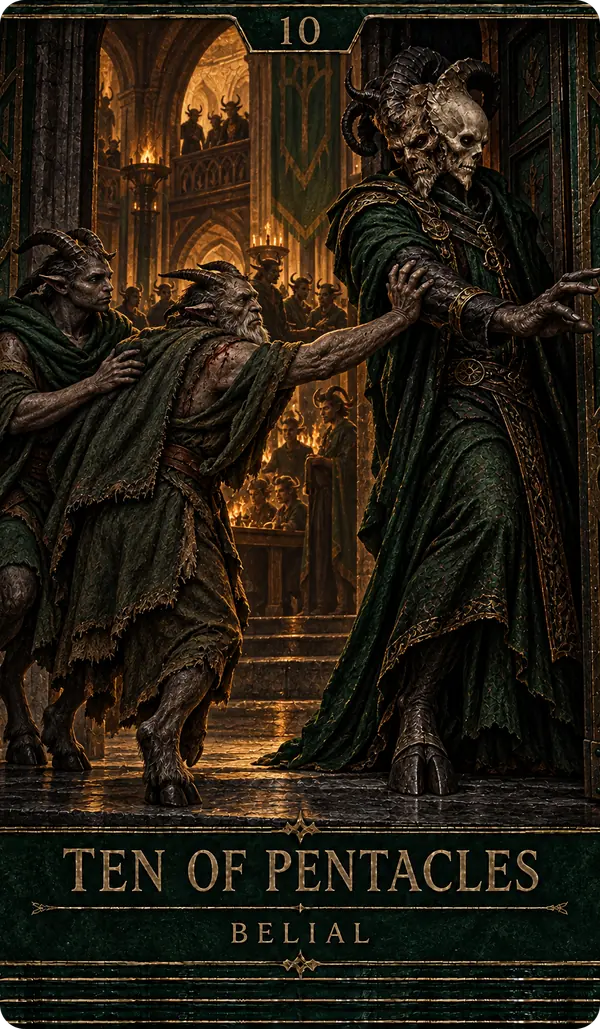 Crimson InfernoTen of PentaclesBuild arrangements that remain useful beyond you.
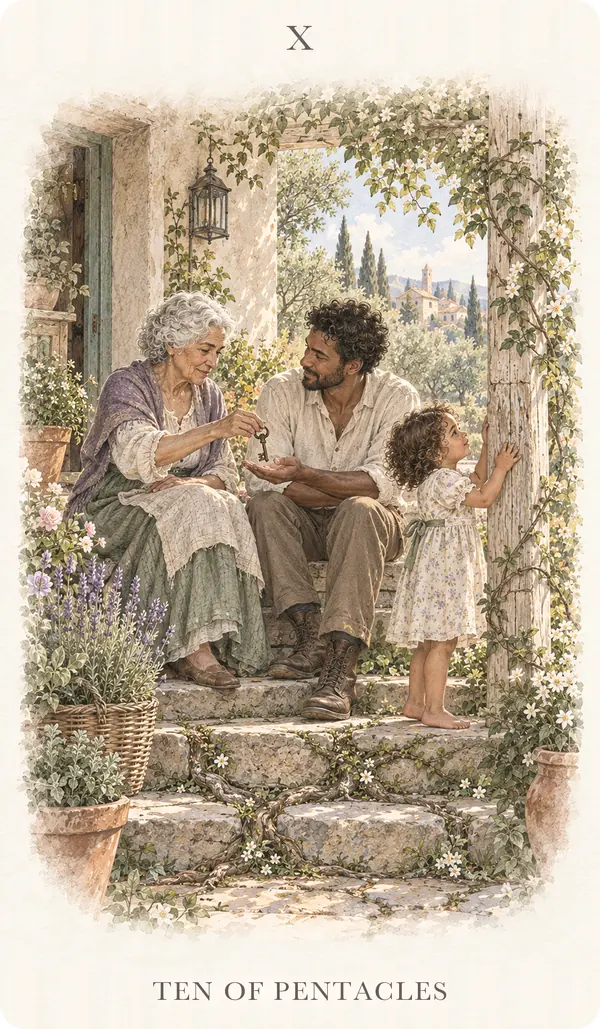 Everyday WondersTen of PentaclesShared resources built to last beyond one person’s effort.
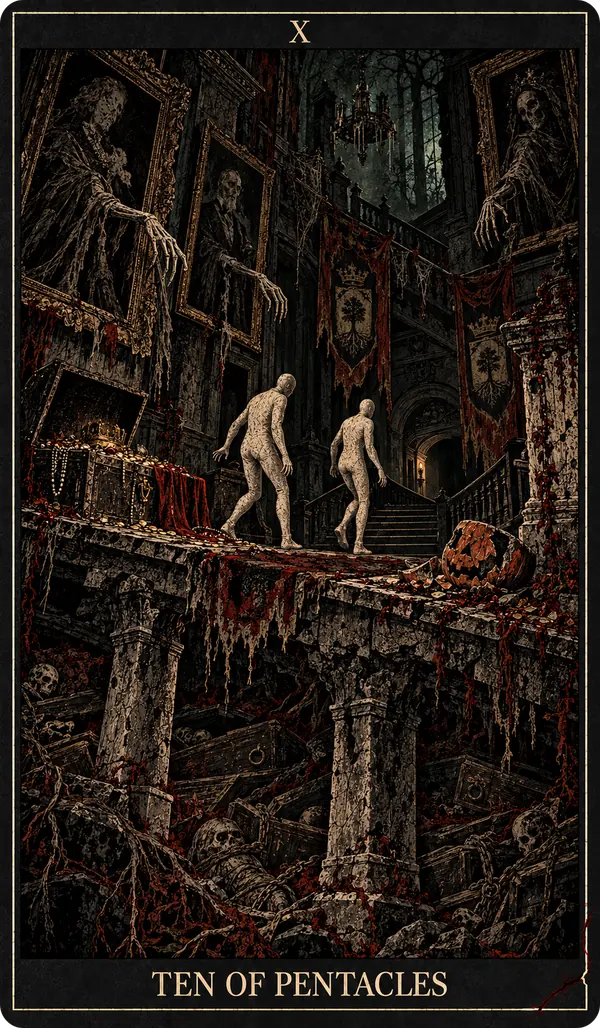 Mirror NightTen of PentaclesKeep the life-supporting inheritance and end its harmful claim.
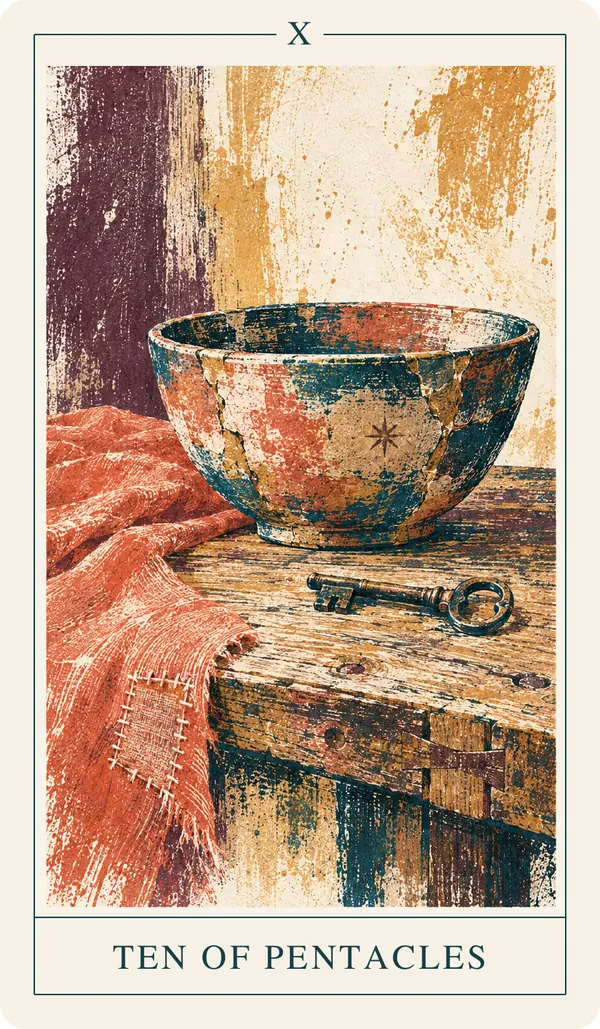 Self ContactTen of PentaclesBuild durable support that can be shared and passed on.
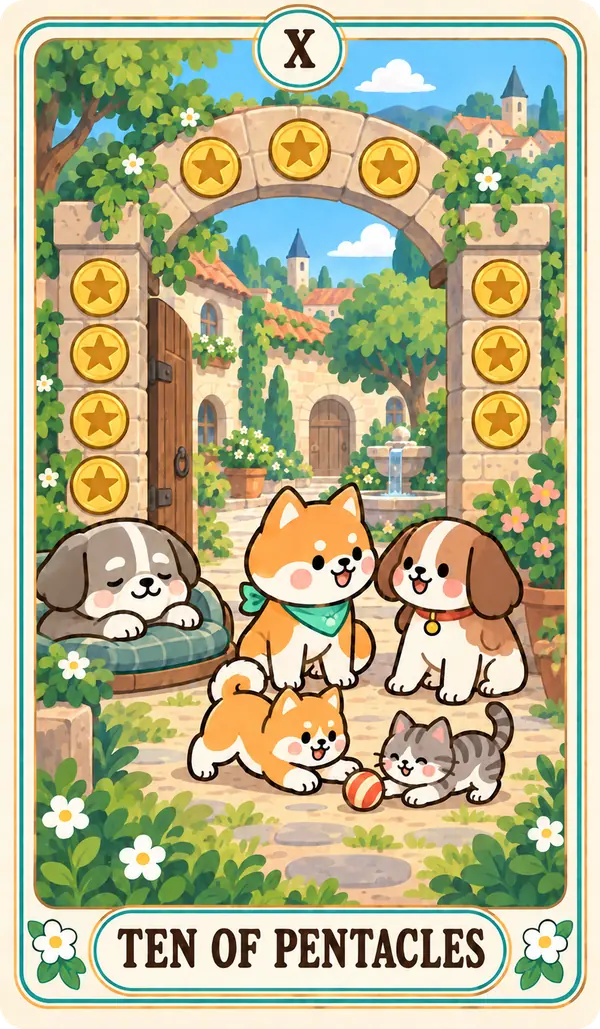 Shiba TownTen of PentaclesLegacy; durable support; shared resources across generations.
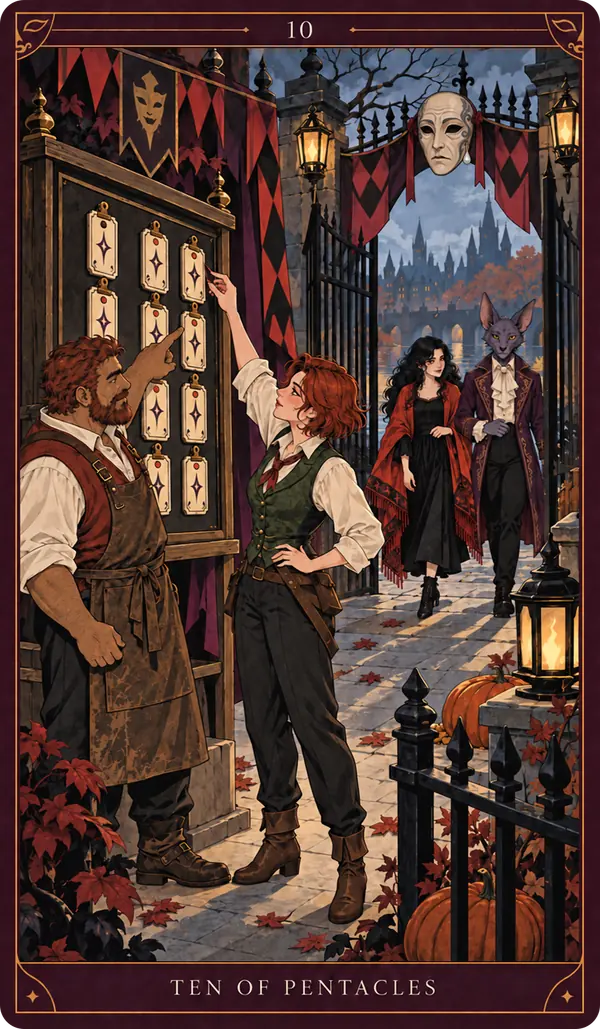 Velvet MasqueradeTen of PentaclesShared resources whose care can pass to others.
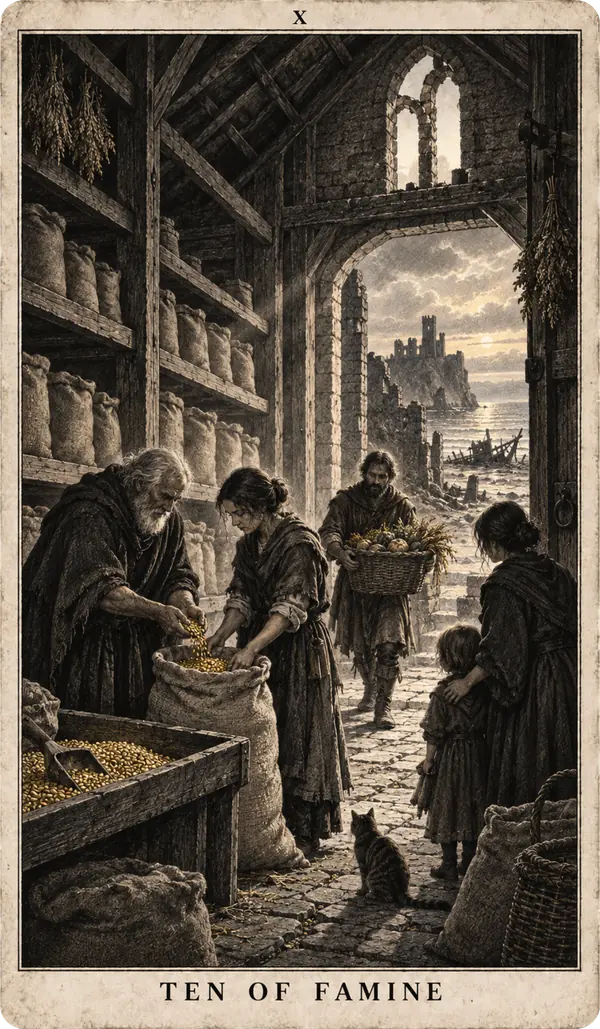 Four HorsemenTen of FamineBuild resources that remain usable for those who come after you.
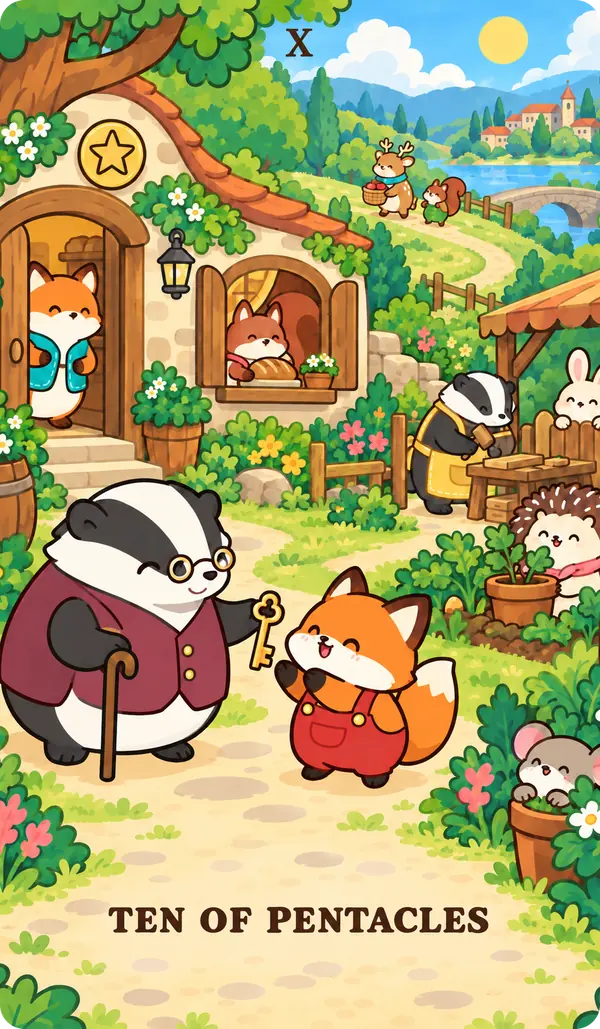 Four TrailsTen of PentaclesLegacy, shared security, family stewardship.
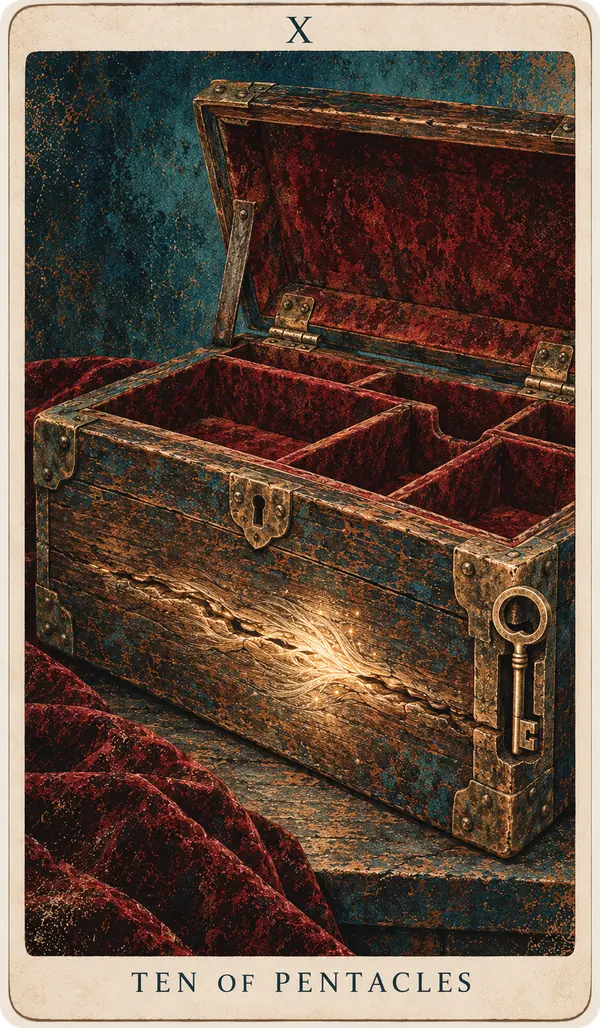 Living ThresholdTen of PentaclesThe old coffer renews its strength at the repair and keeps its key within reach.
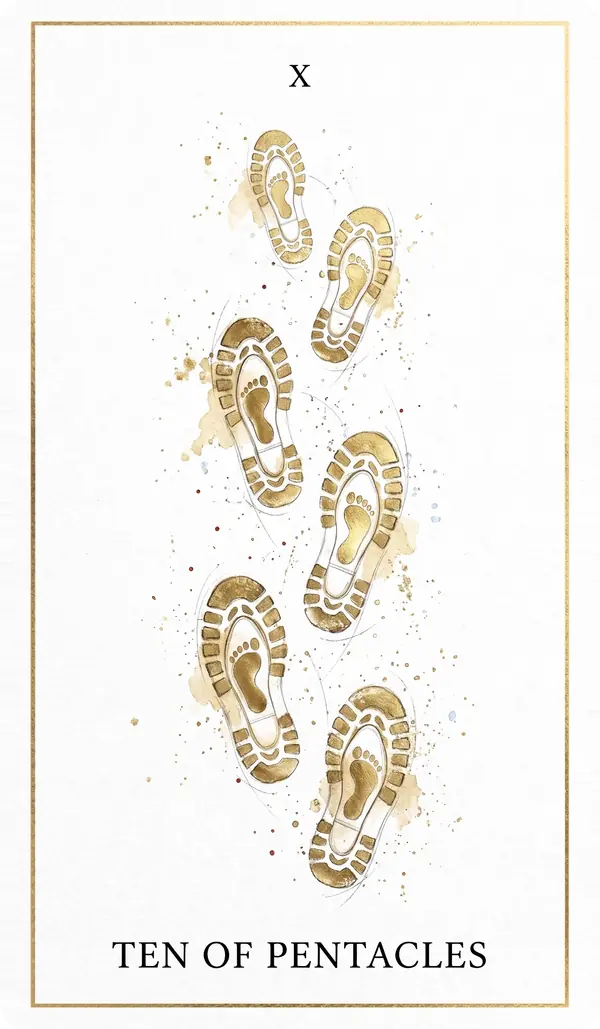 Colour of PowerTen of PentaclesA road already gilded by those who walked before you.
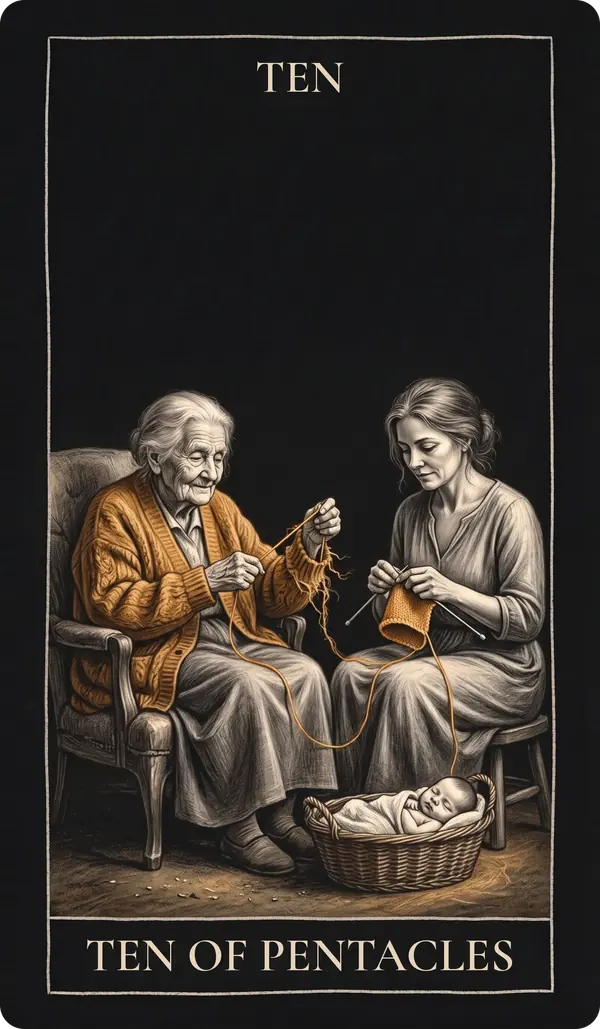 BoundTen of PentaclesWarmth unraveled from one generation to knit the next.
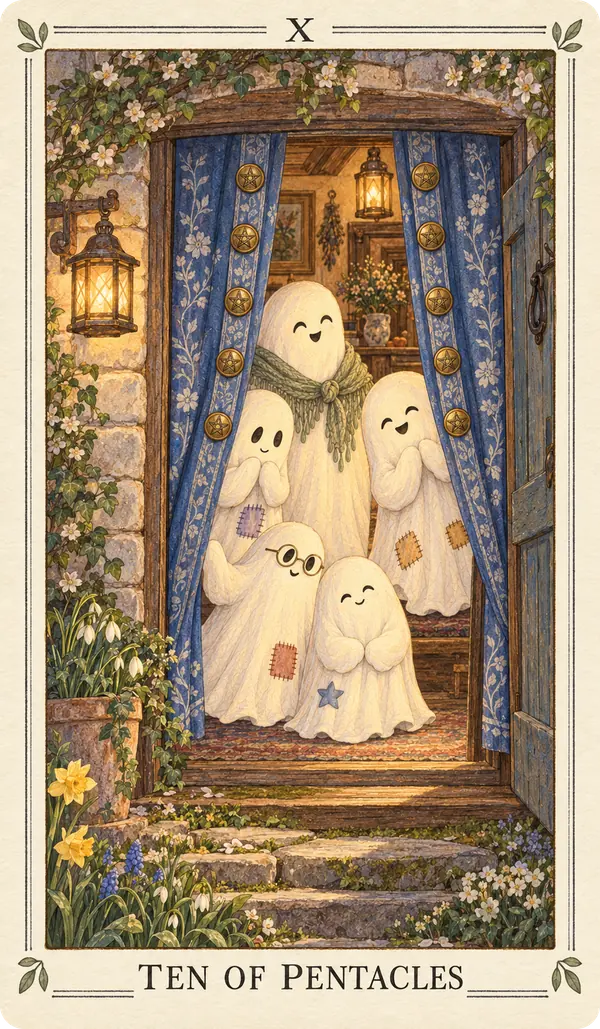 Cozy HauntTen of PentaclesBuild security that others can inherit.
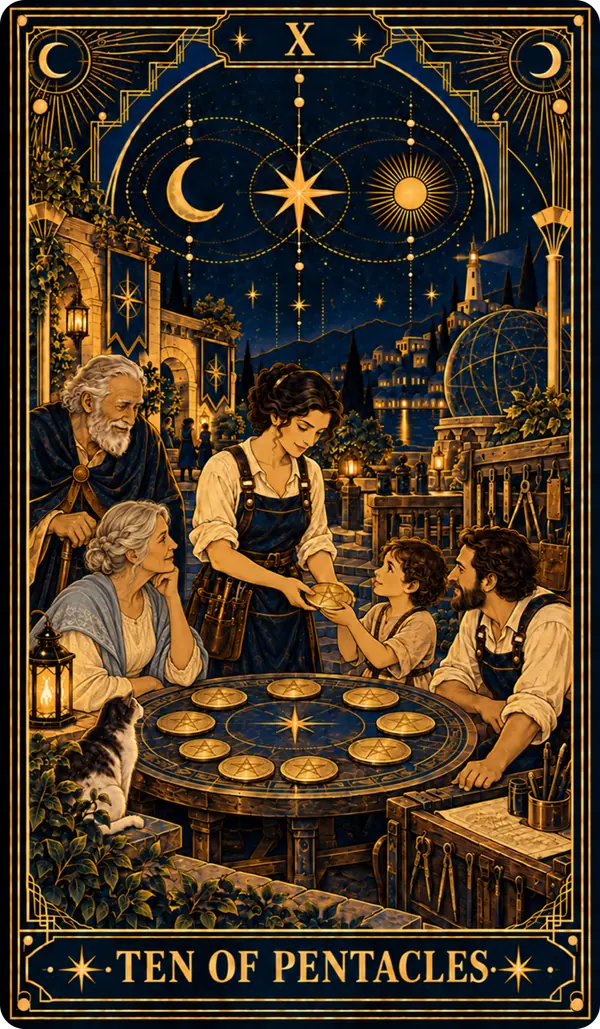 Celestial Night SkyTen of PentaclesA useful craft passed onward.
Where it appears
Questions about this card
Is the Ten of Pentacles a yes or no card in City of Windows?
Upright, the Ten of Pentacles leans yes. Repeated involvement that respects each person’s own space tends to build something steady. Reversed, it leans no. While property or access to a home stands in for closeness, or one person feels cramped in a familiar arrangement, the lean stays no.
Does the Ten of Pentacles mean marriage?
It can point that way. The Ten of Pentacles is traditionally the card of family, home and lasting ties, so it often appears around marriage or a shared household. In City of Windows its picture is quieter: Mira hosts Dana and Sam for a simple lunch, everyone helps, and afterwards each goes back to their own home. It shows a stable circle. What each of you wants is a question to ask each other plainly.
What does the Ten of Pentacles mean reversed?
Reversed, the Ten of Pentacles shows property or access treated as the measure of love. Someone may demand a key to your home “because we’re close,” or keep up a familiar arrangement in which one person feels cramped. Who has the right to decide about their own space? Tell your partner one place or time you want to keep as your own.