Eight of Cups
Eight of Cups in City of Windows · Minor Arcana
RelationshipsIn short
Stepping out of a familiar way of relating when it wears away your own feeling.
Reversed
Going back to an empty ritual out of fear of loneliness, or leaving without a word where a boundary could safely be explained.
- Cups
- Eight
- Water
- The Quiet Leaver
- leaving, by choice, a form of closeness that no longer nourishes
- looking for more honest support
Upright
Stepping out of a familiar way of relating when it wears away your own feeling. Name how long the distance will last, what it is for, and a channel that stays open for practical matters, if that is safe. Dana tells Sam that she will stay with her sister over the coming weekend and won’t keep up the usual appearance that everything is as it was.
They agree to come back to the conversation on Sunday. In the evening she leaves their home with a small bag.
This isn’t punishment by silence, nor a promise that the relationship is bound to end; the distance is there so that she can hear herself.
A question to sit with
“What am I stepping away from, and where am I going for support?”
One step
Name how long the distance will last, what it is for, and a channel that stays open for practical matters, if that is safe.
Reversed
Going back to an empty ritual out of fear of loneliness, or leaving without a word where a boundary could safely be explained.
A question to sit with
“What kind of distance would support you, rather than become a new way of tormenting each other?”
One step
Picture the kind of distance that would support you, and explain it in a sentence where that is safe.
How this deck reads reversed cards
Reversed, a window may show a delay, an imbalance, a defensive reaction or the first step out of one; the neighboring cards help tell which. A reversal does not mean “a bad person”, and one card proves no one’s motive.
In love
A familiar way of being together may have gone thin, and a short, named distance, like Dana’s weekend bag, may help you hear your own feeling again.
- Supports
- A pause with a stated length and a reason you both know.
- Watch for
- Keeping up the look that everything is as it was.
- One step
- Name one routine between you that has gone empty, and say it plainly when you are both calm.
You may be returning to an empty ritual out of fear of loneliness, or slipping away without a word where a boundary could be explained safely.
- Supports
- Distance that supports you instead of hurting either of you.
- Watch for
- Going back to the kitchen window just to avoid being alone.
- One step
- Write what kind of pause would actually help, and how you could say it kindly.
At work
A job rhythm may no longer feed you, and stepping back from one habit, with a clear day to return to the talk, may be wiser than carrying on as usual.
- Supports
- Saying openly what you are stepping back from and until when.
- Watch for
- Drifting away from a task without telling anyone it has worn you out.
- One step
- Choose one recurring work habit you could pause for a week, and tell the person it affects.
Work may be held together by a ritual nobody believes in, or someone may be quietly leaving a project instead of saying what is wrong.
- Supports
- Explaining a step back before people notice the empty chair.
- Watch for
- Vanishing from a team rather than telling them you need less.
- One step
- Tell a colleague one thing you plan to do less of, before you simply stop.
The option that leads down the sidewalk may be about distance, not ending: room to listen to yourself before you decide anything for good.
- Supports
- Taking time apart from the question before you answer it.
- Watch for
- Mistaking a needed pause for a final verdict.
- One step
- Set a date to come back to the choice, and spend the days until then away from it.
A choice may swing between clinging to the familiar door and walking off in silence, when a third way, a spoken pause, may be open.
- Supports
- Looking for the option between staying stuck and leaving mute.
- Watch for
- Treating the old routine as the only safe place.
- One step
- Write the spoken version of the step you are considering, as if you had to explain it.
Walking away from an old rhythm with one light bag may be how you grow now, carrying only what you need to think clearly.
- Supports
- Travelling light, in plans and in expectations.
- Watch for
- Punishing someone with silence and calling it space.
- One step
- Set aside one afternoon this weekend with no duties to anyone, and take only what you need with you.
Leaving without explaining may feel easier than staying in an empty habit, and growth may lie in learning to name a boundary out loud.
- Supports
- Practising one clear sentence about what you need.
- Watch for
- Using distance as a new way of hurting each other.
- One step
- Say one boundary aloud to yourself in the mirror until it sounds like your own voice.
A family habit may have outlived its warmth, and stepping out of it for a while, with a door left open for practical matters, may be kinder than pretending.
- Supports
- Keeping one practical channel open while you take some distance.
- Watch for
- Leaving a family ritual without a word of explanation.
- One step
- Tell one relative which family routine you would like to skip for now, and why, in a sentence.
Someone in the family may keep a hollow tradition going from fear of being alone, or may withdraw without telling anyone why.
- Supports
- Asking a withdrawn relative what they need, without pressing.
- Watch for
- Holding a gathering together only for appearances.
- One step
- Ask the family which tradition still feels warm, and which might rest for a year.
Yes or no
MixedNoA step away may serve you, yet it settles nothing about the relationship, so the answer stays mixed.
Supports
- Some distance may help you hear your own feeling again.
- A pause with a set length and purpose keeps the way back to the conversation open.
Limits
- Stepping back can be read as punishment if nothing is said about why.
- An old rhythm may pull you back before you know what you need.
One step
Before you step back, say how long the distance should last and when you’d like to talk again.
The distance may be either avoided or taken without a word, so the answer leans toward no until it has a clear shape.
Supports
- Noticing that a routine has gone empty is already a start.
- You can choose a distance that supports you rather than one that wounds.
Limits
- Fear of being alone may keep you in a ritual that feeds no one.
- A silent exit may leave the other person guessing, and you unheard.
One step
Write one sentence that would explain your boundary, and decide whether it is safe to say.
What is in the picture
Dana, carrying a single travel bag, walks along a sunlit sidewalk away from the building entrance. Behind her are the ordinary entrance and the kitchen window of their apartment, but Sam isn’t standing at the window. Dana’s face is sad and determined; the sidewalk leads straight back to the doorstep.
This isn’t punishment by silence, nor a promise that the relationship is bound to end; the distance is there so that she can hear herself.
- single travel bag
- sidewalk leading away
- building entrance
- kitchen window with no one at it
- doorstep
This card in other decks
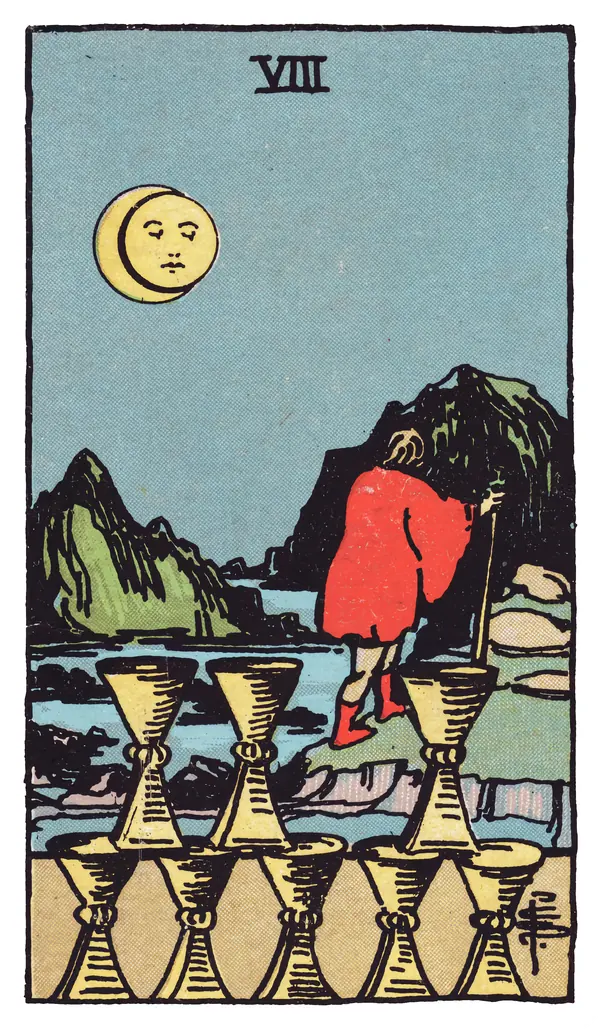 Rider–Waite–SmithEight of CupsSomething that looks fine on the surface may not be enough anymore, and walking away in search of more is valid.
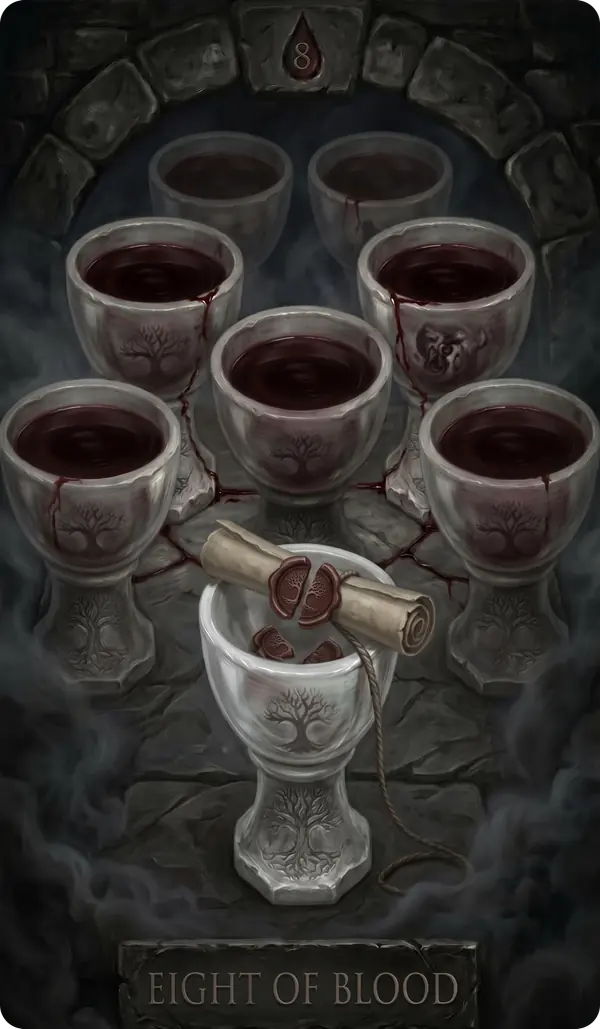 FamiliaEight of BloodA break called by its name: a departure recorded and accepted, so that it does not stay an open wound.
 CarnalEight of CupsA departure from fulfillment that no longer sustains.
 Crimson InfernoEight of CupsWalk away from an arrangement that can no longer nourish you.
 Everyday WondersEight of CupsLeaving, deliberately, what no longer nourishes you.
 Mirror NightEight of CupsDepart without denying grief.
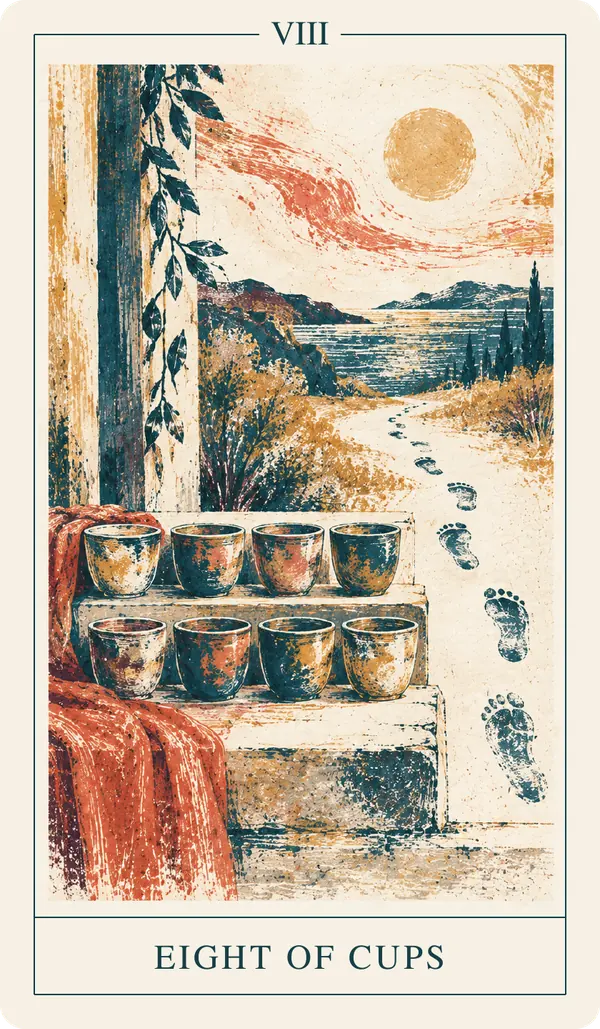 Self ContactEight of CupsSomething insufficient may be worth leaving, even when it is not ruined.
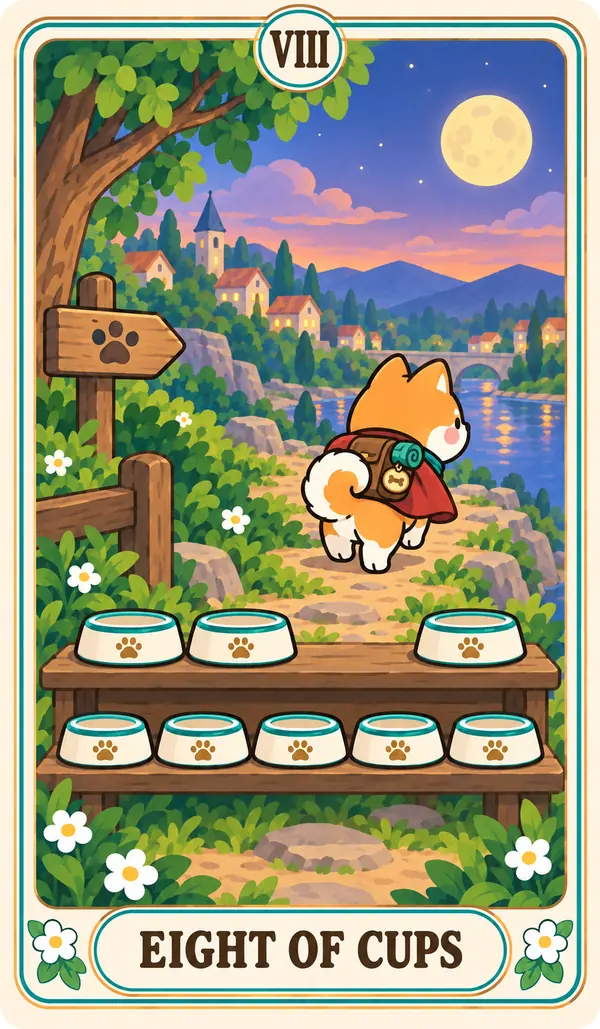 Shiba TownEight of CupsLeaving what no longer fulfills; seeking depth.
 Velvet MasqueradeEight of CupsDeparture, seeking depth and acknowledging insufficiency.
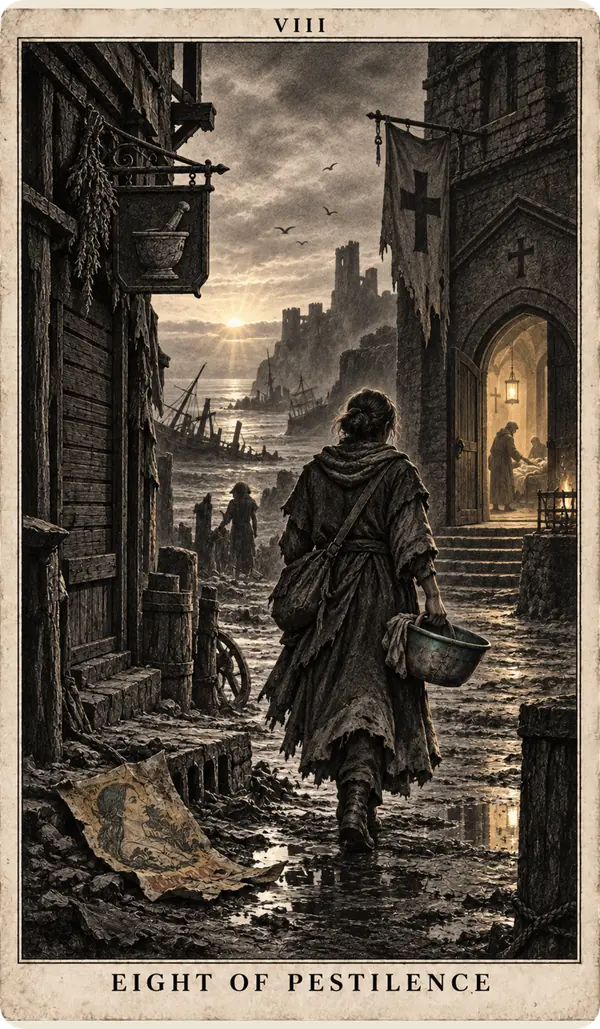 Four HorsemenEight of PestilenceLeave a practice that no longer sustains life and choose work with substance.
 Four TrailsEight of CupsLeaving what no longer nourishes, seeking truth.
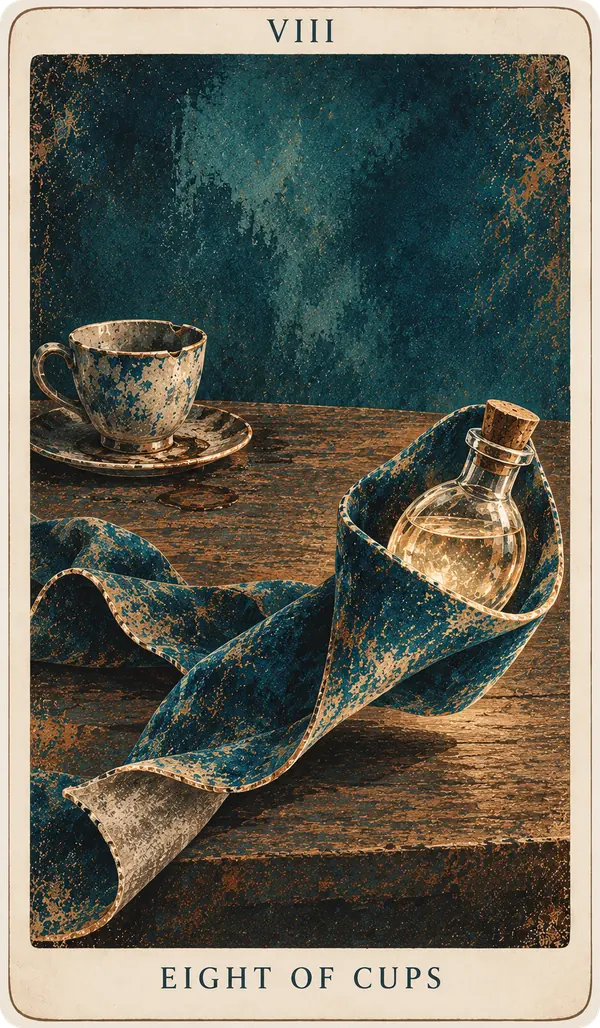 Living ThresholdEight of CupsA supported departure preserves your capacity to care.
 Colour of PowerEight of CupsYou leave what no longer fills you, even if it shines.
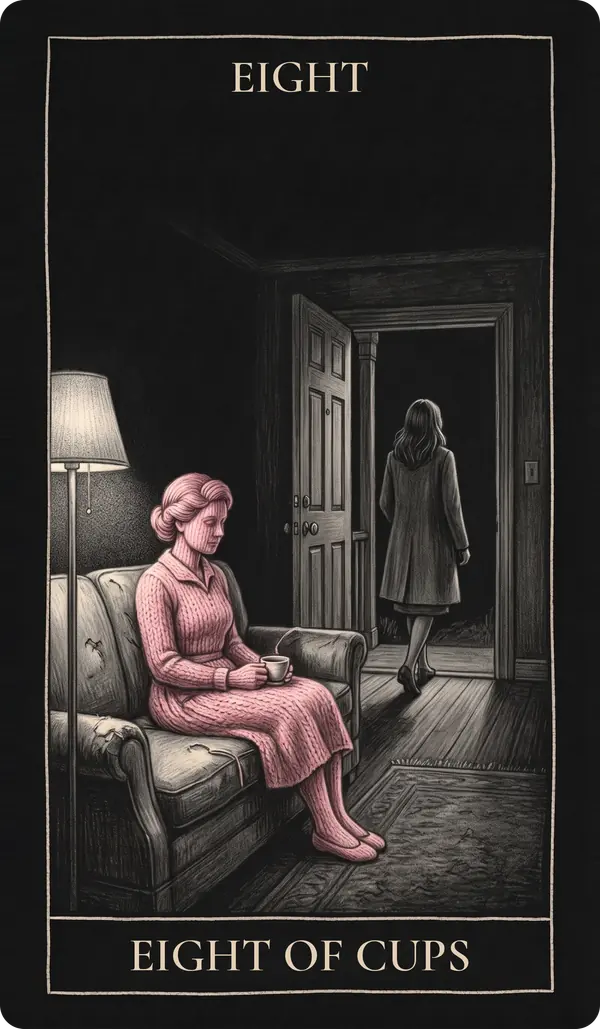 BoundEight of CupsLeaving the self you knitted so everyone would be comfortable.
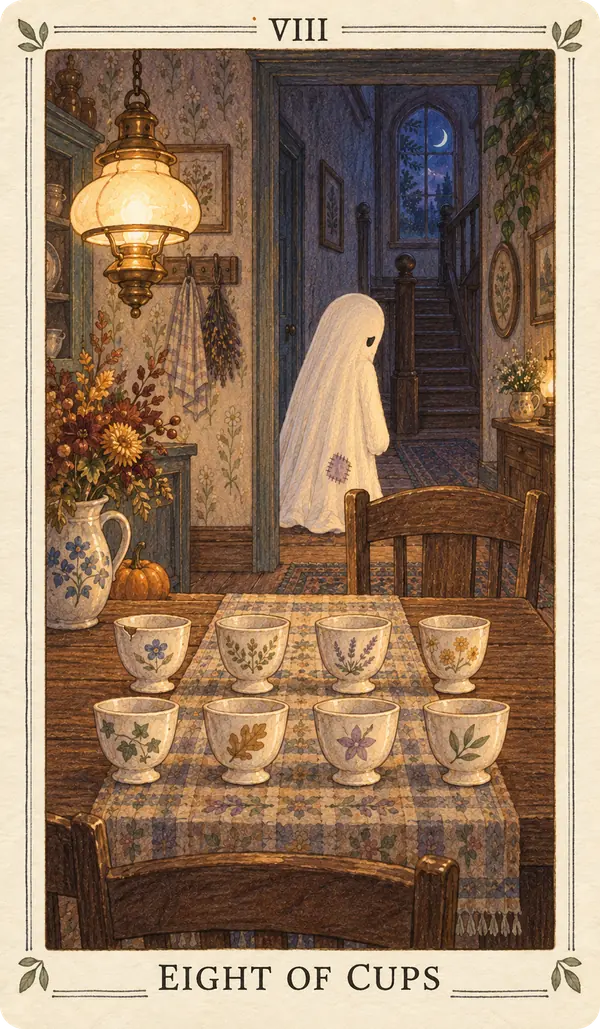 Cozy HauntEight of CupsLeave a familiar arrangement that no longer sustains you.
 Celestial Night SkyEight of CupsToward a source that helps.
Where it appears
Questions about this card
Is the Eight of Cups a yes or no card in City of Windows?
The Eight of Cups is mixed upright. A step away may serve you, yet it settles nothing about the relationship by itself. Reversed, it leans no: the distance may be avoided out of fear of loneliness or taken without a word, so the answer waits until it has a clear shape.
Does the Eight of Cups mean a breakup?
It can point to leaving, and tradition reads the Eight of Cups as stepping away from something that no longer feeds you. In City of Windows the step is distance with a shape: Dana spends a weekend at her sister’s, and she and Sam agree to talk again on Sunday. It is neither punishment by silence nor a fixed ending. Name how long the distance lasts and what it is for.
What does the Eight of Cups mean reversed?
Reversed, the Eight of Cups is going back to an empty ritual out of fear of being alone, or pulling away without a word where a boundary could safely be explained. The risk is distance turning into a new way of hurting each other. The card asks what kind of space would support you, and how to say so while the conversation can stay open.