Where the deck came from
The deck was first published in 1909 by William Rider & Son, a London publisher. It was designed by two people. Arthur Edward Waite, a writer on occult and mystical subjects, set out what each card should contain. Pamela Colman Smith, an artist and illustrator, drew all 78 cards.
Waite also wrote a companion book, The Pictorial Key to the Tarot, which explained the cards and their meanings. The book and the deck together gave English-speaking readers a complete system in one place: pictures to look at and a text to read them by.
Both Waite and Smith belonged to the Hermetic Order of the Golden Dawn, a society in which tarot was studied as part of a wider system of symbols. Some of that symbolism shows in the major arcana, but the deck was made to be read by anyone, not only by members.
The name has shifted over time. For decades the deck was widely called the Rider–Waite tarot, after the publisher and the designer. Many readers and writers now call it Rider–Waite–Smith, adding the name of the woman who actually drew it. We use that name throughout the site.
Past · Present · Future
Where this began, where it stands now, and where it is heading.
- Past
- Present
- Future
Pamela Colman Smith and the picture on every card
Smith’s contribution goes well beyond carrying out a brief. The major arcana had long been pictorial in older decks, and her versions of those 22 cards follow a tradition. The minor arcana is where the deck changed what a tarot card could look like.
The minor arcana is where the deck changed what a tarot card could look like.
In many earlier decks in common use, the numbered cards of each suit, often called the pips, showed the suit symbols arranged in a pattern: five cups, seven coins, three swords crossed. You learned what the Seven of Cups meant from a book or a teacher, because the card itself showed seven cups and nothing more. Smith drew a scene with people in it for every one of the 40 numbered cards. The meaning is acted out on the card.
Some of those scenes are now among the best-known images in tarot:
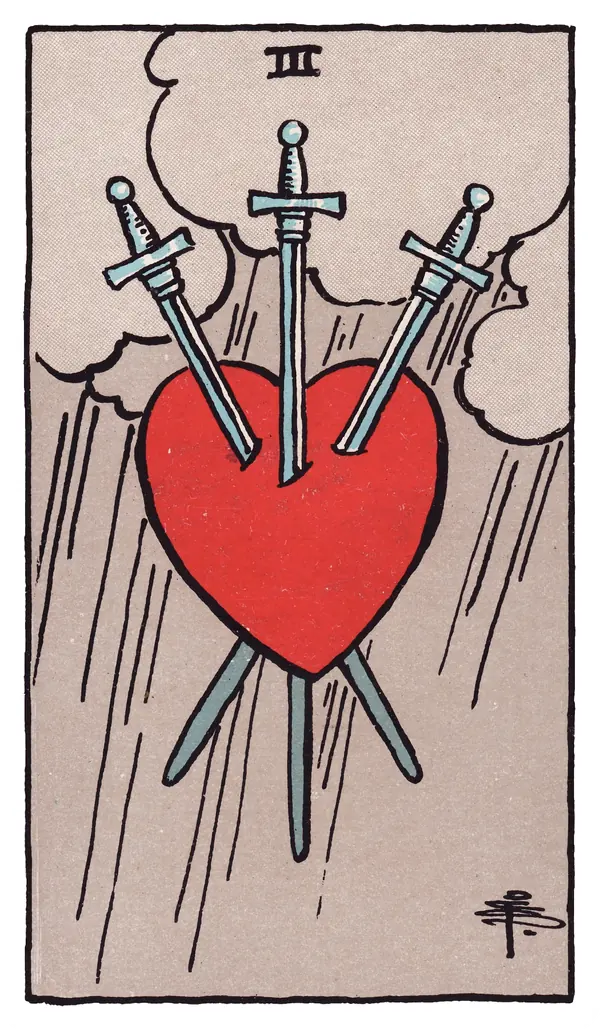
- The Three of Swords: a heart pierced by three swords against a gray sky with rain.
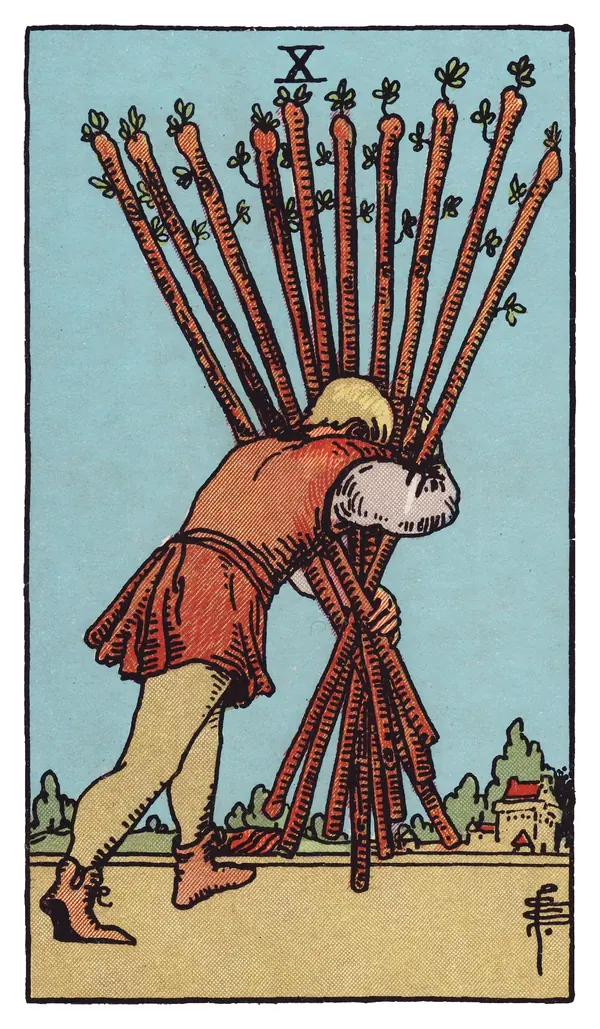
- The Ten of Wands: a figure bent under a bundle of ten staffs, walking toward a town.
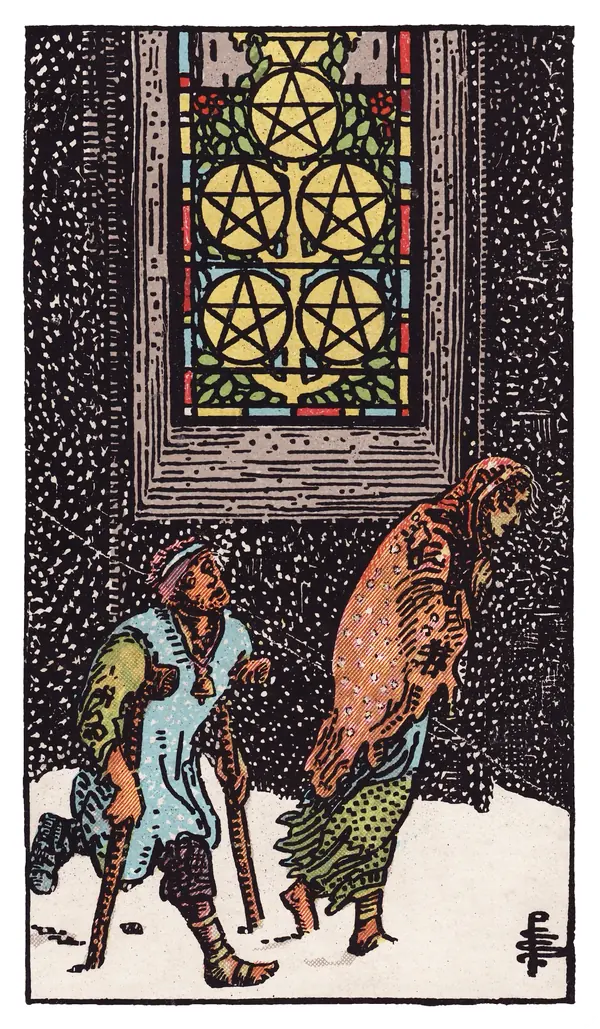
- The Five of Pentacles: two figures in the snow passing a lit church window.
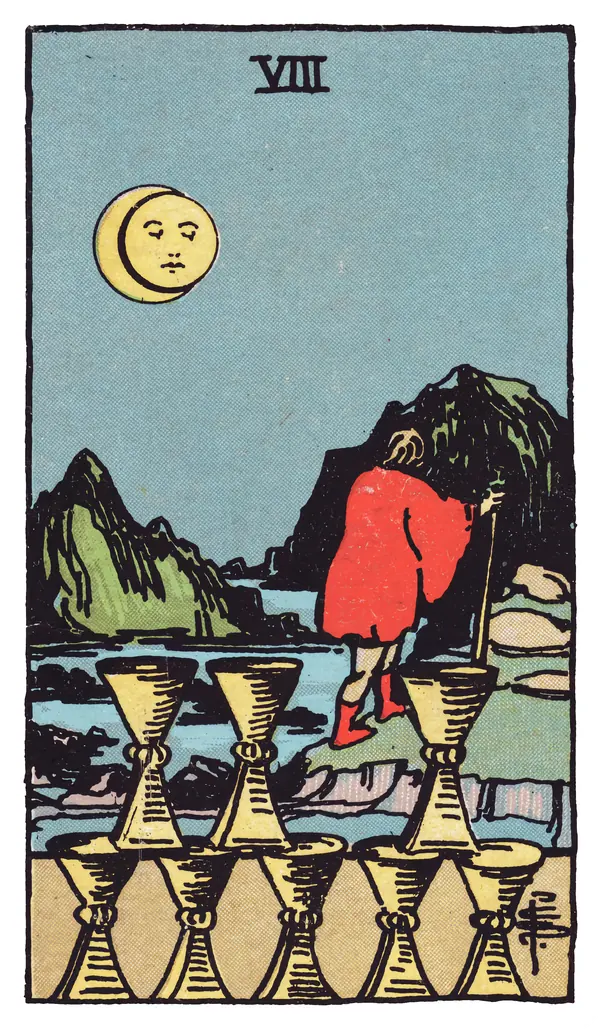
- The Eight of Cups: a figure walking away from a row of stacked cups, toward the hills, under the moon.
A few of her pip scenes closely resemble cards from the Sola Busca, a fifteenth-century Italian deck that also illustrated its numbered cards, and writers on tarot history often point this out. Most of the scenes, though, have no known model, and the style throughout is her own.
Why it became the reference deck
The scenes are the main reason. A beginner can look at a card and describe what is happening before learning a single formal meaning, and that description is often close to the meaning. That makes the deck easier to learn than one where the numbered cards are patterns of symbols.
Over the twentieth century, a large share of English-language tarot books were written with this deck in mind, and many later decks were drawn as direct answers to it. They keep its structure, often keep its scenes, and change the style or the setting. So learning it gives you a common reference point: a reader who knows Rider–Waite–Smith can pick up most modern decks and find their way.
Being the reference deck doesn’t make its meanings the only correct ones. Other traditions read the cards differently, and many readers mix sources. What the deck offers is a shared starting point: when two readers talk about the Tower or the Ten of Swords, they are usually picturing Smith’s version.
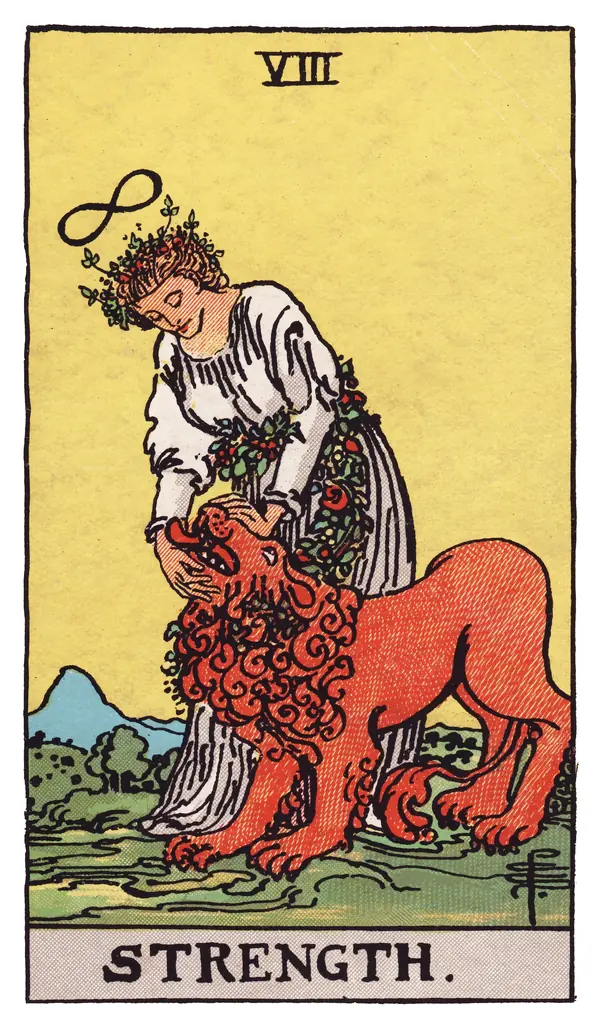
The deck also made one structural change that most later decks kept. Waite placed Strength at number 8 and Justice at number 11, swapping the order found in older decks such as the Tarot de Marseille. If you see Strength numbered 11 in another deck, that deck follows the older order, and neither numbering is wrong.
Reading the deck by its pictures
Because every card shows a scene, the simplest way to start reading this deck is to describe what you see before you look anything up. Who is in the picture, and what are they doing? Which way are they facing? What is in the background, and what is missing from it?
Take the Eight of Cups. A figure walks away from eight cups, toward hills under the moon. Before any book tells you what the card means, you can see that someone is leaving something behind, that it is night, and that the cups are still standing. That description is already close to the traditional meaning: stepping away from something that no longer satisfies, even though it hasn’t fallen apart.
The same approach works on the harder cards. On the Five of Pentacles the lit window is right there, and the figures pass it by. Noticing details like that is how many readers first find a card’s meaning for their own question, and it is why the deck is so often recommended to beginners.
Is the original artwork in the public domain?
The original 1909 artwork is widely treated as being in the public domain, because its copyright has expired. That is the basis on which this site shows scans of Smith’s original cards.
Two points are easy to miss. First, this covers the original 1909 artwork only. Modern redrawn or recolored editions of the deck, including many sold today, are new works with their own rights, held by their publishers. Second, the name “Rider–Waite” is a trademark held by a US publisher, separate from the artwork. Our edition is not an official or licensed Rider–Waite product.
In practice, this means the pictures you see on our card pages are scans of Smith’s original artwork, not a modern redrawing. If a card here looks slightly different from the deck on your table, your copy is probably one of the later editions, which is worth knowing before you compare details.
Copyright rules differ by country and by use. If you plan to publish or sell anything based on these images, check the rules that apply to you with someone qualified to advise on them. This article describes how the deck is generally treated; it is not legal advice.
How this site uses it
Rider–Waite–Smith is the classic text of this site. Every card page under /en/cards gives that card’s meaning in this deck, upright and reversed, in plain modern language. When you look up a card by its usual name, this is the version you are reading. The deck itself has its own page, Rider–Waite–Smith, with an overview of the edition.
The meanings keep the traditional structure and read each scene before saying what it might mean. Reversed cards are written as a real shift in the card’s energy: the same theme blocked, turned inward, overdone or handled carelessly, rather than its flat opposite. Our guide to the major and minor arcana explains how the 78 cards divide, and the four tarot suits covers what each suit speaks to.
On our card pages, the meaning of each card starts from what its scene shows, then covers the upright and reversed readings. Where a card appears in a spread, the reading adds what its position asks. The picture stays the same wherever the card lands, and the position changes what it is asked to answer.
If you are new to tarot, this deck is a good place to start. If you already read another deck, it gives you a shared vocabulary to compare against. A three-card reading is an easy way to see how the scenes work together, and the Celtic Cross shows how far they can carry a longer reading.
Frequently asked questions
Who created the Rider–Waite–Smith tarot deck?
The deck was designed by Arthur Edward Waite and drawn by the artist Pamela Colman Smith, and it was first published in 1909 by William Rider & Son in London. Waite set out what the cards should contain and wrote a companion book, The Pictorial Key to the Tarot. Smith drew all 78 cards, including scenes for every numbered card of the minor arcana.
What is the difference between Rider–Waite and Rider–Waite–Smith?
They are two names for the same deck. Rider–Waite, the older name, credits the publisher and the designer. Rider–Waite–Smith adds Pamela Colman Smith, who drew the cards, and many readers now prefer it for that reason. When a book or a shop refers to a Rider–Waite deck, it usually means this deck or a modern edition based on it.
Is the Rider–Waite–Smith deck good for beginners?
It is one of the easiest decks to start with. Every card, including the numbered minor cards, shows a scene you can describe before you know the formal meaning, and that description often points toward the meaning. Most English-language tarot books use it as their reference too, so what you learn from it carries over to most other decks.
Are the original Rider–Waite–Smith images free to use?
The original 1909 artwork is widely treated as public domain because its copyright has expired. That does not extend to modern redrawn or recolored editions, which carry their publishers’ rights, or to the Rider–Waite trademark. Rules also differ by country. For any commercial use, check with someone qualified to advise on copyright where you live.
Written by the editorial team · Reviewed on November 4, 2026 · Method →