Three of Famine
Three of Pentacles in Four Horsemen · Minor Arcana
LossIn short
Respect different expertise and judge the result through use.
Reversed
Competing for credit, or ignoring the person who knows the practical fault.
- Famine
- Three
- Earth
- The Mill Menders
- respecting different skills
- judging the result by use
- a repair nobody could make alone
Upright
Respect different expertise and judge the result through use. In a roofless workshop the mason kneels at the stone base, the carpenter works the handle and the baker holds a cloth under the stones for the first flour.
None of them could have mended the mill alone. What counts is whether flour comes out, and whether it is fine or full of grit.
The roof is still open to the weather, and the grain the mill will grind is only what Two could spare.
A question to sit with
“Whose skill does this task still need?”
One step
Ask the person who knows the practical side of your task where it catches, and listen to the whole answer.
Reversed
Competing for credit, or ignoring the person who knows the practical fault. The mason can claim the base and the carpenter the handle, and the argument can go on while the stone stays still.
The baker, who will feel at once whether the flour is fine or gritty, may be the one nobody asks. A mill mended for the sake of a name still has to grind.
In a hungry town a broken mill is counted in bread that was never baked, whoever takes the credit.
A question to sit with
“Who knows the practical fault here, and is the argument over credit drowning them out?”
One step
Find the person closest to the practical fault and ask what they have noticed, before anyone settles who gets the credit.
How this deck reads reversed cards
Reversed, the act on the card turns inward, meets an obstacle, grows harsher or shows its price. On this road a reversal is not automatically the opposite, and not automatically something worse.
In love
What each of you knows how to do may be what mends the relationship.
- Supports
- Valuing the other’s practical skill.
- Watch for
- Measuring love by who did the most.
- One step
- Ask your partner to show you how they handle one thing you usually leave to them.
An argument about who does more may be keeping something between you from being fixed.
- Supports
- Setting the tally aside.
- Watch for
- Keeping score while the problem stays.
- One step
- Agree on one shared repair and leave the credit unspoken.
At work
A problem at work may need several kinds of skill, and the right people may already be near it.
- Supports
- Listening to whoever works closest to the fault.
- Watch for
- Judging the fix by who proposed it.
- One step
- Invite the most practical person on the task to say what they would change.
A project may be stuck while people compete for credit.
- Supports
- Bringing attention back to whether the thing works.
- Watch for
- Ignoring the person who keeps pointing at the fault.
- One step
- Ask the quietest person on the project what they think is wrong.
Once people with different skills weigh in, a choice may become clearer.
- Supports
- Testing options through use.
- Watch for
- Deciding on paper alone.
- One step
- Try each option on a small scale before choosing.
Whose idea it was may be distorting the decision.
- Supports
- Judging options by what they produce.
- Watch for
- Choosing to protect a reputation.
- One step
- Rewrite the options without names attached and read them again.
Learning beside people who have other skills may be how you grow.
- Supports
- Working next to someone who knows what you do not.
- Watch for
- Wanting to master everything alone.
- One step
- Spend an hour watching someone do a practical task you find hard.
Not wanting to learn from someone with less standing may hold growth back.
- Supports
- Asking the person with hands-on knowledge.
- Watch for
- Pride about where good advice comes from.
- One step
- Ask one person you usually overlook for their practical view.
Each member of a family may have a different part to play in repairing something together.
- Supports
- Recognising what each person brings.
- Watch for
- Overlooking the quiet one who knows how things actually work.
- One step
- Ask the family member who fixes things what they think is broken.
Rivalry over who holds the family together may drown out the one who sees the real fault.
- Supports
- Hearing everyone’s practical knowledge.
- Watch for
- Competing to be the one who saved things.
- One step
- Find out from the family member least listened to what they have noticed.
Yes or no
YesNoSkills that meet at one working mechanism can make something run again, so the answer leans yes.
Supports
- Different skills are already gathered at the same task.
- The result can be tested by use.
Limits
- The workshop is still open to the weather.
- The grain to grind is limited.
One step
Ask whether everyone who knows a part of the work has had a say.
While the argument is about credit the mill stays still, so the answer leans no for now.
Supports
- Someone knows where the fault is.
- The mill can still be mended.
Limits
- Credit is taking the attention the repair needs.
- The one who knows the fault may not be heard.
One step
Ask whose practical knowledge has been left out of the decision.
What is in the picture
Three adult workers inspect a repaired hand mill in a roofless workshop: a mason kneels by its stone base, a carpenter checks the handle, and a baker catches the first flour in a cloth. Their gazes meet at the working mechanism.
Different skills meet at a mechanism none of the workers could restore alone.
- repaired hand mill
- stone base
- wooden handle with a copper collar
- cloth held for the first flour
- flour sacks
- roofless workshop
- wrecked ship in the bay
- light breaking through cloud
This card in other decks
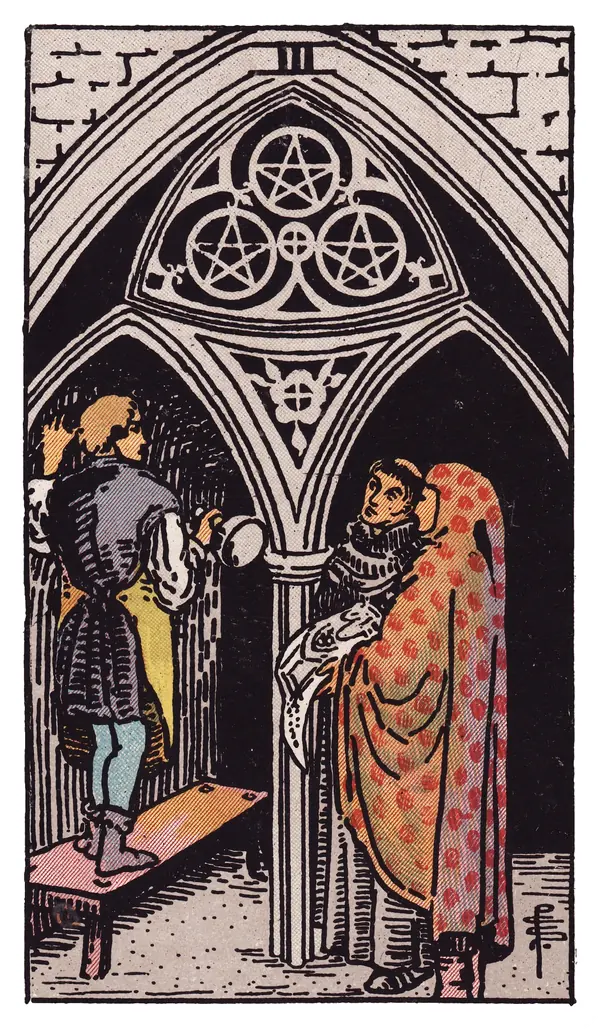 Rider–Waite–SmithThree of PentaclesSkilled work, done well and recognized by others, is building toward something genuinely worth completing together.
 FamiliaThree of BonesSeveral generations lay one foundation together, each share recognised, even though the shares weigh differently.
 City of WindowsThree of PentaclesNaming each person’s specific contribution and bringing them together.
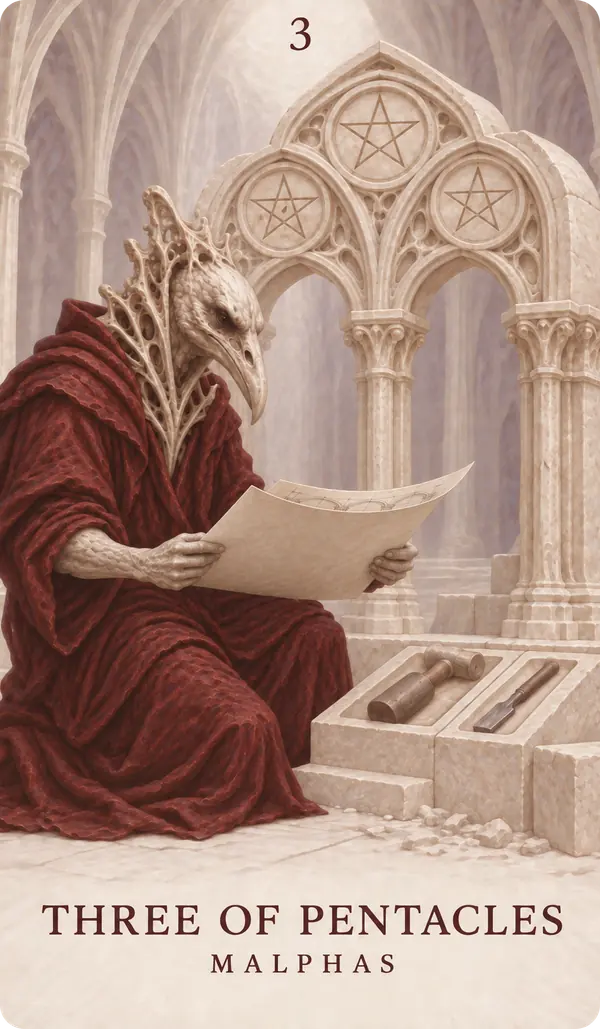 CarnalThree of PentaclesA durable result depends on coordinated craft.
 Crimson InfernoThree of PentaclesMake roles clear and respect complementary expertise.
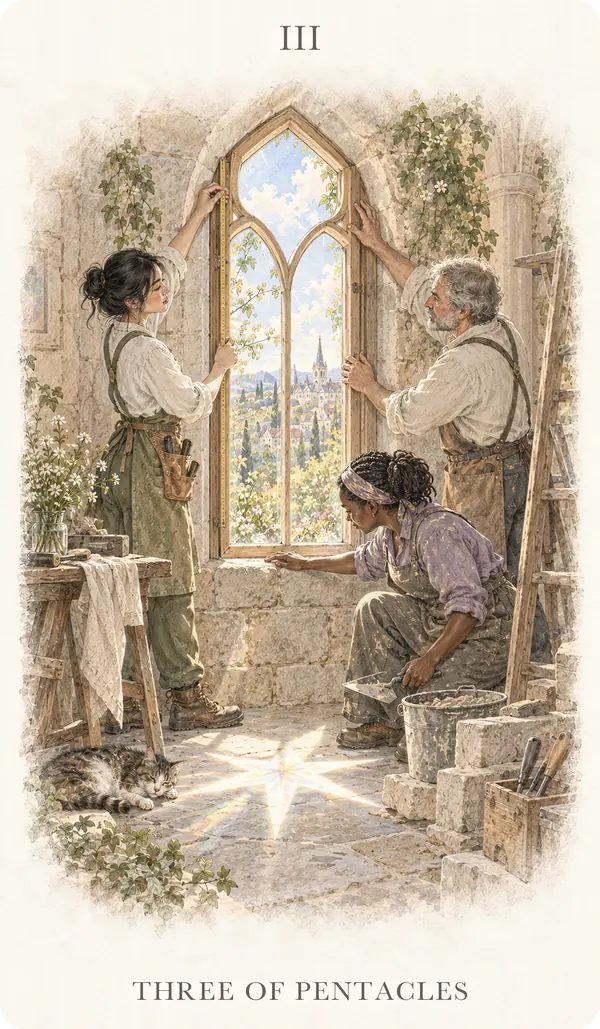 Everyday WondersThree of PentaclesDifferent skills working together, with a clear role for each.
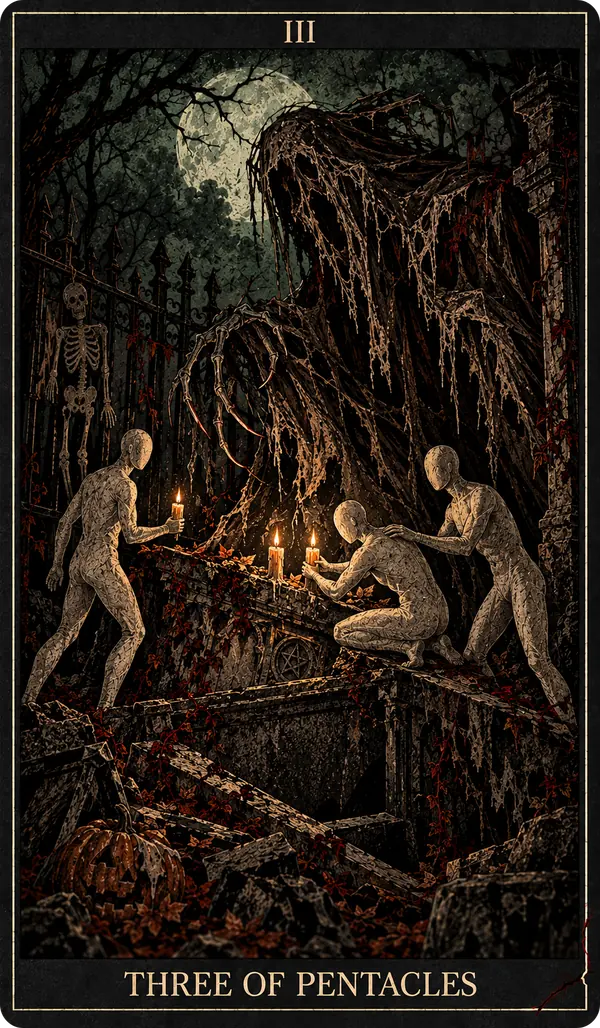 Mirror NightThree of PentaclesCombine distinct contributions into a working protection.
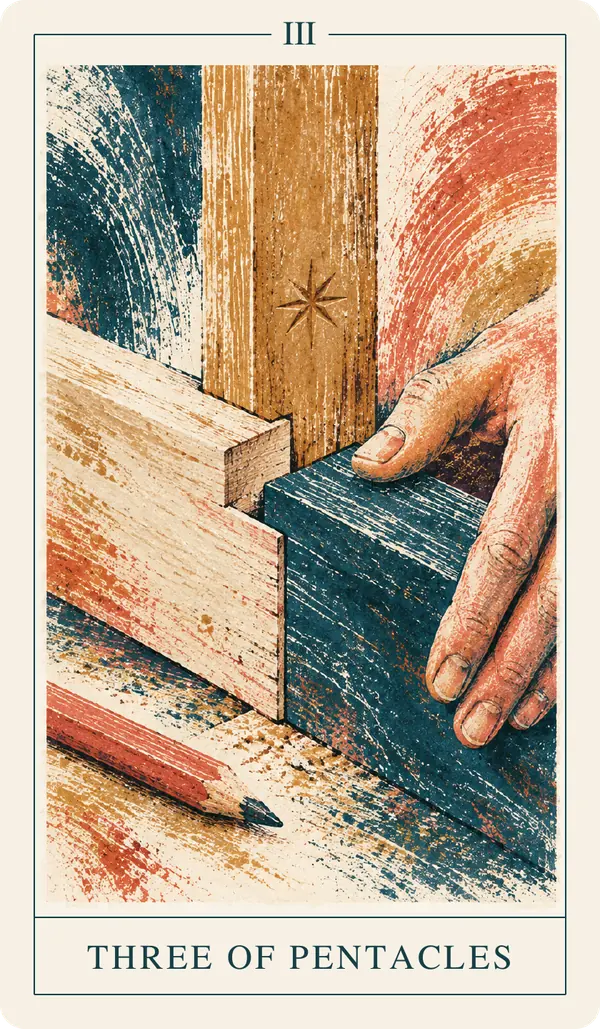 Self ContactThree of PentaclesDifferent skills improve a shared piece of work.
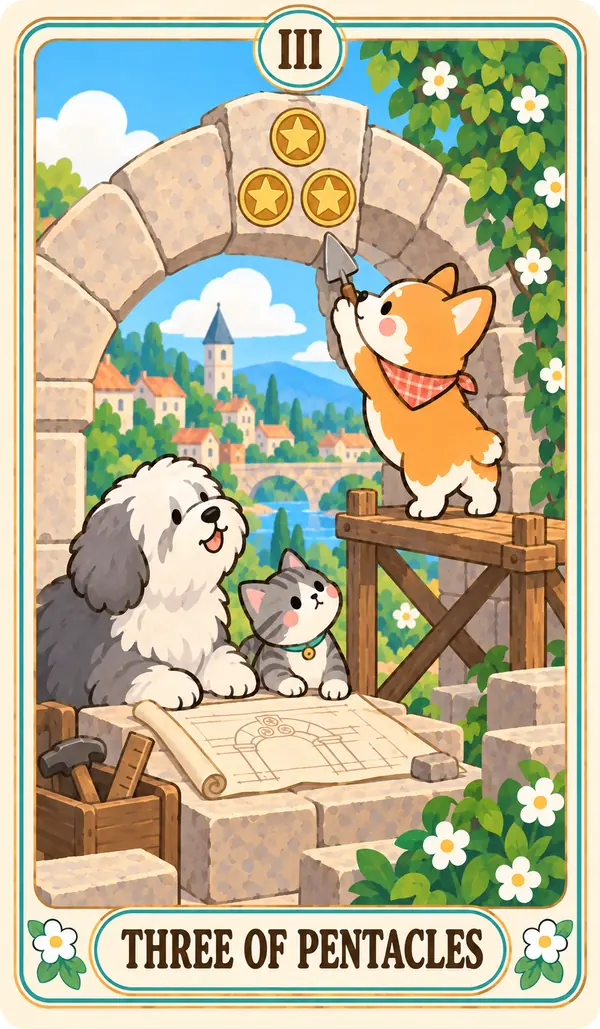 Shiba TownThree of PentaclesCooperation; skill; respecting complementary expertise.
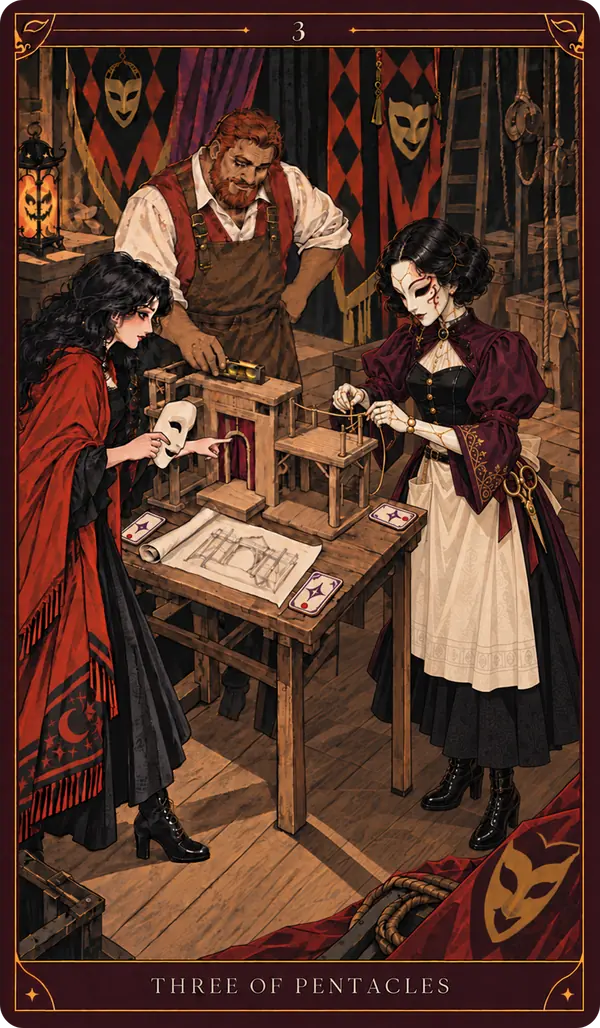 Velvet MasqueradeThree of PentaclesCollaboration through skills that meet a real need.
 Four TrailsThree of PentaclesCollaboration, skill, craftsmanship.
 Living ThresholdThree of PentaclesDifferent tools bring living lining into a shared fit.
 Colour of PowerThree of PentaclesValue appears where knowledge, decision and people meet.
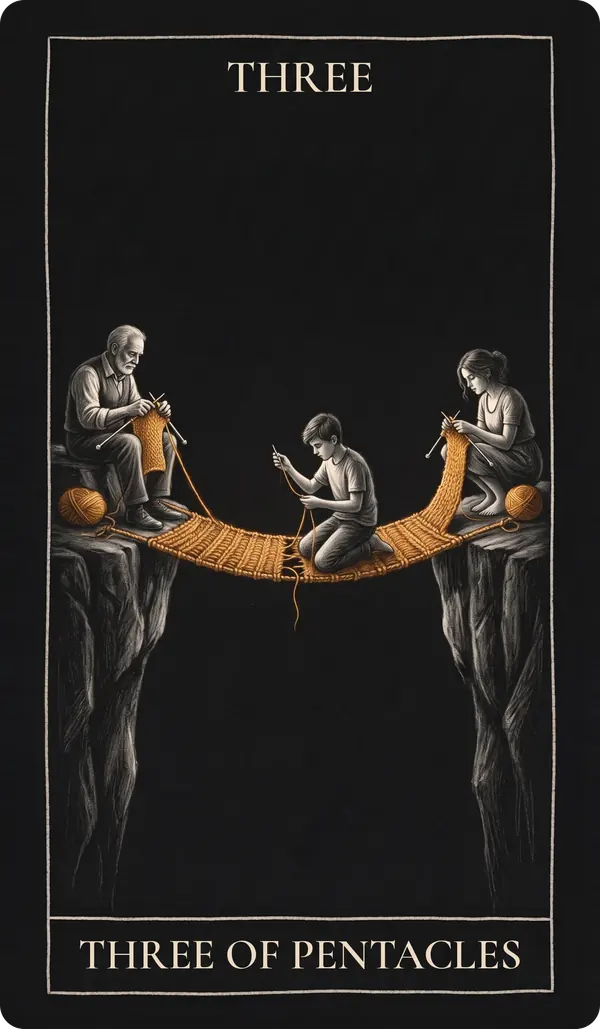 BoundThree of PentaclesWhat several hands build, and what then holds them all.
 Cozy HauntThree of PentaclesCombine complementary skills.
 Celestial Night SkyThree of PentaclesDifferent hands, shared work.
Where it appears
Questions about this card
Is Three of Pentacles a yes or no card in Four Horsemen?
Three of Pentacles leans yes upright: skills that meet at one working mechanism can make something run again. Reversed, it leans no for now, since while the argument is about credit the mill stays still. Ask whether everyone who knows a part of the work has had a say, and whose practical knowledge was left out.
What does Three of Pentacles mean in love?
In love, Three of Pentacles may point to what each of you knows how to do being what mends the relationship. Reversed, an argument about who does more may keep something between you from being fixed. Ask your partner to show you how they handle one thing you usually leave to them.
What does Three of Pentacles mean reversed in Four Horsemen?
Reversed, Three of Pentacles describes competing for credit, or ignoring the person who knows the practical fault. Ask whose practical knowledge has been left out of the decision. Agree on one shared repair and leave the credit unspoken, then see whether the mill turns.